Inside the Mind of Danijar Hafner: The Former Google DeepMind Prodigy Teaching Humanoid Robots How to Imagine

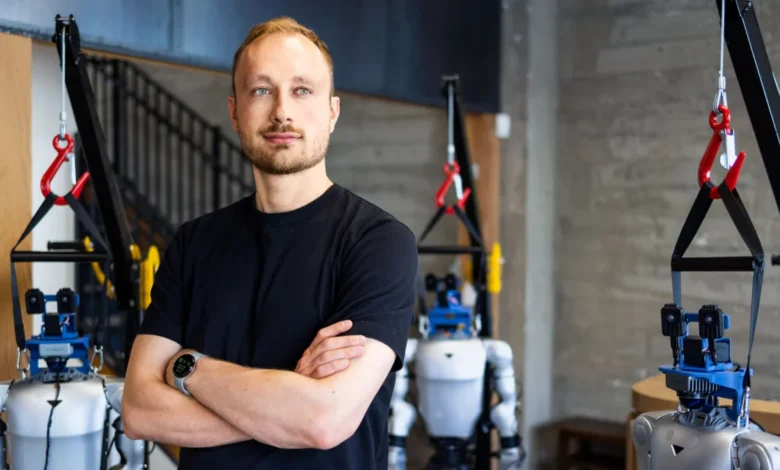
The sparse, high-ceilinged office in San Francisco’s South of Market (SoMa) district bears few hallmarks of a bustling Silicon Valley enterprise. There is little in the way of conventional corporate furniture, no gleaming reception desk, and no lettering on the door to indicate the identity of the new tenant. Yet, suspended from custom-built metal racks running down the center of the open-plan room, a collection of humanoid robots hangs like dormant marionettes. Imported from manufacturers in China, these bipedal machines represent the physical vanguard of a quiet revolution in artificial intelligence.
At the center of this clandestine operation is Danijar Hafner, a 31-year-old researcher who departed Google DeepMind in the fall of 2025 to launch his own stealth-mode startup. Hafner’s objective is as ambitious as it is technically daunting: to imbue machines with the capacity to generalize their behavior, allowing them to navigate and adapt to unfamiliar physical environments without the exhaustive, real-world trial-and-error training that has historically bottlenecked the robotics industry.
While Hafner remains tight-lipped regarding the precise commercial applications of his new venture, he frames it as the culmination of years of academic and industrial research focused on teaching AI systems to extrapolate from limited training data and handle novel, unpredictable surroundings.
The Mechanics of Machine Imagination: Model-Based Reinforcement Learning
The foundational technology driving Hafner’s work is model-based reinforcement learning, a paradigm that diverges significantly from traditional data-hungry machine learning techniques. Rather than forcing a robot to interact with the physical world millions of times—risking mechanical failure, hardware damage, and immense computational expenditure—Hafner develops sophisticated "world models."
In simple terms, a world model is an artificial intelligence architecture designed to emulate the physics and dynamics of the physical world. An AI agent is placed inside this simulated environment, where it learns how to act, react, and plan. By processing these virtual experiences, the agent develops the ability to forecast future outcomes—essentially dreaming or imagining scenarios before they occur in reality.
This internal simulation allows the agent, and by extension the robot it controls, to navigate unfamiliar situations in the real world ("IRL") with remarkable agility. For instance, if a humanoid robot is deployed into a residential home it has never visited before, it must be capable of processing unfamiliar floor plans, novel obstacle arrangements, and shifting human behaviors. Conventional robots require extensive reprogramming or thousands of hours of physical reinforcement to manage such variability. Hafner’s approach bypasses this bottleneck by enabling the software to anticipate the consequences of its actions through internal mental modeling.
Timothy Lillicrap, a researcher at Google DeepMind and one of Hafner’s former managers and co-authors, holds his former colleague in exceptionally high regard. "I get to interact with a lot of really smart people in research at Google, and he easily sits in the top half of 1%," Lillicrap observes. "In many cases he would build, single-handedly, things it would take entire teams of engineers to build."
From Rural Germany to the Global Stage: A Chronology of Innovation
Hafner’s trajectory from a rural town in northeastern Germany to the epicenter of global artificial intelligence research is a study in early aptitude and relentless self-direction. Raised by parents who worked as classical musicians, Hafner developed an early fascination with computation. Taught the fundamentals of programming by a neighbor, he began diving into online courses dedicated to artificial intelligence while still in high school.
"I was always fascinated with how thinking works," Hafner reflects. For him, computer science offered a rigorous, empirical methodology to replicate cognitive processes in silicon.
Key Milestones in Hafner’s Career:
- Pre-2015: Self-taught programming and foundational AI coursework during high school in rural Germany.
- 2015: Enrolls as an undergraduate engineering student at the Hasso Plattner Institute in Potsdam; secures a student researcher position at Google Brain during his second year.
- 2015–2023: Completes roughly a dozen internships and full-time roles across Google Brain and Google DeepMind in the United Kingdom, Canada, and the United States, collaborating with industry pioneers such as Geoffrey Hinton and Ashish Vaswani.
- 2019: Introduces PlaNet, a breakthrough model allowing agents to execute actions by planning ahead using learned world models.
- 2020–2023: Develops the Dreamer series (Dreamer 2, Dreamer 3, and Dreamer 4), achieving human-level performance in Atari games and solving complex challenges in Minecraft without direct gameplay interaction.
- 2023–2024: Launches the DayDreamer project, translating virtual algorithms into physical robotic hardware capable of adapting to real-world disruptions.
- Fall 2025: Departs Google DeepMind to found his stealth-mode startup in San Francisco’s SoMa district.
During his tenure at Google, Hafner worked alongside luminaries who shaped the modern AI landscape. These included Geoffrey Hinton, widely regarded as one of the founding figures of deep learning, and Ashish Vaswani, a co-author of the seminal 2017 research paper "Attention Is All You Need," which introduced the transformer architecture underpinning contemporary large language models like GPT-4.
Proving the Paradigm: From Video Games to Physical Robotics
Before attempting to solve the complex physics of humanoid robotics, Hafner methodically tested and refined his algorithms within controlled, virtual environments: video games.
His early breakthrough, PlaNet (Planning Network), demonstrated that an AI agent could learn the underlying rules of an environment from image pixels alone and plan its actions accordingly. This was followed by Dreamer 2, which achieved a historic milestone by reaching human-level performance on Atari 2600 games relying purely on world models rather than direct reactive policies.
The progression continued with Dreamer 3, which made headlines by solving the notoriously difficult Minecraft Diamond challenge—autonomously discovering how to mine in-game diamonds without human intervention or prior ruleset programming. Pushing the boundaries of data efficiency further, Dreamer 4 achieved the ability to learn complex tasks entirely from offline data sets of recorded gameplay videos, completely eliminating the need for the agent to actively play the game during its training phase.
Transitioning these virtual agents into physical hardware was the natural next step. Through his DayDreamer project, Hafner successfully applied the Dreamer algorithm to physical robots. The machines were able to operate autonomously in novel environments, instantly adapting to physical perturbations—such as being forcefully pushed over by human researchers—without requiring task-specific retraining.
Broader Implications and Industry Impact
Hafner’s transition from foundational research at Google DeepMind to entrepreneurial venture capital-backed stealth development underscores a broader trend within the artificial intelligence sector: the migration of advanced cognitive models from digital text and image generation into physical embodiment.
For decades, the robotics industry has faced a fundamental scaling barrier. While software models scaled exponentially by consuming vast tranches of internet data, physical robots remained constrained by the slow, expensive, and potentially hazardous nature of gathering real-world training data. If a robotic arm drops a glass or a humanoid robot falls down a flight of stairs during physical reinforcement learning, hardware is damaged, and progress halts.
By leveraging world models that can simulate physics, anticipate outcomes, and "imagine" failure scenarios safely within a digital architecture, Hafner’s methodology addresses the data scarcity problem that has long plagued robotics. If successful, this approach could drastically accelerate the deployment of autonomous systems into unstructured human environments, ranging from eldercare facilities and domestic households to disaster relief zones and dynamic manufacturing floors.
As Hafner’s startup prepares to emerge from stealth mode, the technical community is watching closely. While the office in SoMa remains sparsely decorated, the theoretical weight of what hangs from its ceiling could redefine the relationship between artificial intelligence and the physical world. Asked about his ultimate ambitions for the new company, Hafner offers a characteristically understated hint: "I was interested in solving a problem that would change the world."