Holistic Fine-Tuning of Agentic AI: A Comprehensive Framework for Production Reliability

Fine-tuning agentic AI systems has evolved into a multifaceted engineering challenge that extends far beyond the traditional model-training paradigms of the early 2020s. As organizations increasingly deploy Large Language Models (LLMs) to perform autonomous tasks—such as triage, data retrieval, and complex tool orchestration—the industry has identified that success depends on a holistic integration of four distinct levers: training data architecture, parameter-efficient fine-tuning (PEFT), runtime hyperparameter optimization, and preference alignment. When these components are treated in isolation, agents frequently exhibit "brittleness," failing to meet production standards despite successful initial training runs.
The current state of AI development highlights that frontier base models are highly capable at generalized instruction-following but often falter when tasked with the high-precision requirements of agentic workflows. In 2026, the primary objective of fine-tuning is no longer to impart missing knowledge—which is better handled by Retrieval-Augmented Generation (RAG)—but to enforce exact output schemas, domain-specific vocabularies, and consistent behavioral patterns that standard prompting cannot guarantee.
The Evolution of Agentic Development
The shift toward agentic AI represents a transition from chat-based interactions to action-based workflows. In these systems, an agent must interface with internal tools such as order lookup functions, financial refund systems, and escalation pathways. Historically, developers focused heavily on model weights, ignoring the nuances of the "runtime" environment. However, field data suggests that even a perfectly trained model will fail if it operates with a temperature setting that permits hallucinations during critical tool-calling sequences.
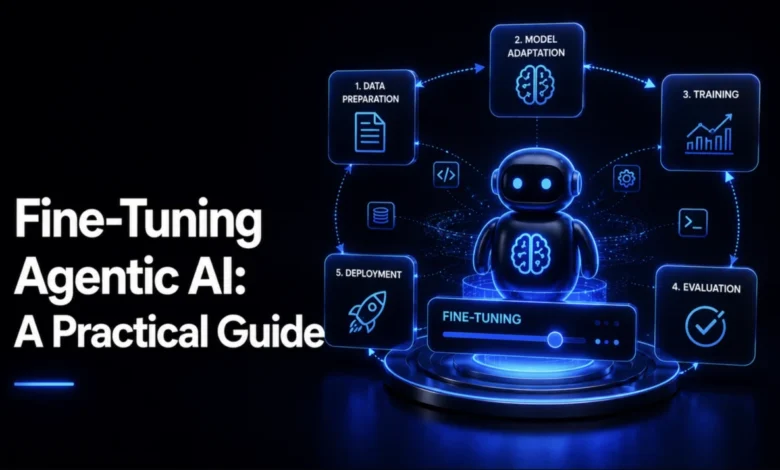
The methodology for robust agentic training now follows a disciplined four-stage lifecycle. By standardizing this process, engineering teams can reduce the variance that leads to system failures in live production environments.
Phase 1: Structuring High-Precision Training Data
Data quality remains the most significant predictor of model performance in tool-calling scenarios. Unlike general-purpose language tasks where volume is paramount, tool-calling requires structural integrity. A dataset consisting of a few hundred syntactically perfect, schema-compliant examples is vastly superior to thousands of loosely formatted, noisy entries.
Engineering teams are increasingly adopting rigorous validation protocols. Before a training job is initiated, every tool-calling example must pass a schema-validation check. This process involves verifying that every generated function call maps directly to the authorized tool set, contains all required arguments, and adheres to the expected JSON format. By catching errors such as missing arguments or hallucinations of non-existent tools at the dataset level, developers avoid the significant cost of failed training runs that result in models prone to systemic instability.
Phase 2: Optimizing Efficiency with QLoRA
Once the dataset is validated, the industry standard for model adaptation is Quantized Low-Rank Adaptation (QLoRA). This approach enables the training of massive, high-parameter models on constrained hardware by freezing the base model in 4-bit precision and training small, low-rank adapter matrices.
The selection of hyperparameters—specifically the rank (r), the scaling factor (lora_alpha), and the dropout rate—is critical. Research indicates that for small instruct-tuned models, a configuration of r=4 and alpha=32 provides an optimal balance between model expressivity and the risk of overfitting. By isolating trainable parameters to roughly 1.7% of the total model size, QLoRA preserves the general capabilities of the base model while precisely tuning it for the specific tool-calling syntax required by the agent.
Phase 3: Runtime Hyperparameters and Inference Reliability
The "runtime" phase is frequently overlooked, yet it is often the deciding factor in production reliability. Inference settings such as temperature, top-p, and the implementation of retry logic serve as the final gatekeepers of output quality.
Data from recent performance sweeps demonstrate that while lower temperatures (approaching 0.0) generally improve the reliability of tool-calling, they may limit the agent’s flexibility in ambiguous situations. An effective strategy currently employed by leading AI labs involves a tiered approach: utilizing a deterministic temperature for initial calls and implementing a "retry" mechanism that automatically triggers at a lower temperature if the initial output fails to parse. Empirical testing suggests that this strategy can push the success rate of complex triage agents above 98%, demonstrating that architectural improvements at inference time are often more cost-effective than further training.
Phase 4: Preference Alignment and Behavioral Nuance
Supervised Fine-Tuning (SFT) is inherently limited because it provides the model with only one "correct" answer per prompt. It fails to account for scenarios where a response might be syntactically correct but contextually suboptimal. To address this, Direct Preference Optimization (DPO) has emerged as a crucial tool for alignment.
DPO allows developers to train models on pairs of responses: a "chosen" response and a "rejected" one. Even if both responses are technically valid and correctly formatted, the model learns the preference for the more contextually appropriate action. For instance, in a support-ticket triage scenario, an agent might be able to correctly issue a refund. However, if the query is a high-value, vague dispute, the better judgment call is to escalate to a human agent. DPO explicitly trains the model to recognize this distinction, effectively teaching it "judgment" rather than just "compliance."
Evaluation Discipline and Avoiding Regressions
The final and most critical component of the development lifecycle is the evaluation framework. The primary risk in fine-tuning is "catastrophic forgetting," where a model gains efficiency in specific tool-calling tasks but loses its general linguistic capability or common-sense reasoning.
Industry best practices now mandate the use of automated "verdict" functions to replace manual, subjective interpretation of metrics. These functions track two key metrics simultaneously: the improvement in target task accuracy (e.g., tool-calling success) and the stability of general capabilities (e.g., performance on benchmarks like MMLU). If the general capability drops beyond a predefined threshold—typically around 3%—the system triggers a "HOLD" verdict, preventing the deployment of the model despite its gains in specific task areas.
Broader Implications and Future Outlook
The transition toward holistic, four-dial tuning signifies the maturation of the AI agent sector. As organizations move from proof-of-concept demos to critical business operations, the "black box" nature of AI training is being replaced by systematic, rigorous engineering. The focus is shifting from "how much data can we throw at the model?" to "how precisely can we control the agent’s environment and decision-making process?"
By integrating these four pillars—dataset validation, efficient adaptation, inference-time controls, and preference alignment—developers can build systems that are not only performant but also predictable and safe for production. This disciplined approach is likely to become the baseline for all enterprise-grade agentic AI, as the tolerance for error in automated systems continues to decrease in tandem with their increasing integration into the global economy. The ability to catch regressions early and maintain a high-quality feedback loop remains the defining hallmark of sustainable AI development in the current technical landscape.