Governing AI Agent Access with Okta Cross App Access and Amazon Bedrock AgentCore

The proliferation of generative AI agents within enterprise environments has introduced a significant security paradox: while these agents are designed to perform tasks on behalf of users, traditional identity management frameworks often struggle to maintain granular control over that delegation. When an AI agent accesses a customer record or updates a support ticket, it essentially acts as a proxy for the human user. Historically, this has forced security teams to rely on shared service accounts or overly permissive per-app OAuth consent, both of which obscure the audit trail and complicate the revocation of access. A new integration between Okta’s Cross App Access (XAA) and Amazon Bedrock AgentCore provides a robust solution to this identity governance challenge by establishing a verifiable chain of delegation from the user to the agent and, finally, to the resource.
The Governance Gap in AI Delegation
In a standard enterprise workflow, a user signs into an application, which then tasks an AI agent with performing specific operations. The critical security question for identity administrators is: which agent is authorized to act for which user, within which specific application, and how can that authorization be instantly revoked? Previous methods often failed to link the agent’s actions back to the specific user’s permissions, creating a "blind spot" where a compromised agent or a misconfigured service account could perform unauthorized actions without clear accountability.
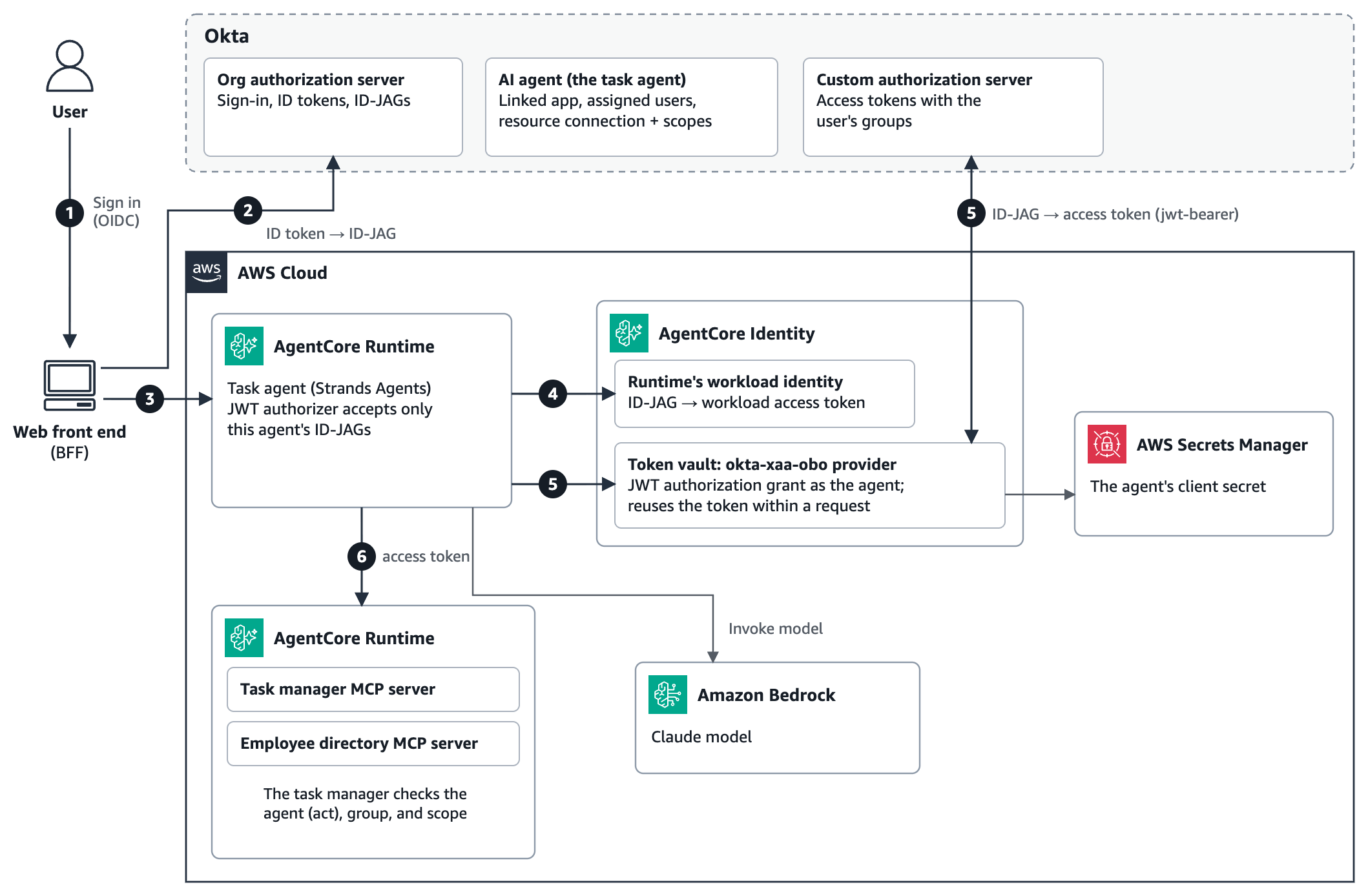
Okta Cross App Access (XAA) addresses this by formalizing the identity provider (IdP) as the central governance plane. By registering an agent directly within Okta, administrators can establish explicit resource connections. When an agent requests to act on behalf of a user, Okta evaluates policy in real-time, effectively validating the delegation chain before any token is issued. Testing has demonstrated that when an administrator removes a user’s assignment, Okta terminates the agent’s ability to request new tokens within approximately one second, with existing tokens expiring within five minutes.
The Mechanics of the Execution Plane
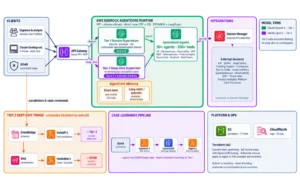
While Okta acts as the decision-making authority, the execution plane is managed by Amazon Bedrock AgentCore. This platform provides the necessary infrastructure to build, connect, and scale agents across diverse models and frameworks. The integration utilizes two core capabilities: AgentCore Runtime and AgentCore Identity.
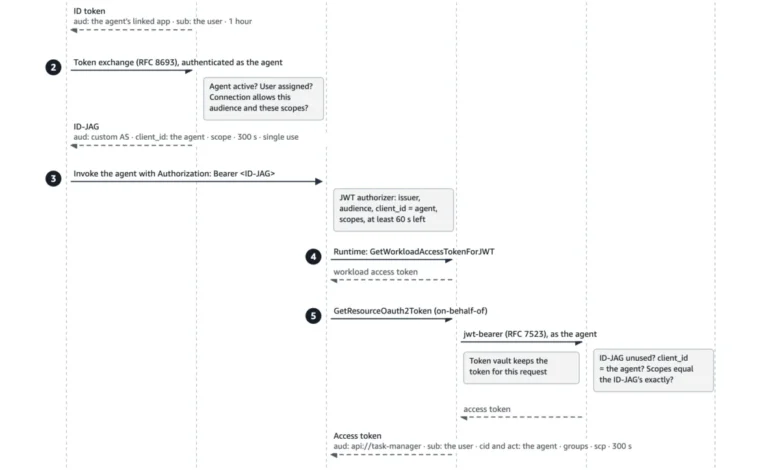
The AgentCore Runtime serves as the validation layer, ensuring that the grants issued by Okta are legitimate. Once validated, AgentCore Identity facilitates a secure token exchange. It redeems the Okta-issued Identity Assertion JWT Authorization Grant (ID-JAG) for a short-lived access token. Crucially, the agent code itself never touches the sensitive client credentials or the Okta token endpoint; the entire exchange is handled by AgentCore Identity, which stores the resulting token in a secure vault. This architecture minimizes the risk of credential leakage and ensures that the agent operates within a tightly defined scope. Performance metrics indicate that this added layer of security introduces a latency of only 0.6 seconds in a typical 30-second end-to-end request, making it highly efficient for production-grade applications.
A Three-Token Delegation Chain
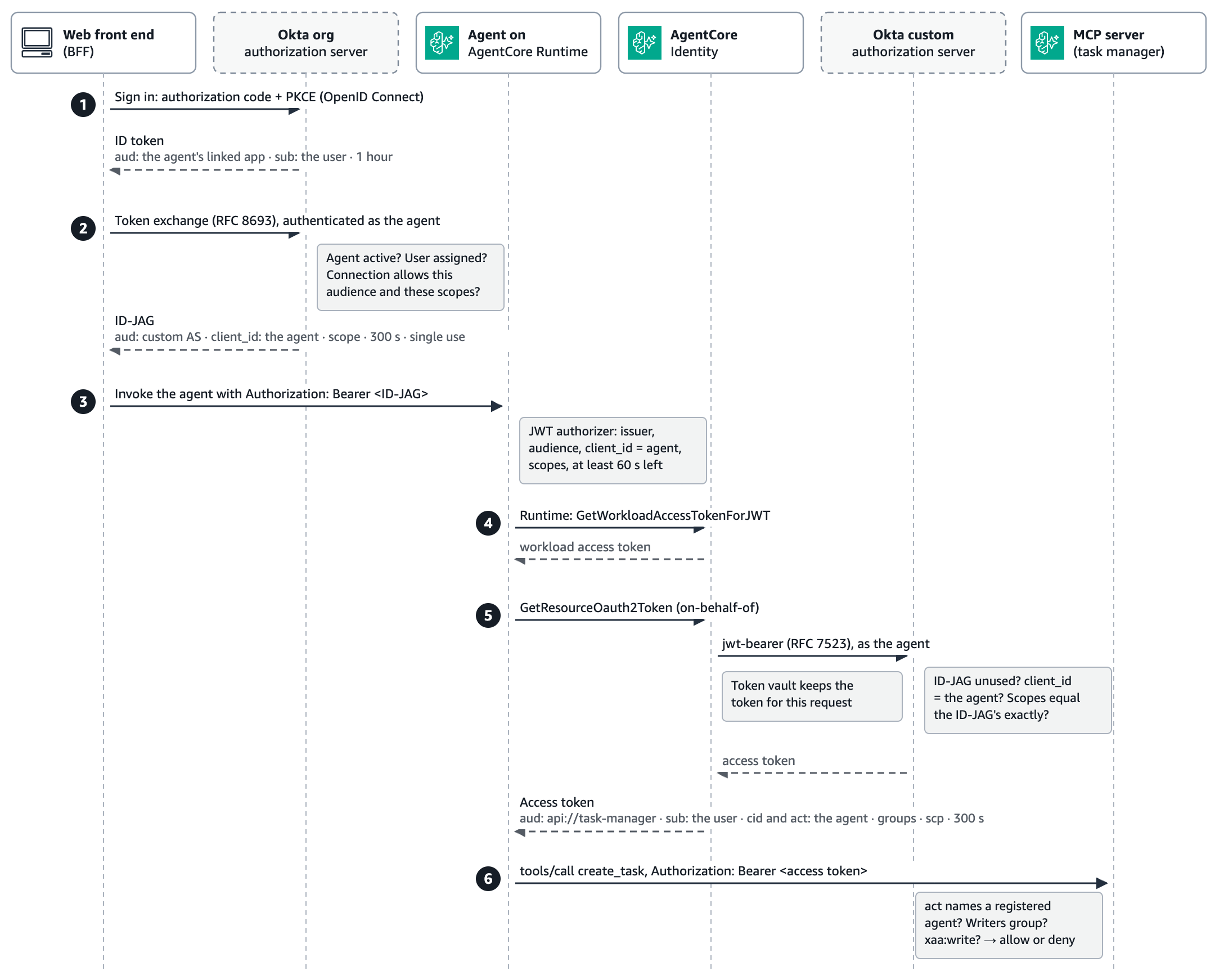
The solution relies on a sophisticated three-token chain that ensures each step of the delegation is authenticated and authorized:
- The ID Token: Confirms the identity of the human user interacting with the system.
- The ID-JAG (Identity Assertion JWT Authorization Grant): Represents Okta’s governance decision, stating that the specific agent is authorized to act for the user.
- The Access Token: The final credential accepted by the resource, which encodes both the agent’s identity and the user’s authority.
This chain ensures that every request is traceable. If an agent attempts to use a token for a user who has been unassigned, or if the agent attempts to exceed its approved scopes, the downstream resource will reject the request. This granular control is enforced by checking the "act" (actor) and "cid" (client ID) claims within the token, preventing unauthorized entities from assuming the agent’s role.
Implementation and Operational Best Practices
Deploying this architecture requires meticulous configuration. Organizations must register their agents in the Okta Admin Console, defining the specific scopes—such as xaa:read and xaa:write—that the agent is permitted to perform. By leveraging a custom authorization server within Okta, administrators can create a "JWT bearer policy" that only admits tokens issued to that specific agent.
To maintain a secure posture, the following practices are recommended based on recent implementation trials:
- Freshness of Grants: Always mint a fresh ID-JAG for each request. These tokens are designed to be single-use and have a limited lifespan; reusing them increases the risk of replay attacks and policy staleness.
- Scoped Authority: Use the
groupsclaim within the ID token to manage per-user permissions. This allows the system to differentiate between a user who can only read data and one who is authorized to modify it, regardless of the agent being used. - Credential Protection: Store the agent’s Okta client secret in a secure location, such as AWS Secrets Manager. AgentCore Identity can be configured to reference these secrets without exposing them to the application code, facilitating easier rotation and lifecycle management.
- Immediate Revocation: Treat the Okta resource connection as a "kill switch." In the event of a suspected compromise, deleting the connection in Okta provides an immediate halt to the agent’s operations, a faster response time than deactivating the agent identity itself.
Comparative Analysis: XAA vs. Standard Token Exchange
While standard RFC 8693 token exchange can also propagate user identity downstream, it lacks the context-aware governance provided by Cross App Access. In a standard exchange, the agent’s identity is often not explicitly declared, and scopes are frequently inherited or widened, potentially granting an agent more power than the user possesses. Conversely, XAA explicitly names the agent in the act claim and enforces the exact scopes approved by the administrator.
Furthermore, XAA provides superior auditability. Every grant is logged in the Okta System Log with the agent clearly identified as the actor. This visibility is vital for compliance-heavy industries such as financial services, healthcare, and media, where an organization must be able to prove exactly how and why an automated system accessed sensitive data.
Broader Industry Implications
The ability to govern AI agents with this level of precision has far-reaching implications. For media and entertainment companies, this pattern solves the problem of managing access to vast asset libraries where permissions vary by territory, release window, and content type. By anchoring the agent’s authority in the enterprise IdP, companies can ensure that agents only act on data for which they have specific, verified clearance.
Similarly, in the public sector and healthcare, where regulatory requirements regarding data privacy are stringent, this architecture provides a standardized framework for audit and control. By separating the governance plane (Okta) from the execution plane (Amazon Bedrock), organizations can adopt AI at scale without compromising their security posture.
Conclusion and Future Outlook
The integration of Okta Cross App Access and Amazon Bedrock AgentCore represents a significant maturation of AI governance. By moving beyond simple service accounts to a verifiable, claim-based delegation model, enterprises can confidently deploy AI agents that are as secure as they are capable.
As organizations continue to integrate more complex AI workflows, the importance of this "governance-first" approach will only increase. Future iterations of this architecture, as explored in upcoming technical series, will look to incorporate centralized gateways, such as the Amazon Bedrock AgentCore Gateway, combined with policy-as-code frameworks like Cedar. This will allow for even more complex, dynamic security policies that can be applied across entire fleets of agents on platforms like Amazon EKS, further hardening the enterprise AI stack against evolving threats. For now, the combination of Okta and AgentCore provides the foundational security required to turn the promise of generative AI into a manageable, governed reality.