Maximizing GPU Efficiency and Fault Tolerance in Distributed PyTorch Training with NVIDIA Resiliency Extension on Amazon EKS

Large-scale distributed training jobs, which often span dozens of nodes and run for days, have historically been plagued by a fundamental instability: the inevitability of hardware and software interruptions. Whether caused by network partitions, memory errors, or infrastructure-level failures, a single GPU fault in a large cluster frequently triggers a disastrous cascade. In standard configurations, NVIDIA Collective Communication Library (NCCL) timeouts propagate rapidly to healthy workers, leading to pods crashing or restarting out of sync. This results in significant periods of idle time where expensive GPU clusters burn through electricity and operational costs while achieving zero training progress. Furthermore, the traditional practice of synchronous checkpointing—where every save operation blocks all ranks on input/output (I/O) tasks—can consume up to 40% of the total wall time, creating a massive efficiency bottleneck.
To address these systemic challenges, a new integration strategy has emerged: combining the NVIDIA Resiliency Extension (NVRx) with PyTorch Fully Sharded Data Parallel (FSDP) training environments hosted on Amazon Elastic Kubernetes Service (Amazon EKS). By implementing asynchronous checkpointing, in-process fault recovery, and automated job-level restarting, engineering teams can now decouple training progress from the latency of checkpoint storage and drastically reduce the recovery window following a system failure.
The Anatomy of Training Failures
The scale of modern AI training—often involving thousands of H100 GPUs—has turned minor, infrequent hardware glitches into statistical certainties. In a typical training environment, when a single worker fails, the remaining nodes often experience "NCCL timeouts." Because the collective communication primitives require all participants to remain synchronized, the loss of one node stalls the entire job. In a standard Kubernetes deployment, the orchestration layer must detect the failure, terminate the remaining pods, and restart the entire job from the last successfully saved checkpoint. This "CrashLoopBackOff" cycle often consumes four to five minutes per incident.
For a cluster undergoing multiple faults per hour, the cumulative recovery time can exceed the time spent actually training, effectively halving the effective utilization of the hardware. This has forced researchers into a difficult trade-off: either checkpoint frequently to minimize lost progress—which increases the time spent on blocking I/O—or checkpoint infrequently, which risks losing hours of computation when a fault inevitably occurs.
The NVRx Technological Framework
The NVIDIA Resiliency Extension (NVRx) introduces a suite of Python-based primitives designed to inject fault tolerance directly into the training script without requiring custom kernels, forks, or recompilation of PyTorch. This is achieved through three primary mechanisms that operate at distinct levels of the training stack.

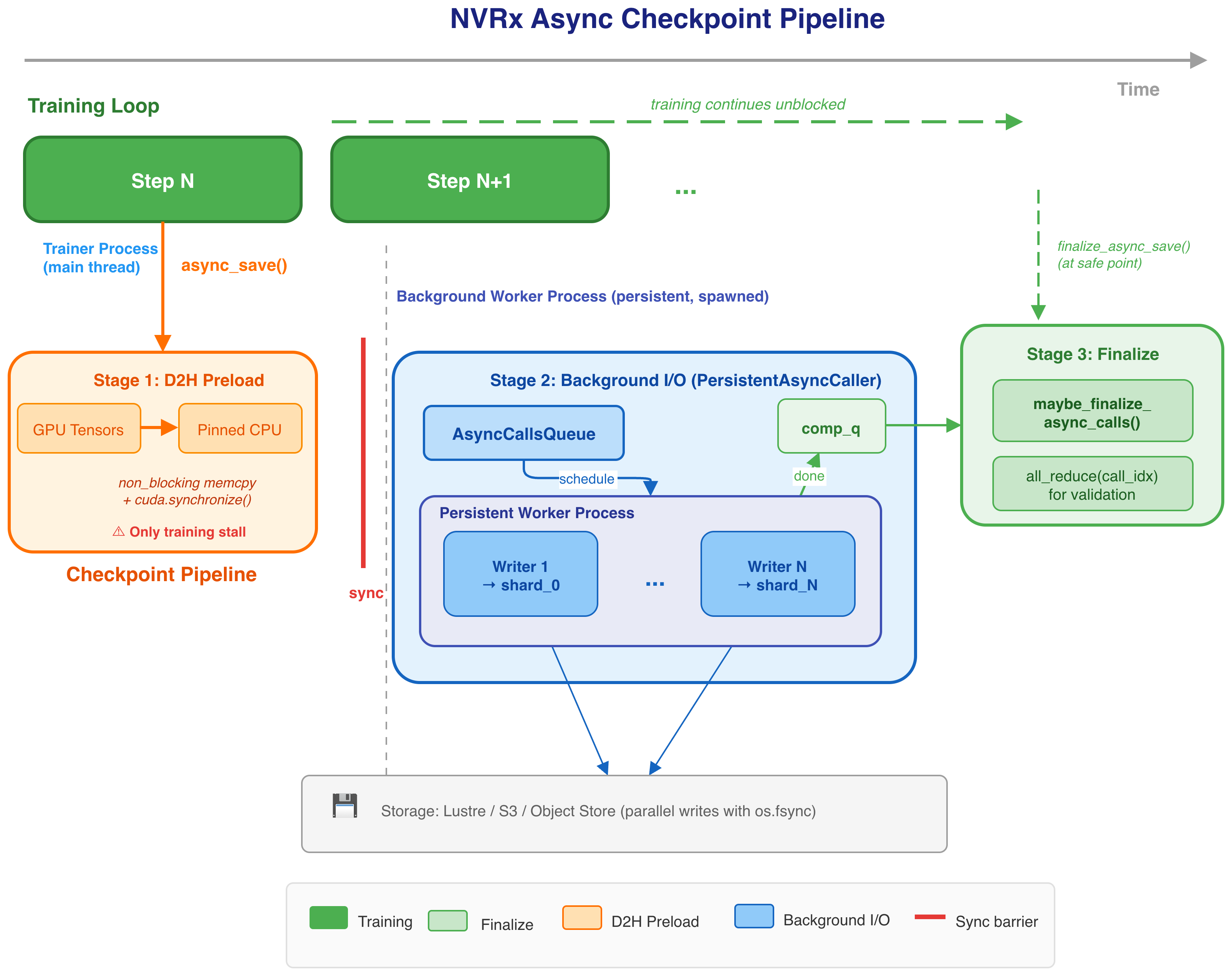
First, asynchronous checkpointing utilizes the TorchAsyncCheckpoint module. By replacing traditional torch.save commands with async_save, the main training thread offloads the state dictionary to a background process. The main thread immediately resumes the next forward and backward pass, while a secondary process handles the serialization and write-to-disk operation. Because the system leverages FSDP’s LOCAL_STATE_DICT, each rank writes its own shard to shared storage—such as Amazon FSx for Lustre—eliminating the rank-0 bottleneck that often cripples performance at scale.
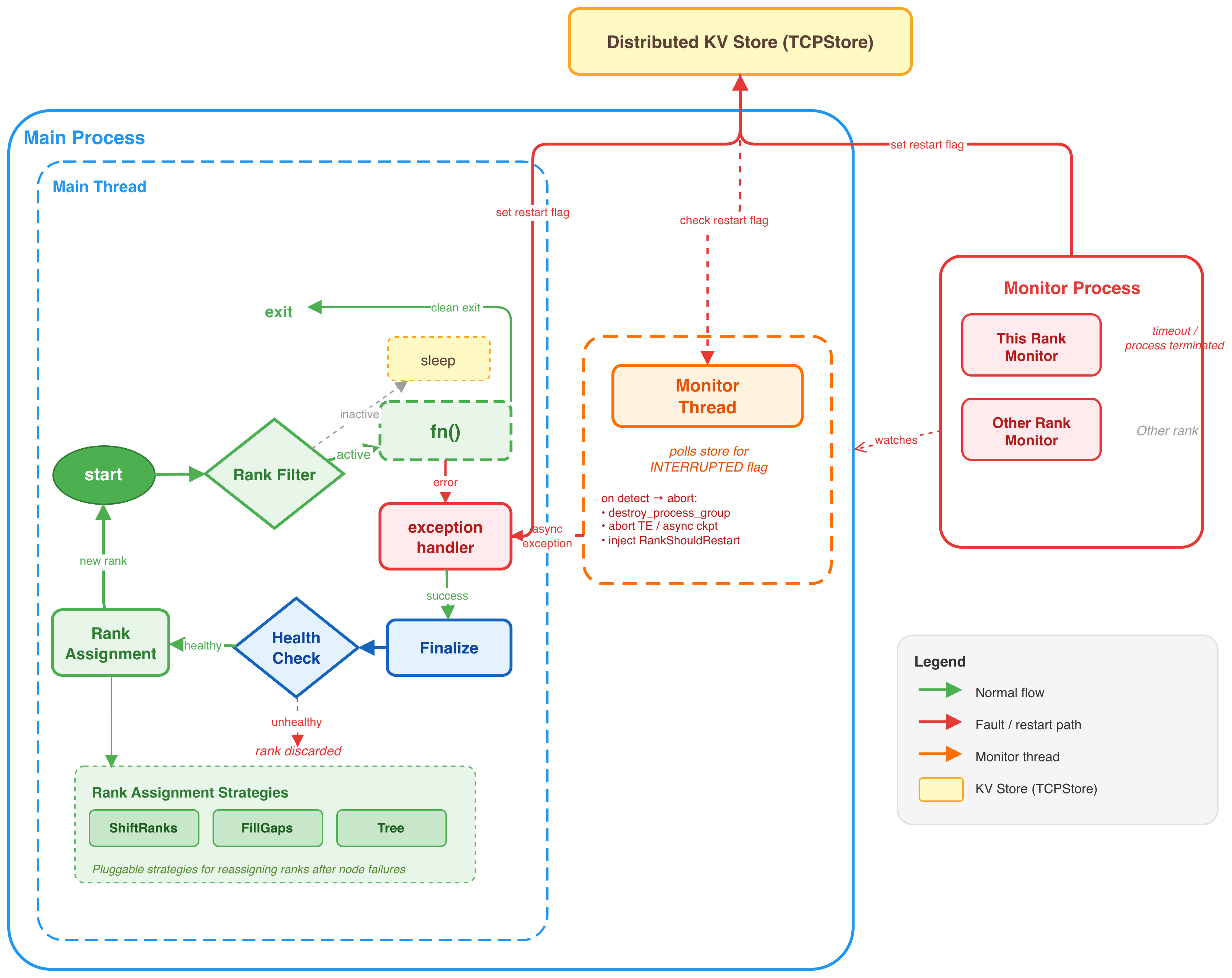
Second, in-process restart capabilities allow a training job to recover from "soft" faults—such as unhandled exceptions or transient hangs—without destroying the Python process or the container. By wrapping the primary training function in an inprocess.Wrapper, the system monitors for specific failure signals. When a fault is detected, the wrapper halts the NCCL process group, runs health checks on hardware components like NVLink and network interfaces, and re-rendezvouses the surviving workers. Because the Python interpreter and CUDA memory state are preserved, the training resumes within seconds.
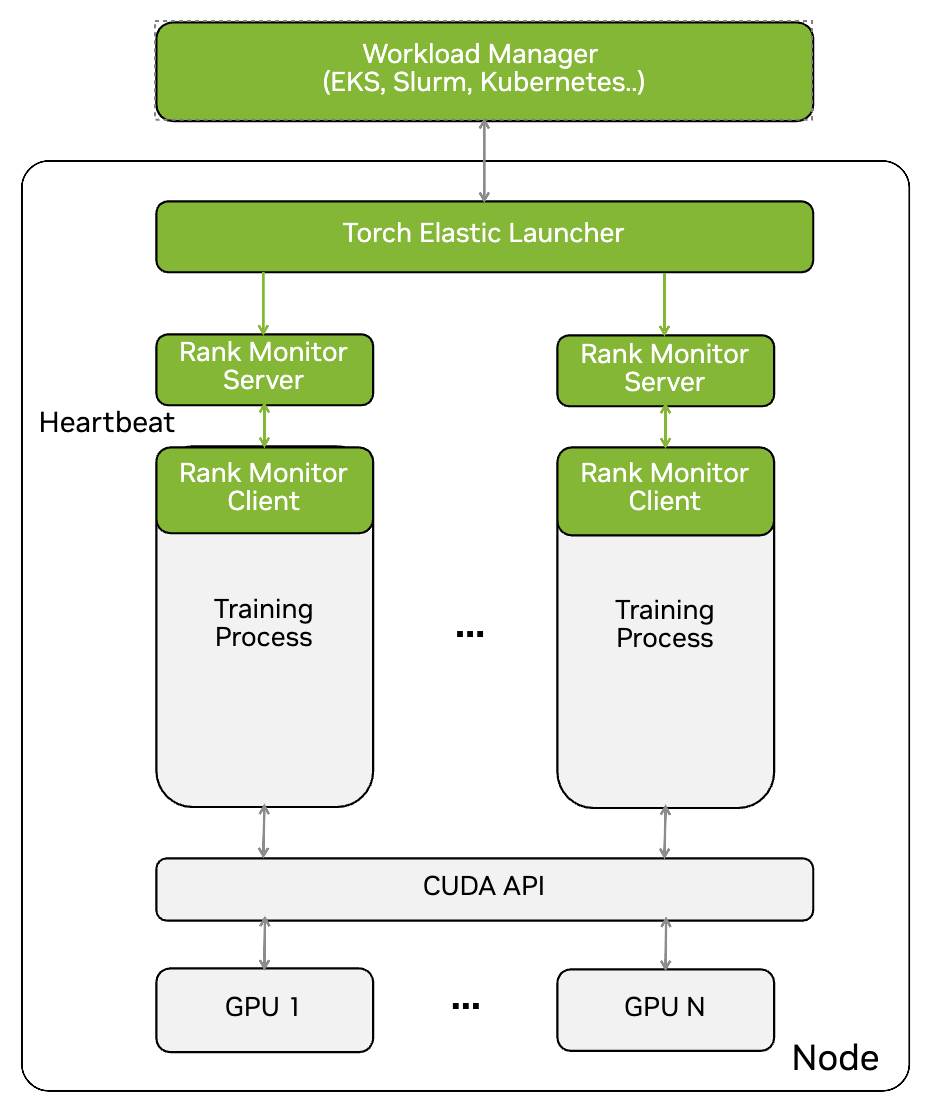
Finally, for "hard" faults—such as out-of-memory (OOM) errors or operating system-level hangs that kill the process—the ft_launcher binary serves as an external watchdog. By deploying a RankMonitorClient that sends regular heartbeats, the system can identify when a specific rank has gone unresponsive. If a timeout threshold is exceeded, the launcher automatically terminates the stalled process, reclaims the GPU resources, and initiates a clean restart of the affected workers, allowing them to rejoin the job from the most recent checkpoint.
Infrastructure and Data Throughput
The implementation on Amazon EKS relies heavily on a high-performance infrastructure foundation. By using p5.48xlarge instances, each equipped with eight NVIDIA H100 80 GB GPUs and 32 Elastic Fabric Adapter (EFA) network interfaces, developers can achieve the low-latency networking required for large-scale distributed training.
A critical component of this architecture is the integration of Amazon FSx for Lustre. By mounting the filesystem directly into the training pods via the FSx CSI driver, the infrastructure provides a high-throughput, low-latency shared storage layer. The placement of FSx in the same Availability Zone as the GPU nodes is essential for reducing read latency during the recovery phase, as the time taken to reload a checkpoint into GPU memory is typically the most significant variable in total recovery time.
Empirical Benchmarking and Performance Gains
Performance testing conducted on 2-node to 8-node clusters—representing 16 to 64 H100 GPUs—demonstrates a substantial improvement in training efficiency. When comparing synchronous checkpointing to NVRx asynchronous checkpointing, the results indicate that synchronous methods suffer from a flat, high-penalty I/O tax, losing approximately 40% of wall time to disk writes. In contrast, NVRx maintained 99% training efficiency regardless of the node count.
The impact of checkpoint frequency is particularly illustrative. When checkpointing every 100 steps, synchronous systems saw their training efficiency plummet to 14.7%, as the time required to write to disk began to exceed the time spent on actual computation. Under the same conditions, the asynchronous approach maintained a 29.6% efficiency level, effectively doubling the speed of the training cycle by masking I/O latency.
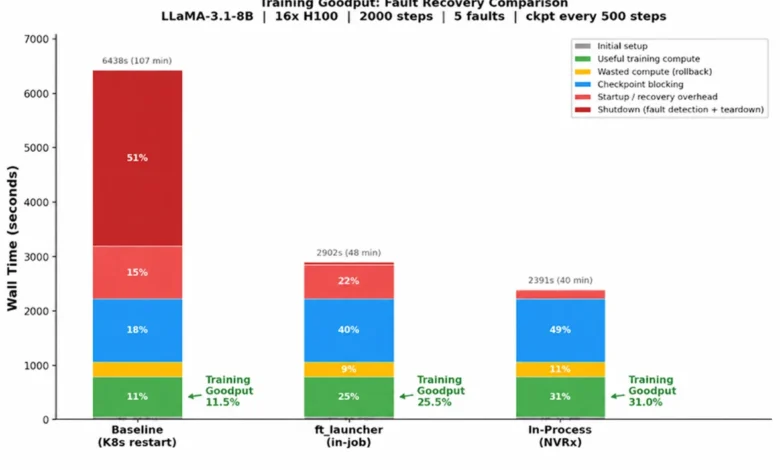
Regarding fault recovery, the data reveals a stark contrast between baseline Kubernetes behaviors and NVRx-enabled environments. In controlled experiments where five deterministic faults were injected into a 2,000-step training run:
- Baseline Kubernetes experienced a total recovery time of 270 seconds per fault, leading to a training goodput of approximately 11.5%.
- The ft_launcher mechanism improved recovery to 17 seconds per fault, resulting in a training goodput of 25.5%.
- The NVRx in-process restart achieved a recovery time of 10 seconds per fault, yielding a training goodput of 31%.
Implications for the AI Industry
The shift toward resilient training architectures marks a maturing of the AI industry. As model sizes move into the multi-trillion parameter range, the probability of failure increases, making "perfect" hardware reliability an impossible goal. By moving the burden of fault tolerance from the cluster orchestrator into the application layer, developers are creating systems that are inherently self-healing.
For large-scale AI enterprises, these findings suggest that the primary constraint on training speed is no longer just the raw compute power of the silicon, but the efficiency of the software stack in handling the inevitable entropy of large distributed systems. The ability to checkpoint frequently without performance penalties allows researchers to shorten the feedback loop of their training cycles, effectively increasing the "effective" throughput of existing hardware fleets without adding a single extra GPU.
As this technology continues to evolve, the focus is expected to shift toward even more granular recovery mechanisms and the integration of automated diagnostic tools that can preemptively identify failing hardware before it causes an application crash. For now, the integration of NVRx and EKS provides a robust template for teams looking to maximize the return on their significant investment in accelerated computing infrastructure.