Amazon Bedrock AgentCore runtime upgrade revolutionizes infrastructure for autonomous AI agents

As the artificial intelligence landscape shifts from experimental chatbots to autonomous, long-running digital agents, the underlying infrastructure must adapt to meet the demands of enterprise-scale production. Agents are no longer simple query-response tools; they now function as complex systems capable of processing insurance claims, auditing software codebases, and coordinating multi-step workflows across distributed cloud environments. To address the operational bottlenecks inherent in these sophisticated tasks, Amazon has introduced a major update to the Amazon Bedrock AgentCore runtime, a managed compute layer designed to handle the deployment and execution of agents at scale without the burden of manual infrastructure management.
The evolution of agentic workloads necessitates a move away from traditional request-response architectures toward more persistent, event-driven environments. With this update, Amazon aims to solve the dual challenges of inefficient memory allocation and unpredictable cold-start latency, both of which have historically hindered the performance of production-grade agents.
A Chronology of Agent Evolution
The journey of the AI agent has been rapid, characterized by three distinct phases of development. In the initial phase, agents were predominantly interactive chat interfaces. These sessions were ephemeral, characterized by a simple "ask and answer" flow that typically resolved in mere seconds. The infrastructure requirements for this phase were straightforward: low latency and basic session state management.
The second phase saw the emergence of task-oriented agents, such as those integrated into Integrated Development Environments (IDEs) for coding assistance. These agents required longer context windows and could operate for minutes or hours, necessitating persistent state and more robust resource management.
We are currently entering the third phase: the era of ambient, autonomous agents. These systems operate unattended, triggered by external events or internal triggers, and often run in the background for extended periods. They perform critical business logic, surfacing results only when a specific milestone is reached or a human-in-the-loop decision is required. This shift has necessitated the new, more elastic version of the AgentCore runtime, which is engineered to be as durable for long-running processes as it is responsive for interactive users.
Addressing the Technical Debt of AI Scaling
Industry analysis indicates that as agents grow in complexity, developers encounter two primary barriers: inefficient memory utilization and "cold start" variability.
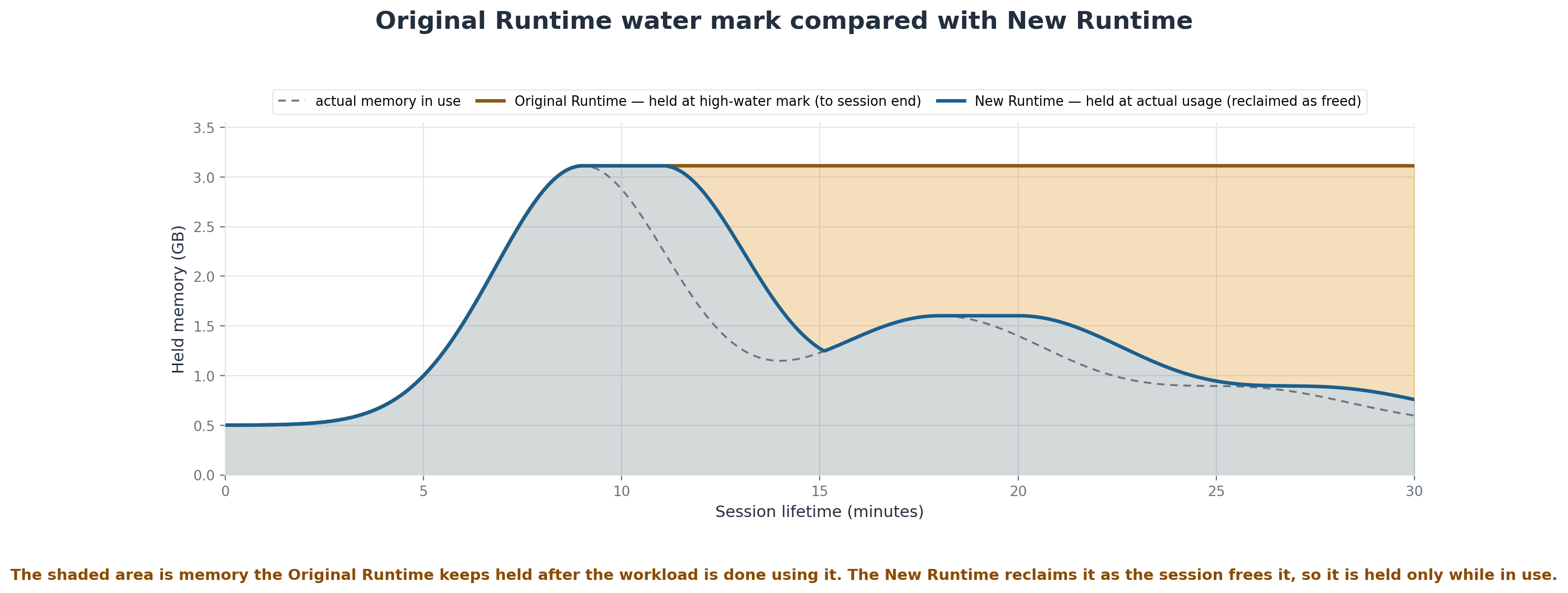
Historically, cloud-based agent runtimes relied on a "pay-for-peak" memory model. If an agent’s peak memory usage during a complex task hit a specific threshold, the user was billed for that high watermark for the duration of the session, regardless of whether that memory was actually being utilized in the later stages of the operation. This created a significant financial hurdle for long-running agents that might only experience short, intermittent spikes in activity.
Furthermore, the "cold start" problem has plagued serverless architectures for years. When an agent is idle, its environment is scaled down to zero to save costs. When a new request arrives, the infrastructure must provision a container, pull the necessary images, and initialize the agent. This process can lead to latency spikes that exceed 30 seconds for larger, more complex agent images. In an interactive environment, a delay of this magnitude is unacceptable.
The New Architecture: Efficiency and Elasticity
The updated Amazon Bedrock AgentCore runtime addresses these issues through two primary innovations: demand-based memory paging and snapshot-based environment restoration.
Under the new model, memory is no longer a static reservation. The runtime begins with a lean, efficient memory profile and pages in additional resources only as the workload demands them. Furthermore, the system is now capable of reclaiming memory that has gone "cold" throughout the lifecycle of a session. If an agent completes a memory-intensive task, the runtime proactively frees that memory, ensuring that the cost-tracking remains tethered to actual consumption rather than peak usage.
The improvements to cold-start times are equally significant. By utilizing a snapshotting mechanism, the runtime prepares the agent environment once and then creates a snapshot. When a new request triggers a cold start, the system restores the environment from this snapshot rather than performing a full boot-and-initialize sequence.
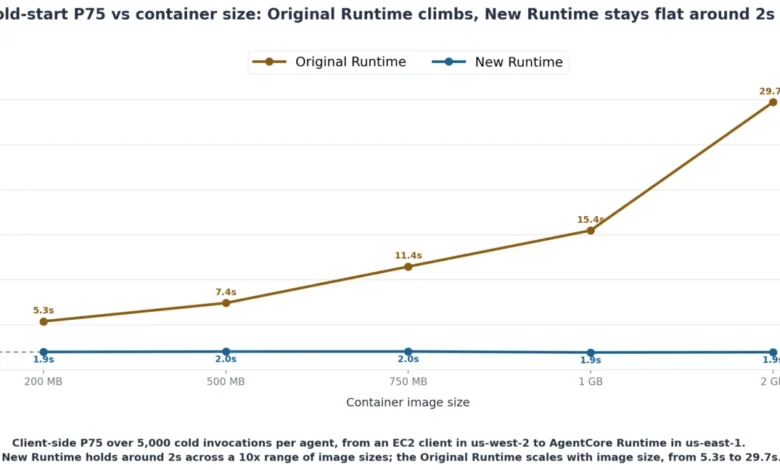
Data provided by Amazon regarding the performance of the new runtime highlights a stark improvement in consistency. In testing with an echo agent, the new runtime maintained a P75 cold-start latency of approximately two seconds across image sizes ranging from 200 MB to 2 GB. In contrast, the previous iteration saw latency balloon from roughly 5.4 seconds to nearly 30 seconds as image size increased. This predictability allows developers to build more reliable user experiences, knowing that the platform’s portion of the startup time is bounded and consistent.
Economic and Operational Implications
For enterprises managing hundreds or thousands of agents, these changes carry significant economic weight. The transition to a consumption-based model that tracks actual usage means that companies can deploy "always-on" agents without incurring the prohibitive costs associated with over-provisioned infrastructure.
"The consumption model now bends to the workload rather than forcing the workload to bend to it," noted a technical representative during the announcement. This shift is expected to lower the barrier to entry for smaller organizations looking to integrate autonomous agents into their customer service or operational pipelines.
The implications extend beyond cost. By removing the need for developers to manage "warm pools" of compute resources—a common, expensive workaround for cold-start latency—the update allows engineering teams to focus on the business logic of the agent rather than the underlying plumbing of the infrastructure. This shift in focus is likely to accelerate the deployment of advanced AI features in commercial applications.
Future Roadmap and Strategic Direction
The current release is merely the first step in a broader roadmap for the AgentCore runtime. Amazon has signaled several upcoming features designed to further increase flexibility and control:
- Committed Baseline Discounts: To accommodate steady-state, always-active agents, Amazon plans to introduce a pricing tier where users can reserve a memory floor at a discounted rate while still retaining the ability to burst above that floor on demand.
- Expanded Compute and Storage: Larger vCPU and RAM allocations are planned to support high-performance computing agents that require significant processing power.
- x86 Support: To improve interoperability, the platform will expand support for x86 microVMs, allowing teams to port legacy tools or environments directly into the AgentCore ecosystem without refactoring code.
- Enhanced Lifecycle Management: Future updates will introduce the ability to suspend and resume sessions through memory snapshotting, enabling agents to persist across long-term, non-continuous workflows.
- Scoped Identity for Unattended Agents: Security remains a paramount concern for autonomous agents. New session-context keys will allow for granular, scoped permissions, ensuring that an agent operating without human oversight cannot access data or systems beyond its defined remit.
Conclusion
The release of the new AgentCore runtime represents a maturation point for enterprise AI. As the technology moves from the laboratory into the core of business operations, the focus is shifting from "what can AI do" to "how can AI run reliably and affordably at scale." By solving the fundamental compute, memory, and latency constraints, this update provides a robust foundation for the next generation of autonomous digital agents. For developers, the goal is clear: to build systems that are as responsive as they are autonomous, capable of handling the mundane to the complex with efficiency and precision. As the ecosystem continues to evolve, the ability to manage these agents with the same rigor as traditional software will be the defining factor in the widespread adoption of agentic AI.