As Large Language Models (LLMs) transition from experimental research projects to the backbone of modern enterprise software, the economics of AI deployment have shifted dramatically. Companies are no longer asking how to make a model work, but how to make it run at scale without ballooning cloud infrastructure budgets. Inference—the process of generating text from a trained model—is often the primary cost driver for AI applications, characterized by high memory consumption, compute-heavy matrix multiplications, and latency bottlenecks that can frustrate end users.
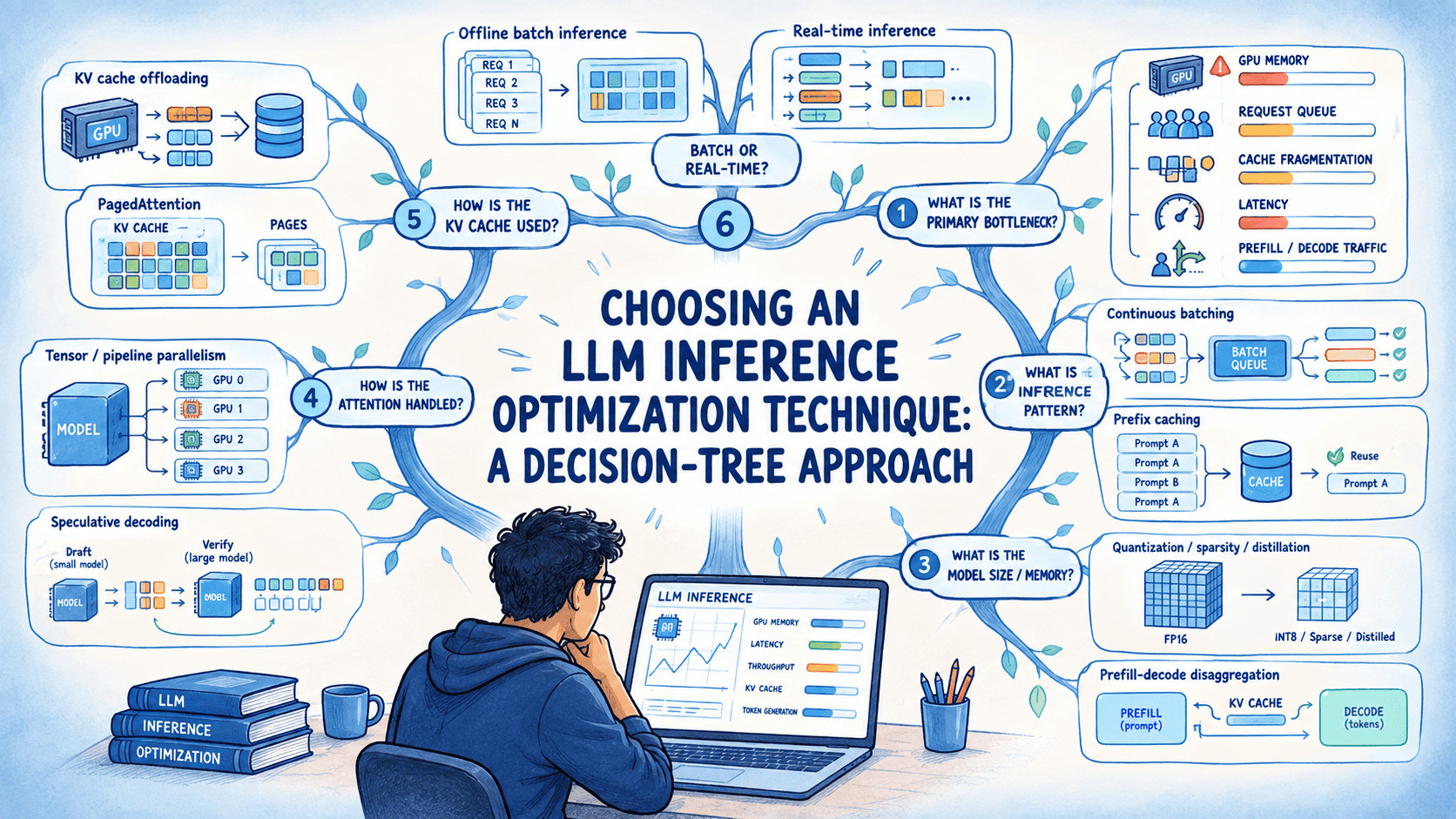
To address these challenges, engineers have developed a suite of optimization techniques. However, applying these techniques blindly is a recipe for engineering debt. Optimization is not a "one size fits all" endeavor; it is an exercise in bottleneck identification. By utilizing a systematic six-question decision tree, technical teams can match the right performance-tuning strategy to the specific constraints of their unique production workload.
The Anatomy of an Inference Bottleneck
Before evaluating technical interventions, it is critical to understand the environment in which LLMs operate. Inference is fundamentally constrained by three factors: GPU compute cycles, high-bandwidth memory (HBM) throughput, and the interconnect speed between devices.
In early 2023, the industry consensus was that model size was the primary barrier to entry. As parameter counts climbed into the hundreds of billions, hardware availability became the primary hurdle. By late 2024, the focus shifted toward "serving efficiency"—the ability to maximize tokens per second per dollar. This shift was precipitated by the rise of complex multi-turn chat applications and retrieval-augmented generation (RAG) workflows, which place unique strains on the KV (Key-Value) cache, the memory structure that stores previous tokens to speed up future generations.
Phase 1: Model-Level Assessment
The first step in any optimization audit is determining if the model is correctly sized for the target hardware. If a model consumes 90% of a GPU’s VRAM just to load its weights, there is no headroom for the KV cache. This leads to severe "batching starvation," where the system cannot process multiple requests in parallel because it lacks the memory to store the intermediate state for each user.
In such cases, techniques like quantization, sparsity, and model distillation are the primary levers. Quantization, which reduces the precision of model weights (e.g., from FP16 to INT8 or INT4), has become the industry standard for fitting larger models onto smaller, more cost-effective hardware. While there is a documented trade-off in output perplexity—the statistical measure of a model’s surprise—advances in calibration techniques have rendered these losses negligible for most practical applications.
Phase 2: Optimizing the Prompting Strategy
Once the model size is optimized, the focus shifts to the incoming traffic. A pervasive issue in modern LLM deployment is the redundant computation of shared prefixes. In many RAG-based systems or long-context chat interfaces, the initial system prompt or retrieved context remains static across hundreds of user interactions.
Without optimization, the model re-processes these identical tokens for every single request, wasting millions of compute cycles. Prefix caching has emerged as a high-leverage solution. By storing the KV cache of a common prompt in persistent memory, the engine can "pre-fill" the context window instantly. Recent benchmarks from major inference providers indicate that prefix caching can reduce time-to-first-token (TTFT) by up to 80% in multi-turn conversational agents.
Phase 3: Traffic Patterns and Batching
When multiple users query an LLM simultaneously, the serving engine must manage the execution flow. A naive implementation processes requests sequentially, but this leads to massive GPU underutilization. Continuous batching, a technique popularized by engines like vLLM, solves this by allowing new requests to enter the batch as soon as an existing request finishes, rather than waiting for a full batch completion.
However, even with batching, memory fragmentation remains a silent killer of throughput. If an engine allocates a fixed, maximum-length memory block to every request—anticipating a 4,096-token response when the actual response is only 50 tokens—the GPU memory becomes a "Swiss cheese" of unused, reserved space. PagedAttention, which treats memory similarly to how operating systems manage virtual memory via paging, has proven to be the definitive solution, allowing for near-perfect memory utilization even with highly variable output lengths.
Phase 4: Latency vs. Throughput Trade-offs
The final stage of the decision tree addresses the tension between latency and throughput. If the priority is "per-token latency"—the speed at which text streams to the user—speculative decoding is the current state-of-the-art. By employing a small, "draft" model to predict a sequence of tokens that a larger, "target" model then verifies in a single parallel pass, latency can be cut significantly.
The caveat, however, is that this adds architectural complexity. If the draft model’s predictions are frequently rejected by the target model, the overhead of the extra computation can actually result in slower performance than standard sequential decoding.
For enterprise-scale applications where the volume of requests is massive, prefill-decode disaggregation represents the frontier of infrastructure design. By separating the "prefill" phase (processing the input) from the "decode" phase (generating the output) onto dedicated hardware, teams can optimize for the different compute profiles required by each. Prefill is compute-bound, while decoding is memory-bandwidth-bound. Disaggregating these tasks prevents them from contending for the same resources, ensuring that a surge in long-document processing doesn’t crash the latency of real-time conversational agents.
Summary of Optimization Strategies
| Technique | Primary Benefit | Implementation Complexity |
|---|---|---|
| Quantization | Reduced memory footprint | Low |
| Prefix Caching | Faster TTFT for repeated prompts | Medium |
| Continuous Batching | Improved overall throughput | Low (default in modern stacks) |
| PagedAttention | Eliminated memory fragmentation | Medium |
| Speculative Decoding | Reduced inter-token latency | High |
| Disaggregation | Resource isolation at scale | Very High |
Operational Pitfalls and Future Outlook
Even with the correct optimization selected, performance may fall short of expectations due to implementation errors. A common observation in data centers is the "zero-hit" scenario for prefix caches, usually caused by non-deterministic serialization where even a minor difference in whitespace or key-ordering renders the cache useless. Furthermore, attempting to implement disaggregation on a low-traffic workload often introduces more latency due to network transfer overhead than it saves in computation.
As of late 2026, the industry is trending toward automated orchestration layers that dynamically switch between these techniques based on real-time traffic analysis. Rather than manually selecting a strategy, future inference engines will likely function as "self-tuning" systems, monitoring memory pressure and token arrival rates to toggle between PagedAttention, speculative decoding, and cache offloading on the fly.
For organizations navigating this landscape, the recommendation remains consistent: start with the bottleneck. Attempting to optimize for latency when the system is actually constrained by memory throughput is a counterproductive expenditure of engineering time. By systematically traversing the six-question decision tree—from model size to architectural disaggregation—teams can achieve the balance of performance, cost, and reliability required to sustain modern AI operations.