Sandboxing AI Agent Code Execution in Python: Containers, MicroVMs and Beyond

The rapid integration of autonomous AI agents into enterprise workflows has introduced a critical security paradigm shift: the necessity of isolating code generated by large language models (LLMs). As agents transition from simple chatbots to sophisticated systems capable of writing and executing arbitrary Python code to solve complex data tasks, they become potential vectors for system compromise. Securing these agents requires a multi-layered architectural approach, balancing the performance needs of real-time execution with the imperative to prevent unauthorized system access, data exfiltration, or resource exhaustion.
The Evolution of Execution Security
The security of an AI agent is inherently tied to the environment in which its output is executed. When an agent is granted a "code execution tool," it essentially becomes an interface for remote code execution (RCE) on the host system. Without robust sandboxing, a malicious prompt or a hallucinated function call could allow an agent to read sensitive environment variables, scan internal networks, or disrupt host infrastructure.
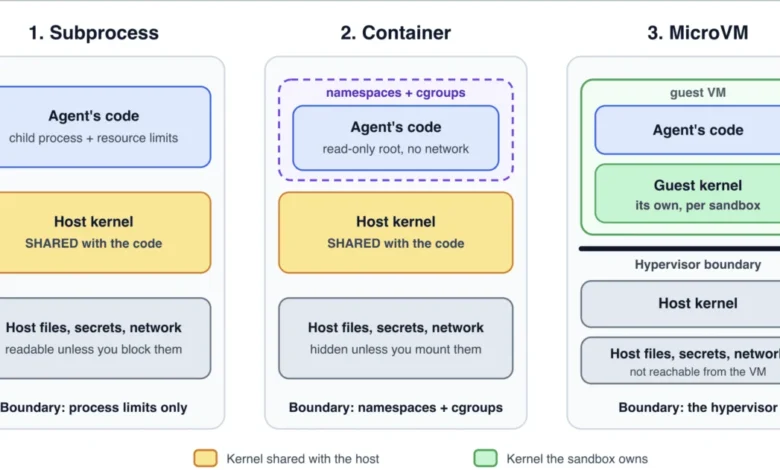
Historically, the industry has relied on three distinct tiers of isolation, each offering a different trade-off between security and latency. The progression from simple subprocesses to hardened containers and finally to dedicated microVMs reflects the industry’s maturation in handling untrusted code execution.
Tier One: Process-Level Isolation
At the most basic level, developers often utilize limited subprocesses. This method involves spawning a child process from the main application, using Linux-native features like resource limits and unshare namespaces to restrict the execution context.
This approach is highly performant, as it incurs minimal overhead. However, it is fundamentally the weakest form of isolation. Because the child process shares the host’s kernel and filesystem, it remains susceptible to "breakout" attacks if kernel vulnerabilities are present. Furthermore, enforcing granular limits—such as restricting access to specific directories or preventing network calls—is notoriously difficult to configure correctly. In practice, while a subprocess can cap CPU and memory usage, it often fails to provide true protection against sophisticated attackers or accidental system-level interference.
Tier Two: Containerized Environments
Docker containers represent the current industry standard for balancing isolation and usability. By leveraging Linux namespaces and control groups (cgroups), containers provide a more structured boundary than subprocesses. A hardened container can be configured with a read-only root filesystem, restricted capabilities (cap-drop ALL), and a network-less environment, significantly reducing the attack surface.
However, containers are not silver bullets. A 2025 analysis of security vulnerabilities—most notably in the runc runtime—demonstrated that container breakouts remain a viable threat vector. Because containers share the underlying host kernel, a single exploit that compromises the kernel allows an attacker to bypass the container boundary entirely. Consequently, security teams are increasingly wary of using containers for truly hostile or untrusted code without additional layers of protection.
Tier Three: MicroVMs and Hypervisor-Level Isolation
The most robust solution currently available is the microVM, powered by technologies like Firecracker. Unlike containers, which use OS-level virtualization, microVMs utilize hardware-level virtualization. Each execution environment operates on its own dedicated kernel, managed by a hypervisor.
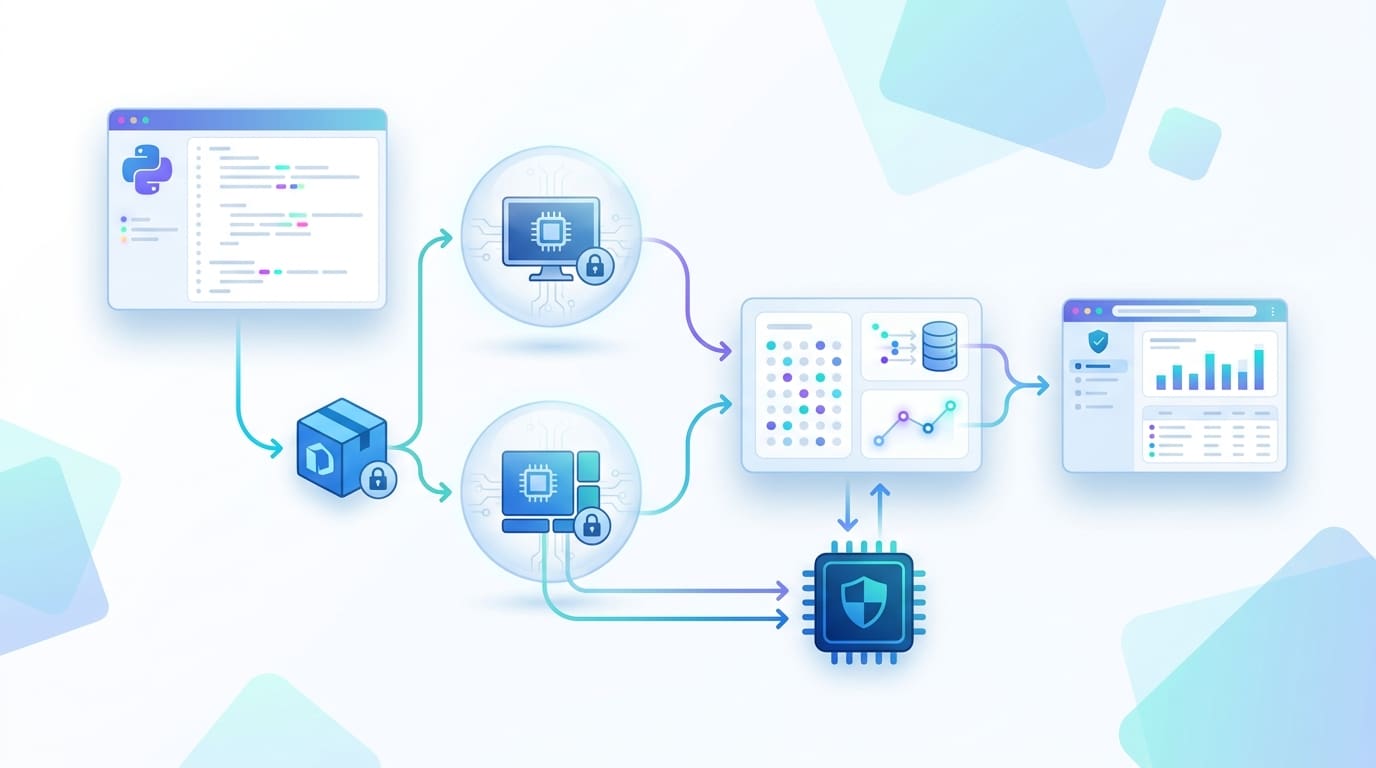
This architecture provides the strongest security guarantee: if a process manages to compromise its environment, it is trapped within a guest kernel, isolated from the host. Industry leaders, including AWS (for Lambda functions) and various specialized sandbox providers like E2B, have adopted this model because it effectively eliminates the risks associated with shared kernels. While the boot time of a virtual machine was historically measured in seconds, modern microVMs have reduced this latency to the millisecond range, making them increasingly viable for high-frequency AI agent tasks.
Comparative Analysis of Performance and Security
When evaluating these options, organizations must weigh the cost of "safety latency"—the time taken to spin up an environment versus the risk of a breach.
| Feature | Subprocess | Container | MicroVM |
|---|---|---|---|
| Isolation | Low (Process) | Medium (Namespace) | High (Hypervisor) |
| Kernel | Shared (Host) | Shared (Host) | Dedicated (Guest) |
| Startup Time | < 10 ms | ~50–100 ms | ~150–300 ms |
| Use Case | Trusted/Dev | Semi-trusted | Untrusted/Public |
The data indicates that while microVMs introduce a slight latency penalty, the security gains are substantial. For enterprise applications where an agent might access sensitive databases or API keys, the marginal increase in startup time is a necessary trade-off to ensure complete environmental isolation.
Implementing a Secure Execution Loop
To effectively manage these environments, developers should treat the execution tool as a modular component. The agent should interface with a generic Sandbox object, allowing the backend to be swapped out without modifying the core agent logic.
A standard implementation involves:
- Defining the Interface: Establishing a universal structure for
stdout,stderr, and exit codes to ensure the LLM receives consistent feedback regardless of the sandbox tier. - Resource Capping: Regardless of the tier, strict limits must be applied to CPU cycles, memory usage (address space), and disk I/O.
- Network Isolation: By default, all sandboxes should be disconnected from the network. If an agent requires external data, it should be mediated through a proxy or an explicitly defined set of allowed endpoints.
Broader Implications and Future Trends
The shift toward microVMs is accelerating. As of late 2026, major cloud providers have begun standardizing on microVM-based architectures for serverless and agentic workloads. This transition reflects a broader trend toward "security-by-default" in the AI infrastructure stack.
The implications for developers are clear: the era of running agent-generated code in unprotected host environments is ending. Future-proofing an AI application requires designing for modularity, allowing for the transition from simpler, faster environments to more secure, hypervisor-isolated ones as the agent’s reach and autonomy grow.
Ultimately, the choice of sandbox is a reflection of the organization’s risk appetite. While startups or experimental projects may prioritize the speed of subprocesses or containers, mature production systems must adopt the hardware-level isolation of microVMs. As the technology continues to evolve, the distinction between these tiers will likely blur as hypervisors become even more lightweight, eventually offering the performance of a subprocess with the security of a full virtual machine. By abstracting the execution layer, developers can ensure their agents remain powerful, versatile, and—most importantly—contained.