Integrating Codex with Amazon Bedrock for Enterprise AI Engineering at Scale

The adoption of generative AI tools like Codex has fundamentally altered the landscape of software development, allowing engineers to accelerate coding tasks, troubleshoot unfamiliar libraries, and automate repetitive boilerplate generation. However, for large-scale enterprise platform teams, the transition from individual developer experimentation to organizational deployment presents a significant architectural challenge. Organizations must balance the need for developer velocity with stringent security, governance, and operational standards. A new framework for integrating Codex with Amazon Bedrock provides a structured pathway to achieve this, enabling teams to utilize high-performance OpenAI models while maintaining centralized control over identity, access management, and observability.
The Architectural Challenge of Enterprise AI Deployment
When developers adopt AI-assisted coding tools, the primary friction point for platform engineering teams is the fragmentation of the tech stack. If left unmanaged, developers may rely on disparate, ad-hoc authentication methods that bypass corporate security protocols, creating "shadow AI" pockets that lack auditability. The objective of the current AWS-centered guidance is to bridge this gap by allowing Codex to utilize Amazon Bedrock for inference, ensuring that all model requests are routed through established AWS infrastructure—specifically utilizing AWS Identity and Access Management (IAM), regional policy enforcement, and standardized observability pipelines.
By shifting from fragmented, third-party model access to a unified AWS-managed path, organizations can apply consistent security postures. This approach moves the model request flow from the developer workstation directly into the AWS ecosystem, where existing enterprise policies regarding data residency, user identity, and cost tracking can be applied without requiring the construction of a secondary operational stack.
Establishing the Pilot Framework
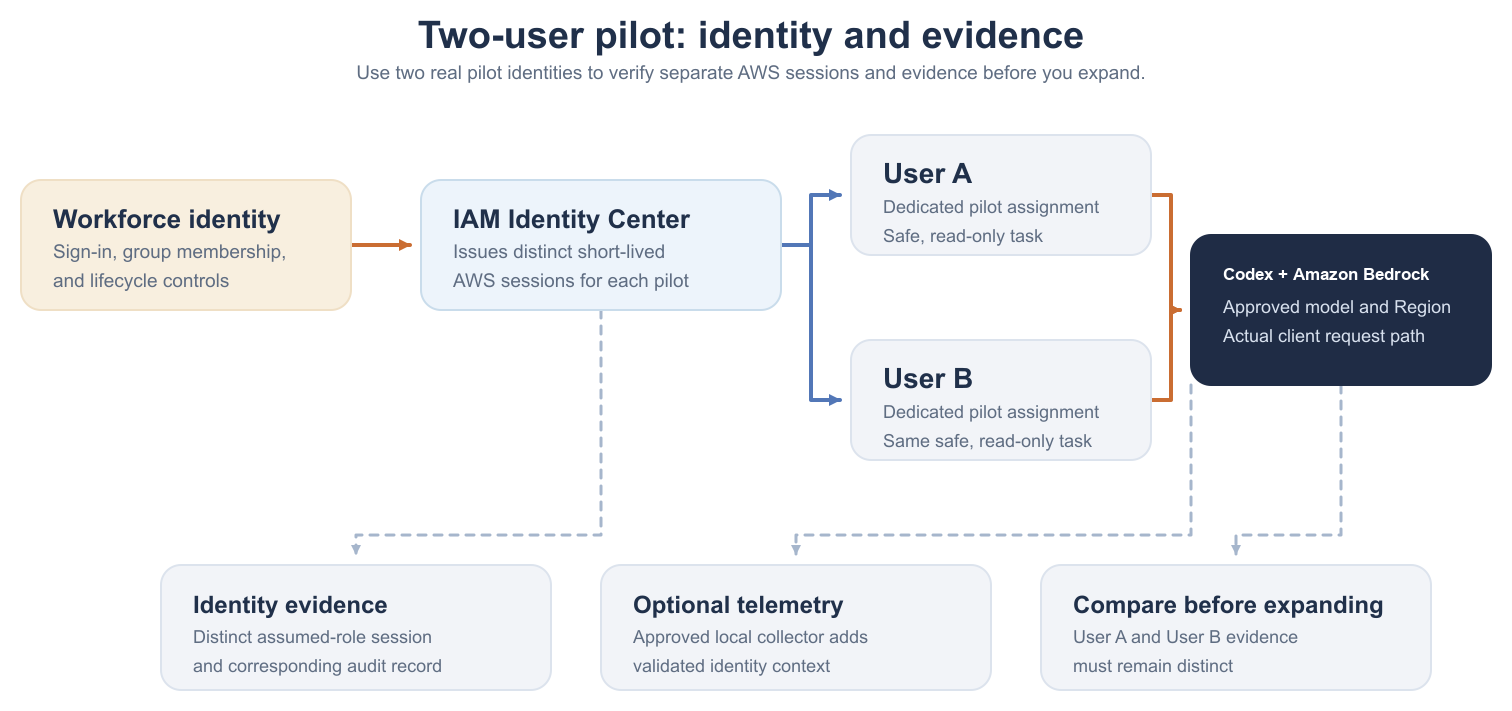
A successful rollout of AI engineering tools follows a phased methodology, beginning with a "least-privilege" pilot. This initial phase is designed to confirm that the technical plumbing—identity propagation, regional model availability, and network connectivity—functions correctly before scaling to wider engineering departments.
Before initiating a pilot, organizations must verify model availability via the Amazon Bedrock console, ensuring that specific models (such as the GPT-5.6 series) are supported in the targeted AWS Regions. The pilot itself typically involves a small group of developers who utilize their existing workforce identity provider, such as Okta or Microsoft Entra ID, to authenticate via SAML. This integration leverages IAM Identity Center, which provisions temporary, short-lived AWS credentials for Codex. By utilizing these existing enterprise identity providers, the organization ensures that every model invocation is attributable to a specific user, meeting compliance and audit requirements from day one.
Choosing the Right Integration Path
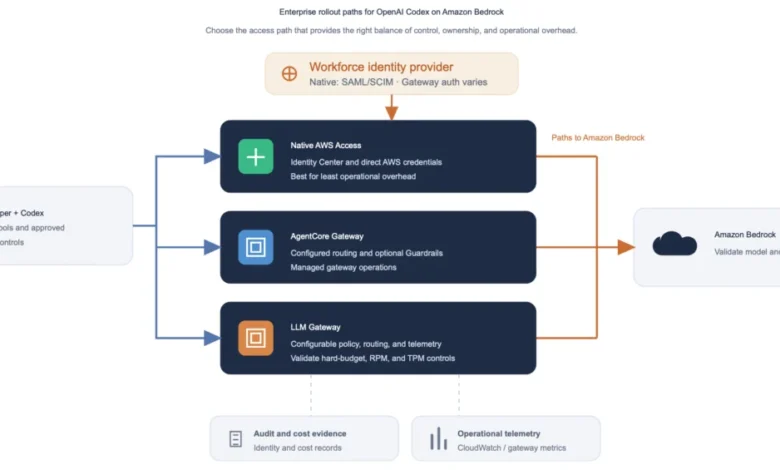
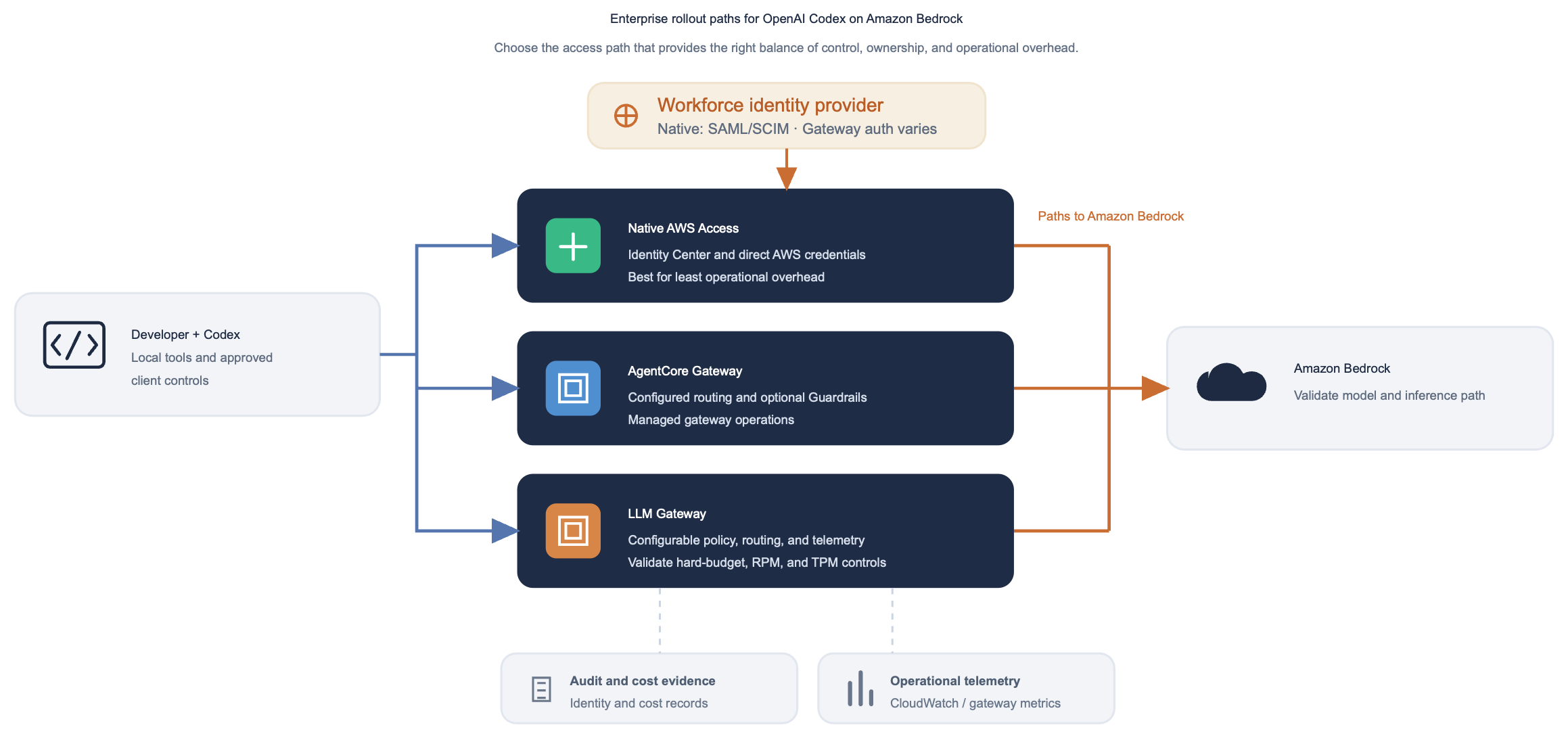
The architecture of the deployment generally falls into one of three distinct categories, each with varying levels of complexity and control:
- Native AWS Access: This is the most direct route, ideal for initial pilots. It relies on standard AWS IAM permissions and is best suited for organizations that already possess a robust, mature IAM strategy. It minimizes infrastructure overhead by allowing Codex to communicate directly with the Amazon Bedrock API using standard CLI-based authentication.
- AgentCore Gateway: This approach introduces a managed gateway layer. It is the recommended path for organizations requiring centralized routing, fine-grained access control, or the application of Amazon Bedrock Guardrails, which filter input and output to prevent the generation of harmful or non-compliant content.
- LLM Gateway Pattern: This is an advanced configuration for enterprises that require sophisticated request-path controls. It involves a dedicated middleware layer that inspects and transforms requests before they reach the model. While powerful, this path requires a higher degree of operational maintenance from platform engineering teams.
Operational Observability and Cost Governance
A critical component of any enterprise-grade AI deployment is the ability to observe, measure, and allocate costs. The integration of the AWS Distro for OpenTelemetry (ADOT) with Codex allows for the collection of granular metrics, including token usage, API latency, and request duration. These metrics are then visualized through Amazon CloudWatch dashboards, providing administrators with real-time insights into how AI tools are being utilized across the engineering organization.
From a financial perspective, relying on standard AWS billing records—specifically the AWS Cost and Usage Report (CUR)—provides the most accurate picture of consumption. Because these reports are tied directly to the IAM principal initiating the request, platform teams can allocate costs back to specific departments or project codes with high accuracy. This is a significant improvement over "black box" third-party AI subscriptions, where usage visibility is often limited or obfuscated by vendor-specific reporting tools.
Standardizing Team Behavior and Security Boundaries
Beyond the infrastructure, enterprise standardization requires clear guidelines for how developers interact with AI agents. This involves the deployment of organization-owned plugins and hooks that enforce security policies. For instance, teams can implement "pre-tool" hooks that intercept requests before they are executed, allowing for the injection of security checks or the blocking of unauthorized command-line actions.
Furthermore, the Model Context Protocol (MCP) introduces a new dimension of extensibility. By allowing Codex to interface with external systems, MCP servers create a powerful, flexible environment for developers. However, these servers also represent new trust boundaries. Therefore, the governing policy must dictate that only pre-approved, vetted MCP servers are accessible, and credentials for these services must be managed through secure, centralized secrets management processes rather than being hardcoded in developer-level configuration files.
The Role of Governance in Large-Scale AI Adoption
The shift toward integrating AI directly into the development lifecycle is not merely a technical upgrade; it is a fundamental shift in how organizations manage risk. As AI tools gain the capability to read codebases, propose changes, and execute shell commands, the potential for inadvertent data leaks or unauthorized system modifications increases.
Official industry responses to these challenges highlight the importance of "human-in-the-loop" verification. No matter how sophisticated the AI agent becomes, it remains a tool for assistance rather than an autonomous decision-maker. Consequently, most enterprise policies require that any code generated by an AI be subjected to the same rigorous peer review and automated testing processes as human-written code. By enforcing these checks, organizations ensure that AI-driven velocity does not come at the expense of software quality or security.
Implications and Future Outlook
The ability to wrap generative AI tools within the protective envelope of AWS infrastructure provides a blueprint for the next decade of software development. By leveraging native identity, monitoring, and security services, companies can safely adopt advanced LLMs without creating the fragmented operational debt that plagued early enterprise cloud migrations.
The phased rollout approach—moving from a controlled pilot to an organization-wide standard—allows for the incremental discovery of operational pain points. For instance, early pilot feedback often reveals the need for more granular rate limiting or additional guardrails on sensitive data exposure. By addressing these in the "Expansion" phase, organizations can refine their policies before full-scale deployment.
Ultimately, the goal of this integration is to transform AI from a disruptive, independent technology into a managed, highly efficient component of the corporate engineering workflow. As the technology matures, we can expect deeper integration between AI observability platforms and enterprise CI/CD pipelines, allowing for even more automated security enforcement and cost-efficient scaling. For organizations that prioritize governance alongside innovation, this framework offers a stable foundation for the future of AI-augmented engineering.
Administrative Checklist for Success
To ensure a smooth transition, administrators are advised to follow a formal launch checklist:
- Identity Mapping: Ensure all developers are correctly mapped to their respective IAM roles within the workforce identity provider.
- Regional Compliance: Verify that the chosen AWS Regions meet data sovereignty requirements for the codebase being analyzed.
- Telemetry Deployment: Ensure the ADOT collector is properly configured on all developer workstations to prevent "blind spots" in usage data.
- Rollback Procedures: Maintain a clear, tested method for disabling AI access instantly in the event of a security incident.
- Training and Documentation: Provide developers with clear guidance on what constitutes "safe" and "unsafe" use of the tool, specifically regarding the handling of secrets and proprietary data.
By adhering to these principles, enterprises can harness the immense potential of Codex while maintaining the rigorous operational standards required to protect their most valuable digital assets.