NVIDIA Redefines AI Economics and Inference Performance with Groundbreaking MLPerf Inference v6.1 Results and Vera Rubin Preview


The economics of artificial intelligence have reached a critical inflection point, where system performance, efficient infrastructure scaling, and continuous software optimization dictate the operational viability and revenue potential of enterprise deployments. In the rapidly evolving landscape of generative AI, large language models, and complex reasoning frameworks, the ability to maximize token generation while minimizing resource consumption is paramount. Higher system performance directly correlates to an increased volume of generated tokens, which in turn drives higher top-line revenue for cloud service providers and enterprise data centers alike. Simultaneously, efficient infrastructure scaling ensures that operational throughput grows in direct proportion to hardware investments, reducing the capital expenditure required to serve billions of users globally. Underpinning these economic pillars is platform fungibility—the capability of a unified hardware and software architecture to seamlessly execute diverse workloads, ranging from traditional model training and inference to multi-step reasoning, recommendation engines, natural language processing, and advanced video generation, thereby maintaining high asset utilization rates across expensive computing clusters.
Addressing these foundational requirements, NVIDIA has unveiled a comprehensive suite of performance milestones in the latest MLPerf Inference v6.1 benchmarks. The newly released data underscores the profound impact of full-stack co-design, highlighting significant performance leaps delivered by the cutting-edge NVIDIA Vera Rubin architecture and the high-efficiency Grace Blackwell platform. For enterprise decision-makers navigating complex infrastructure choices, these benchmarks provide critical empirical data regarding long-term inference economics, hardware scalability, and software velocity.
The Rise of Vera Rubin: Next-Generation Inference Benchmarks
In a clear signal of its accelerating cadence of hardware and software innovation, NVIDIA submitted preview results for the Vera Rubin NVL72 platform on two of the most computationally demanding and contextually complex benchmarks in the MLPerf Inference v6.1 suite: DeepSeek-R1 and Qwen3-VL. These workloads represent the modern paradigm of AI, requiring advanced multimodal processing and extensive reasoning capabilities that stretch the limits of traditional silicon.
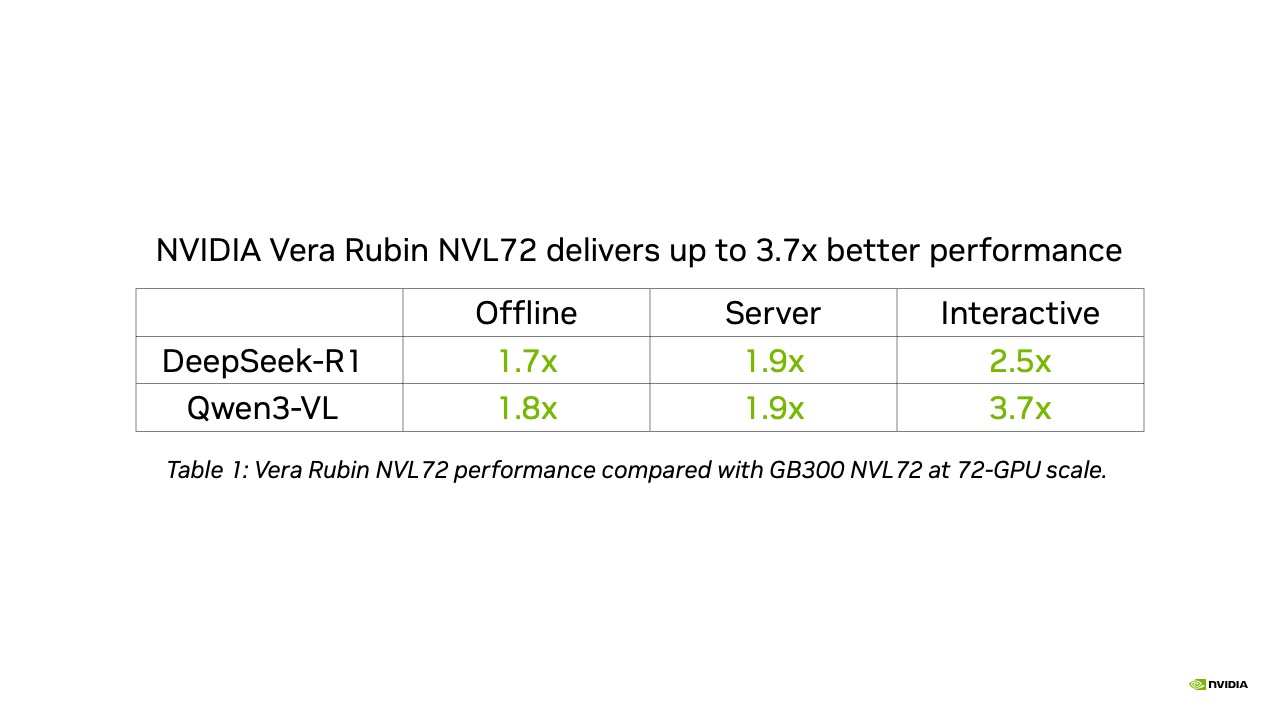
The Vera Rubin NVL72 architecture demonstrated staggering performance advantages in early testing. Across offline, server, and interactive deployment scenarios, the platform delivered up to 3.7 times higher throughput than the preceding GB300 NVL72 architecture when running Qwen3-VL. This massive efficiency gain was achieved by leveraging vLLM alongside the NVIDIA Dynamo open-source inference framework. Furthermore, on the heavily scrutinized DeepSeek-R1 benchmark, utilizing the highly optimized NVIDIA TensorRT-LLM library, the Vera Rubin system achieved throughput levels up to 2.5 times higher than the GB300 NVL72.

These early metrics point to a compounding trend of architectural enhancements and software maturity. By dramatically increasing the token generation rate per rack, the Vera Rubin NVL72 enables organizations to serve exponentially more users, accelerate response times for interactive applications, and drastically lower the total cost per token.
Architectural Co-Design: Hardware and Software Synergy
The extraordinary performance gains demonstrated by the Vera Rubin platform are not the result of brute-force hardware scaling alone; rather, they stem from a rigorous full-stack co-design philosophy that synchronizes silicon engineering with systems software. At the hardware level, Vera Rubin incorporates enhanced Tensor Cores and a deeply integrated Transformer Engine designed to accelerate both the prefill and decode stages of the inference lifecycle.
Moreover, the widespread adoption of NVFP4 numerical precision plays a pivotal role in optimizing memory bandwidth and capacity. By reducing the memory footprint across model weights, attention mechanisms, and Key-Value (KV) caches, NVFP4 allows significantly larger models to fit comfortably within high-speed memory pools, thereby driving up overall throughput without measurable degradation in output accuracy.
To maximize efficiency across Mixture-of-Experts (MoE) architectures—which underpin complex reasoning models such as DeepSeek-R1 and Qwen3-VL—Vera Rubin deployments heavily utilized disaggregated serving techniques. By decoupling the prefill stage from the decode stage and implementing large-scale expert parallelism, the platform eliminates operational bottlenecks. This is anchored by the sixth-generation NVIDIA NVLink and NVLink Switch scale-up domain, which delivers a staggering tenfold increase in packet rates and a threefold reduction in latency compared to off-the-shelf Ethernet switching fabrics, providing the robust backbone required for rack-scale efficiency.
Scaling Efficiency and Rack-Level Productivity in Enterprise Deployments
While raw processing speed is vital, scaling efficiency—the degree to which adding more GPUs translates into linear performance gains—remains the ultimate test of enterprise AI infrastructure productivity. Without high-efficiency scaling, organizations face diminishing returns where adding twice the hardware yields only marginal improvements in throughput, completely skewing the total cost of ownership.
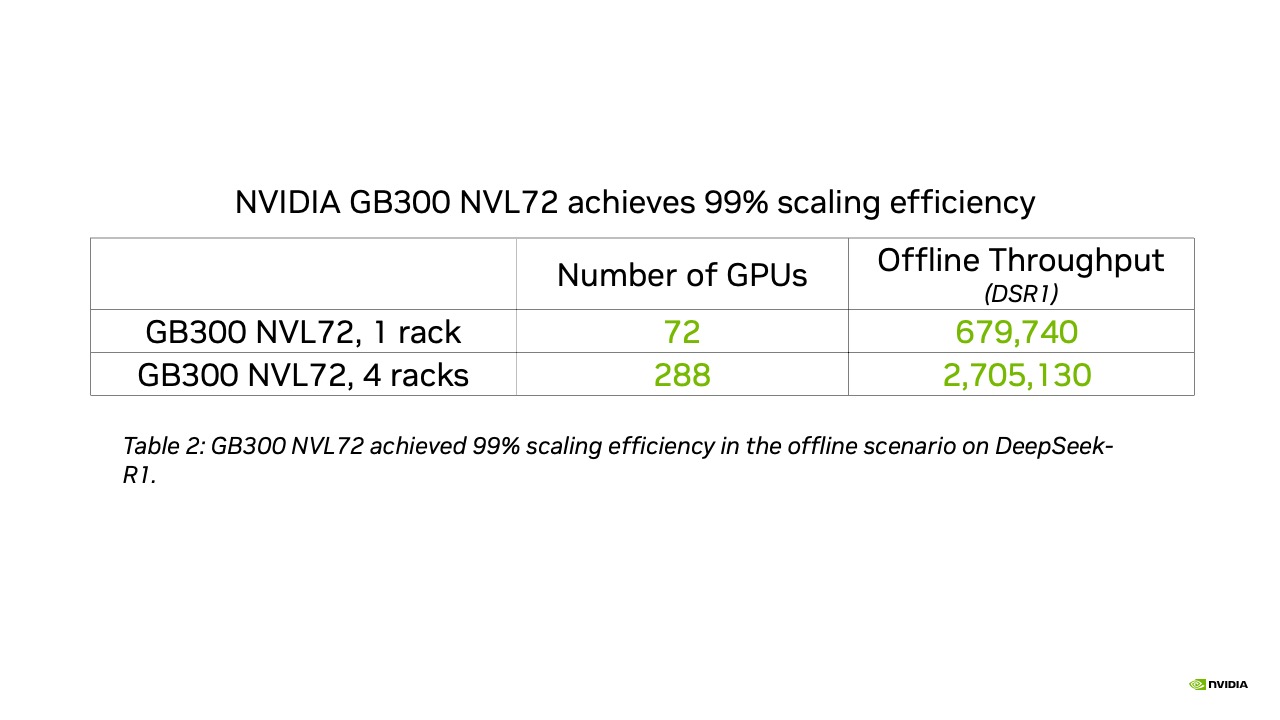
NVIDIA addressed this challenge head-on during the MLPerf Inference v6.1 evaluations, showcasing exceptional scaling capabilities with the GB300 NVL72 platform. In rigorous testing on the DeepSeek-R1 benchmark, a single GB300 NVL72 rack comprising 72 GPUs was scaled horizontally across a four-rack configuration containing a total of 288 GPUs. The system achieved a remarkable 99% scaling efficiency in the offline scenario, proving that throughput grows almost perfectly in proportion to the added hardware resources.
This architectural mastery extended to demanding video generation workloads as well. On the WAN 2.2 text-to-video benchmark, the GB300 NVL72 achieved rack-scale efficiency metrics of 0.65 high-definition 720p videos per second, maintaining an average rendering latency of just 5.7 seconds per video. This performance represents a ninefold increase in throughput and a 7.5-fold latency reduction compared to a single-node configuration, illustrating the profound benefits of integrated rack-scale networking.
The Evolution of Agentic AI and Dynamic Workloads
As artificial intelligence transitions from simple chat interfaces to autonomous AI agents capable of reasoning, planning, and executing multi-step workflows, the metrics used to evaluate inference performance must evolve accordingly. Traditional benchmarks that measure static token throughput per second are no longer sufficient to capture the computational nuances of agentic workloads.
Recognizing this paradigm shift, preview testing on advanced evaluation frameworks such as the SemiAnalysis AgentX benchmark revealed that the Vera Rubin NVL72 system delivered up to 30 times better performance than the GB300 NVL72. This quantum leap highlights the platform’s suitability for complex, multi-turn reasoning tasks that define the next frontier of enterprise automation. To standardize these measurements globally, upcoming industry evaluations such as the MLPerf Endpoints benchmark are expected to introduce standardized metrics specifically designed to capture the unique operational demands of agentic inference.
Continuous Software Optimization and Ecosystem Collaboration
Hardware is only as capable as the software stack running upon it. NVIDIA’s commitment to continuous software optimization was prominently displayed in the v6.1 submission cycle, where GB300 NVL72 performance on the Qwen3-VL benchmark improved by up to 1.6 times compared to previous v6.0 figures. These gains were unlocked through progressive optimizations, including lower KV cache precision modes, advanced kernel fusion techniques, improved hardware kernels, and refined disaggregated serving architectures enabled by vLLM and NVIDIA Dynamo.
Significantly, software enhancements have continued to compound even after the official MLPerf submission deadline. Unverified post-submission benchmarks targeting massive architectures such as the GPT-OSS-120B language model and the DLRMv3 recommendation model demonstrate further performance headroom, signaling that enterprise customers will continually extract more value from their hardware investments over time.
This technological momentum is strongly supported by a vast, rapidly mobilizing partner ecosystem. A total of 19 prominent technology vendors and cloud service providers participated in the MLPerf Inference v6.1 evaluation cycle, with eight specifically showcasing deployments on multi-node Blackwell NVL72 infrastructure. The participating ecosystem includes industry leaders such as ASUS, Microsoft Azure, Cisco, CoreWeave, Crusoe, Dell Technologies, Fujitsu, Giga Computing, Hewlett Packard Enterprise (HPE), Inventec, Lambda, MiTAC Computing, Nebius—which also submitted independent Vera Rubin NVL72 preview results demonstrating stellar performance—Oracle Cloud Infrastructure, Quanta Cloud Technology, Red Hat, ScitiX, Supermicro, and Wiwynn.
Broad Implications for the Global AI Economy
The release of the MLPerf Inference v6.1 results, anchored by the preview of the Vera Rubin architecture and the scalable efficiency of the Grace Blackwell platform, marks a pivotal maturation phase for the global artificial intelligence market. By systematically addressing the economic realities of inference—namely power consumption, capital expenditure per token, and architectural fungibility—NVIDIA continues to set the benchmark for enterprise-grade AI infrastructure.
From compact, edge-native deployments utilizing platforms like the Jetson AGX Thor running TensorRT Edge-LLM on edge-agentic benchmarks, up to massive, hyperscale AI factories housing hundreds of interconnected server racks, the industry is moving toward a future defined by ubiquitous, high-speed intelligence. As organizations worldwide race to deploy autonomous agents and complex multimodal applications, the combination of aggressive hardware co-design, annual architectural cadences, and continuous software refinement ensures that enterprise AI will remain both economically viable and technologically limitless.
Related posts: