The Shrinking Premium: Why the Pay Gap Between Private Equity-Backed CEOs and Independent Peers is Collapsing

For decades, the private equity (PE) model has been built on a seductive value proposition: CEOs are invited to trade the relative stability of a traditional corporate role for the high-octane demands of a PE-backed environment, in exchange for the promise of outsized financial rewards. Historically, this meant a significant premium on total compensation, often double that of a typical private-company executive. However, new longitudinal research from Chief Executive Group indicates that this lucrative gap has undergone a structural contraction, leaving industry observers to question whether the traditional incentives of private equity remain as compelling as they once were.
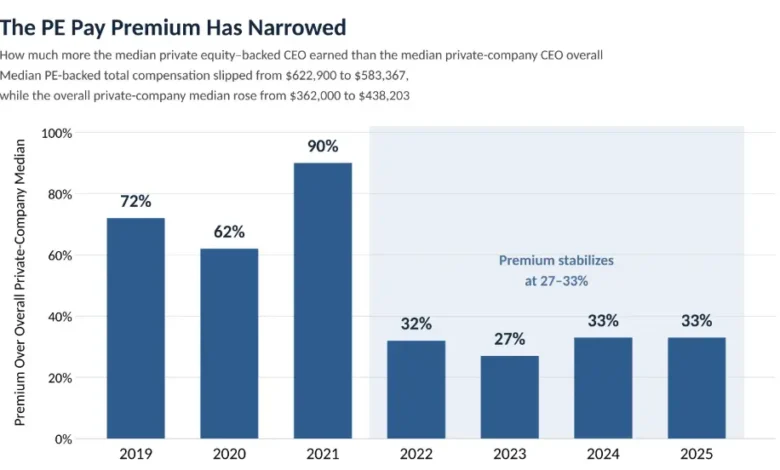
The data, spanning seven years of annual surveys of U.S. private companies from 2019 through 2025, reveals a stark transformation in the economics of executive leadership. In 2019, the median CEO of a PE-backed firm commanded a 72 percent premium over their counterparts at independent private companies. By 2025, that figure had plummeted to a mere 33 percent. This shift is not merely a statistical anomaly but a reflection of a maturing market, changing compensation structures, and a recalibration of how value is created and distributed in the shadow of institutional ownership.
A Chronology of Compensation Volatility
To understand the current state of executive pay, one must look at the turbulent trajectory of the last half-decade. The period between 2019 and 2025 serves as a microcosm of the broader macroeconomic shifts that have defined the post-pandemic era.
In 2019, the median PE-backed CEO earned $622,900 in total compensation, a substantial step up from the $362,000 median for the broader sample of U.S. private firms. As the global economy entered the volatility of 2020, the premium remained robust at 62 percent. However, the true outlier year was 2021. As the economy roared back from initial lockdowns, transaction activity surged and valuations soared. In that year, the median PE-backed CEO compensation climbed to $844,500, while the overall sample median sat at $445,000, driving the premium to a staggering 90 percent.
The correction arrived in 2022. As interest rates rose and the era of "cheap money" began to fade, deal flow slowed and valuation multiples compressed. Median compensation for PE-backed CEOs dropped to $546,000, bringing the premium down to 32 percent. Since that reset, the landscape has remained remarkably consistent: the premium held at 27 percent in 2023, before stabilizing at 33 percent in both 2024 and 2025. This relative stagnation suggests that the "COVID-era" spike was a transient phenomenon driven by specific market conditions, rather than a permanent change in base salary structures.
The Anatomy of Executive Compensation
The complexity of these figures lies in the composition of executive pay. Total compensation is rarely a simple function of base salary. Instead, it is a multi-layered package comprising base pay, annual performance bonuses, benefits, perks, and—most significantly—equity grants and appreciation.
The narrowing gap is particularly notable because it persists even when analysts control for equity gains. This suggests that the decline in the premium is not solely a result of market-driven fluctuations in stock value, but a strategic shift in how PE firms structure their packages. In previous years, PE firms used heavy equity incentives to attract top-tier talent, essentially gambling on aggressive growth targets. Today, the focus has shifted toward operational efficiency and cash flow, leading to more conservative compensation designs.
Furthermore, the "PE premium" has historically been used to compensate for the higher personal risk assumed by a CEO under private equity ownership, where firms often operate under shorter timelines and higher leverage. As the gap narrows, the risk-reward ratio for prospective CEOs is being fundamentally recalculated. If the premium is lower, the professional risk must either be lower as well, or the "upside" potential must be communicated more transparently to remain a competitive offering for top-tier leadership.
Market Implications and Future Outlook
The narrowing gap raises a critical question for both sponsors and potential candidates: Is the current compensation model sufficient to attract the caliber of leadership required to drive transformation in an increasingly difficult economic climate?
Investment analysts suggest that we are entering a phase where the "total value proposition" is becoming more important than the headline compensation figure. For a CEO, the prospect of managing a company through a successful exit, or a "second bite of the apple" through equity participation, remains a powerful motivator. However, if the annual premium over traditional roles continues to hover near the 30 percent mark, the talent pool may become more selective.
"It is no longer just about the paycheck," says one industry analyst who tracks executive pay trends. "The modern CEO is looking at the path to liquidity, the quality of the management team, and the operational support provided by the PE sponsor. If the cash compensation isn’t significantly higher than a standard corporate role, the PE firm must prove that the equity component is not just theoretical, but a realistic path to generational wealth."
Strategic Shifts for Private Equity Firms
For PE firms, the narrowing premium suggests a need for a communication pivot. If they cannot compete on raw salary numbers against an increasingly competitive market for talent, they must focus on the "incentive value." This involves:
- Alignment of Outcomes: Ensuring that executive rewards are tethered to specific, achievable business milestones that demonstrate value creation, rather than arbitrary market conditions.
- Transparency in Equity Modeling: Providing candidates with clearer simulations of how different exit scenarios—from IPOs to trade sales—will impact their personal net worth.
- Operational Support as a Benefit: Marketing the "PE advantage" not as a higher salary, but as an environment where the CEO is provided with the best resources, consultants, and technological tools to succeed in their career.
A New Era of Executive Leadership
The data from Chief Executive Group Research serves as a bellwether for a broader shift in corporate governance. The era of the "excessive" premium, characterized by the 2021 surge, appears to be firmly in the rearview mirror. We are moving toward a more disciplined, perhaps more sustainable, approach to executive compensation.
While the PE-backed CEO still earns significantly more than the average private-company leader, the advantage is no longer a given. For the current cohort of leaders, the goal is shifting from maximizing annual income to optimizing for the "value creation" phase of the investment lifecycle. As companies continue to navigate high interest rates and cautious consumer spending, the PE model will need to prove that its value is found in the growth of the business, not just the structure of the paycheck.
As the industry moves into the latter half of the decade, the focus for both boards and executive search firms will be on long-term sustainability. If the compensation premium continues to compress, we may see a shift in the profile of the "ideal" PE CEO—perhaps moving away from high-priced veterans seeking a quick win, toward younger, highly-driven leaders looking for the operational experience that only a PE-backed environment can provide.
Ultimately, the narrowing gap is not necessarily a signal of a failing model, but a maturing one. The market is finding a new equilibrium—one where compensation is more closely tied to the tangible value created within the four walls of the business, rather than the speculative value of a buoyant market. Whether this adjustment will satisfy the leadership requirements of the coming decade remains to be seen, but one thing is clear: the era of the automatic, massive premium is over.