The Great SaaS Divide: Why AI Agents Are Crushing Front-Office Valuations While Infrastructure and Usage Models Soar

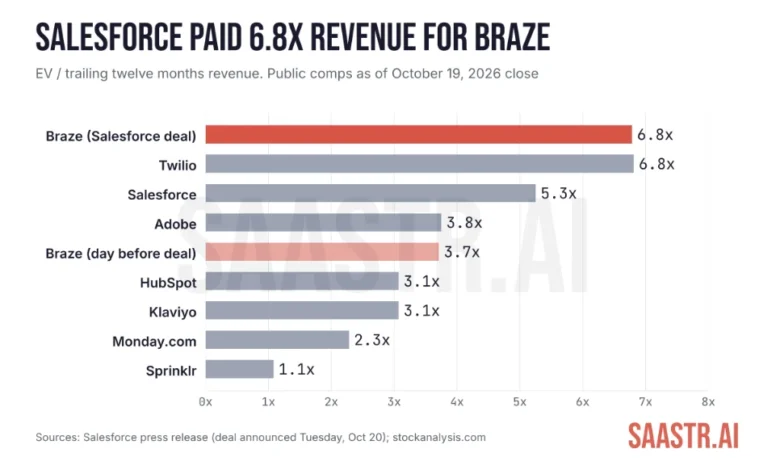
The modern software landscape is currently undergoing a profound structural bifurcation, one where the traditional metrics used to evaluate enterprise technology companies are being entirely rewritten by the advent of artificial intelligence. This divergence became glaringly apparent when enterprise software giant Salesforce announced its agreement to acquire customer engagement platform Braze for $5.66 billion, translating to roughly 6.8 times its trailing twelve months revenue. While a 6.8x multiple might sound like standard baseline activity across broader B2B technology sectors, within the context of go-to-market (GTM) and front-office software, the figure represents a staggering 58 percent premium over Braze’s closing price just days prior.
This multi-billion-dollar transaction brings into sharp focus a broader, underlying market malaise plaguing public front-office applications. While infrastructure, cloud data, and cybersecurity firms continue to command astronomical valuations—often trading well into the double digits—publicly traded GTM applications are increasingly languishing at a fraction of those multiples, despite frequently matching or exceeding the top-line growth rates of their infrastructure counterparts. Industry analysts, market observers, and software founders are now forced to confront a sobering reality: public equity markets are heavily discounting legacy front-office software, anticipating that the widespread adoption of AI agents will fundamentally cannibalize the traditional seat-based business models upon which these applications were built.
Evaluating the Market Disconnect: Growth Versus Multiples
To understand the sheer magnitude of the valuation gap, one must examine the valuation multiples across different sectors of enterprise software. When analyzing mid-October market closing prices, public GTM and front-office applications command a median enterprise value-to-trailing-revenue multiple of approximately 2.7x. Conversely, premier infrastructure and security darlings—such as Cloudflare, Datadog, and Snowflake—boost a collective median multiple hovering around 22.6x, representing an eye-watering eightfold valuation premium.
A superficial glance at these figures might lead observers to attribute the disparity entirely to growth differentials. After all, high-flying infrastructure companies frequently boast year-over-year revenue growth rates well into the mid-30s, outpacing the growth profile of typical front-office applications. However, a deeper dive into specific company performance reveals that growth alone cannot explain the chasm.
Consider a direct cross-sector comparison: Braze, Klaviyo, and cybersecurity titan CrowdStrike all reported matching year-over-year revenue growth rates of exactly 26 percent in their most recent quarters. Yet, the public markets price these entities on entirely different planets. CrowdStrike trades at an astronomical 42.6x trailing revenue, whereas Braze traded at a mere 3.7x prior to the Salesforce acquisition announcement, and Klaviyo hovers at a humble 3.1x. With identical growth metrics, the valuation delta—where CrowdStrike trades at more than 11 times Klaviyo’s multiple—comes down to investor sentiment regarding how artificial intelligence will impact each company’s total addressable market and revenue durability over a five-year horizon.
The Specter of the Debt-Laden Front Office: ZoomInfo as a Case Study
The valuation compression hitting front-office software is perhaps best exemplified by ZoomInfo, which fittingly trades under the stock ticker GTM. With a modest market capitalization of $1.14 billion and an enterprise value sitting at approximately $2.50 billion—inflated significantly by its corporate debt load—ZoomInfo generates roughly $1.26 billion in trailing revenue, resulting in an enterprise value-to-revenue multiple of just 2.0x. In this extreme instance, the total equity of a foundational market intelligence platform is being valued by the public markets at less than a single year of its generated revenue.
This compressed valuation reflects deep-seated investor skepticism regarding the sustainability of legacy database and contact-enrichment models. As automated workflows and AI-driven data sourcing become ubiquitous, the traditional mechanisms of selling static contact lists and company databases are facing an existential evolution. Public markets are pricing in structural headwinds long before they fully materialize on quarterly income statements.
The Mechanics of Disruption: Seats Versus Consumption and Usage
The root cause of the valuation penalty levied against GTM applications lies in a fundamental conflict between traditional software pricing architecture and the operational efficiency introduced by autonomous AI agents. The prevailing infrastructure and security architecture—exemplified by Cloudflare, Snowflake, and Datadog—operates on a consumption-based economic model. Every single API call executed by an AI agent, every gigabyte of data stored in a cloud data warehouse, and every security log generated is a billable event. Consequently, the proliferation of autonomous AI agents directly expands the top-line revenue of infrastructure providers. The exact same dynamic applies to cybersecurity: each newly deployed AI agent constitutes a distinct digital identity and endpoint that requires monitoring, authentication, and defense.
In stark contrast, the vast majority of legacy GTM and front-office applications monetize through a per-seat or per-contact licensing model. AI agents, by their very definition, are designed to eliminate manual toil and reduce headcount requirements. If an enterprise deploys an autonomous AI-powered sales development representative (SDR) that successfully shoulders the workload previously distributed among five human employees, the corporate buyer promptly scales back its software subscription, eliminating four lucrative user seats. Similarly, if an automated marketing agent independently drafts, personalizes, and optimizes cross-channel campaigns, the marketing department requires significantly fewer human operators logging into the platform daily.
This operational transformation is no longer theoretical; it is actively reshaping how modern technology companies operate. Organizations running lean, highly automated business models have demonstrated that massive revenue can be generated with a fraction of the historical headcount. For example, modern tech-enabled operations frequently run multi-million-dollar revenue engines utilizing only a handful of human supervisors alongside scores of specialized AI agents. These agents efficiently execute complex workflows without ever requiring a dedicated enterprise software seat. While this systemic shift has not yet fully devastated the reported revenue figures of established incumbents—evidenced by HubSpot posting a respectable 20 percent growth rate last quarter while trading at a modest 3.1x multiple—public market investors are proactively discounting future revenue streams they expect to evaporate as enterprise customers aggressively optimize their software stack.
The Exception That Proves the Rule: Usage-Based GTM Models
Not all front-office applications are treated equally by the public markets, and the market rewards structural departures from the traditional seat-based model. Twilio stands out as a prime example, trading at a robust 6.8x revenue multiple—outpacing even Salesforce’s valuation of Braze.

The underlying reason for Twilio’s superior multiple lies in its commercial architecture. While Twilio provides messaging and voice infrastructure that underpins many of the exact same customer engagement campaigns run through platforms like Braze and Klaviyo, Twilio charges strictly on a usage basis—per message sent and per minute consumed. If an autonomous AI agent initiates one million personalized customer outreach messages, Twilio captures one million distinct billable events. Conversely, if an AI agent optimizes campaigns on Braze or Klaviyo, the platform merely absorbs the efficiency gain, often resulting in compressed seat counts or flat contract values for the vendor.
Private Markets Versus Public Markets: The Premium on AI-Native Disruption
While public markets remain deeply skeptical of seat-based legacy applications, private equity investors and venture capitalists are aggressively pouring capital into the next generation of AI-native GTM startups at breathtaking valuations. This creates a fascinating dichotomy between public conservatism and private exuberance.
Private market transactions over recent months illustrate a profound willingness among institutional investors to pay massive premiums for companies built from the ground up to leverage AI workflows rather than human seats. Clay, a prominent go-to-market data and workflow automation platform, successfully raised capital at a staggering $7.1 billion valuation. With annualized revenue approaching $200 million, the private valuation sits at roughly 35 times revenue—more than ten times the multiple assigned to public incumbent HubSpot.
Other venture-backed AI pioneers have commanded even more dramatic pricing. Sierra, an enterprise conversational AI platform, secured funding at a $15.8 billion valuation against roughly $150 million in annual recurring revenue (ARR), representing a multiple exceeding 100x. Similarly, emerging enterprise sales and agentic platforms like Rox and Monaco have commanded valuations exceeding 150x their baseline ARR during early financing rounds. Competitors such as Profound, which helps brands optimize their visibility within generative AI search results, command heavy venture backing in a budget category that literally did not exist two years ago.
Crucially, none of these high-flying private startups rely on human seat licenses for monetization. Clay sells data orchestration pipelines that human operations teams and autonomous agents execute in tandem. Sierra monetizes entirely on a consumption model based on successful customer conversations resolved. Rox and Monaco are explicitly engineered around autonomous agents executing the sales lifecycle. Investors are unequivocally signaling that they are not avoiding the GTM category as a whole; rather, they are actively fleeing legacy, seat-constrained GTM software while aggressively funding the agentic disruption poised to replace it.
Strategic Acquirers Step In: The M&A Arbitrage Opportunity
With public market valuations for front-office software compressed to a modest 2x to 3x trailing revenue, traditional initial public offerings (IPOs) have largely ceased to be an attractive or viable exit mechanism for mature software companies. Instead, well-capitalized strategic acquirers and private equity firms have stepped into the vacuum, recognizing a lucrative arbitrage opportunity.
Salesforce’s acquisition of Braze at 6.8x trailing revenue—representing nearly double its unaffected market price—underscores the strategic value legacy enterprise titans place on established customer footprints. Alongside the Braze transaction, Salesforce has actively pursued an aggressive M&A strategy throughout the year, announcing targeted deals for Contentful, m3ter, Fin, Listen Labs, and Loops.
For strategic giants like Salesforce, valuing an asset like Braze purely on its standalone public revenue multiple misses the broader strategic picture. Braze provides direct access to thousands of enterprise brand relationships into which Salesforce can aggressively cross-sell its proprietary Data 360 and Agentforce ecosystems. To a strategic buyer possessing a massive distribution engine, a cash-flow-positive company growing at 26 percent and trading at a suppressed multiple represents an exceptionally compelling acquisition target. Industry analysts widely anticipate a wave of similar consolidation moves as enterprise software behemoths weaponize their balance sheets to absorb undervalued front-office assets.
Strategic Implications and the Path Forward for GTM Founders
The structural repricing of the front-office software sector serves as an urgent strategic warning bell for software founders and executive leadership teams navigating the artificial intelligence transition. To survive and thrive in a market dominated by autonomous agents, founders are being forced to rethink fundamental operational and financial models.
First, software architects must aggressively transition away from antiquated per-seat pricing models toward consumption- or outcome-based monetization frameworks. As demonstrated by the valuation divergence between Twilio and traditional marketing automation platforms, revenue tied directly to agentic activity—such as per-message, per-call, or per-resolved-outcome charges—insulates a business from the headcount reductions driven by AI efficiency gains. When AI agents successfully shrink customer headcount, revenue models tied directly to that headcount inevitably decline.
Second, transparency in financial reporting regarding artificial intelligence adoption is becoming paramount. Historically, AI monetization efforts have been quietly bundled into overall top-line growth metrics, making it difficult for public market analysts to accurately assess the velocity of new product lines. Establishing clear, distinct SKUs for AI-driven capabilities allows management teams to explicitly report attach rates, deal size uplifts, and direct contributions to quarterly growth, helping to bridge the valuation gap between traditional software and AI-native disruptors.
Ultimately, the software sector is moving past the initial panic of technological displacement and entering a phase of ruthless economic rationalization. As public and private markets continue to reallocate capital based on how software creates value in an agent-driven world, the traditional enterprise software playbook will require complete rewriting. Founders who successfully adapt their pricing structures and embrace agentic workflows stand to capture outsized rewards, while those clinging to legacy seat-based models risk being permanently priced out by the market.