Amazon Bedrock AgentCore Launches Web Answer to Streamline Real-Time AI Fact Retrieval

The landscape of enterprise artificial intelligence is undergoing a significant shift as Amazon Web Services (AWS) announces the general availability of Web Answer on Amazon Bedrock AgentCore. This new capability represents a departure from the conventional, labor-intensive pipelines developers previously relied upon to provide AI agents with real-time, grounded information. By collapsing the complex stages of web search, result curation, content synthesis, and citation mapping into a single, managed tool call, AWS aims to solve the persistent challenges of hallucination, stale data, and broken attribution that have hindered the deployment of reliable AI agents in production environments.
The Evolution of Agentic Retrieval
For years, organizations building AI agents—software entities capable of autonomous decision-making and task execution—have faced a recurring architectural bottleneck. To ensure an agent provides current, accurate information, developers had to construct a multi-step "retrieve-then-synthesize" pipeline. This typically involved calling external search APIs, evaluating the credibility of diverse web sources, cleaning unstructured HTML data, and engineering complex prompts to ensure the model could trace its reasoning back to specific URLs.
The operational overhead of this process was substantial. Each link in the chain—search, retrieval, cleansing, and synthesis—introduced a potential point of failure. If the search index returned irrelevant data, the model might hallucinate. If the web page structure changed, the retrieval script would break. Most importantly, ensuring that a claim remained anchored to its source document required sophisticated engineering that often drifted as models updated or sources shifted.
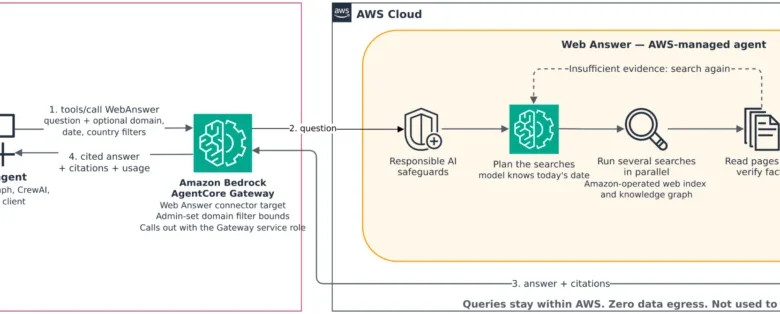
Web Answer addresses these pain points by offloading the entire pipeline to a managed service. When an agent submits a natural-language query to the AgentCore Gateway, the service takes over the planning and execution of parallel web searches. It reads, verifies, and reconciles facts across multiple high-authority sources before returning a response that includes explicit citations. This transition from "DIY pipeline" to "managed service" signifies a maturation in how enterprise-grade AI handles external knowledge.
Chronology of the Development
The path to this release reflects the broader trajectory of AWS’s investment in generative AI. Following the introduction of Amazon Bedrock in 2023, which provided a foundational service for building generative AI applications using top-tier foundation models, the company identified a critical need for agents to operate with "live" information.
By early 2026, the focus shifted from simple model invocation to the orchestration of agentic workflows. Throughout the middle of 2026, AWS began stress-testing the AgentCore architecture, a framework designed to handle the secure, scalable routing of requests between agents and enterprise tools. The beta phase for Web Answer focused on refining the "grounding" mechanism—the process by which the model identifies and confirms the veracity of claims against live internet data. The official launch today marks the culmination of these efforts, moving from a specialized internal tool to a standard feature for all Bedrock AgentCore users.
Supporting Data and Technical Implementation
The mechanism behind Web Answer relies on an orchestration layer that automates the "agentic search" pattern. When a request is made, the Gateway authenticates the user via AWS Identity and Access Management (IAM) or JSON Web Tokens (JWT). The system then initiates multiple parallel searches to diversify the evidence base. Unlike a standard search engine result page (SERP), Web Answer evaluates the content on key pages for factual consistency. If the initial evidence is insufficient to answer the query with high confidence, the system automatically triggers secondary, deeper searches.
From a technical perspective, the tool is integrated via the Model Context Protocol (MCP). This standard allows the agent to treat Web Answer as a native function. The response format is designed for machine-readability, providing both a markdown-formatted answer for the end-user and a structured JSON object for the developer. The JSON output includes the claim, the specific text supporting that claim, and the verified source URL. This granular control allows developers to build interfaces where users can hover over citations to see the source context, directly mitigating concerns regarding AI transparency.
Enterprise Control and Security
In the corporate sector, the utility of a tool is often secondary to its security posture. AWS has integrated Web Answer directly into the existing AgentCore security framework. This includes:
- Identity-Based Access: By leveraging IAM, organizations can restrict which agents or developers have permission to invoke the Web Answer connector.
- Domain Filtering: Administrators can define granular "include" or "exclude" lists for domains. This allows financial, legal, or medical institutions to ensure their agents only ingest information from trusted, pre-approved repositories, effectively creating a "walled garden" of search.
- Geographic Localization: Queries can be scoped to specific countries, allowing for region-specific accuracy—a critical requirement for multinational firms navigating different regulatory environments or local news cycles.
- Billing Transparency: Each call is billable at a rate of $10 per 1,000 requests, providing a predictable cost model that contrasts with the variable latency and resource consumption of self-managed scraping infrastructure.
Implications for the Industry
The shift toward managed, cited search tools like Web Answer has immediate implications for the broader AI development community. First, it lowers the barrier to entry for building high-quality, research-oriented agents. Developers no longer need to be search-engine experts to provide their models with accurate data.
Second, it standardizes the expectation for "citations" in AI. As users become accustomed to seeing verifiable links accompanying AI responses, the tolerance for non-cited, "black-box" answers is likely to diminish. This puts pressure on all AI platforms to prioritize provenance and transparency.
However, analysts note that while this simplifies the technical stack, it also consolidates control within the AWS ecosystem. By choosing Web Answer, developers are trading the flexibility of custom-built scrapers for the reliability and maintenance-free nature of a managed service. For most enterprise use cases, where uptime and accuracy are paramount, this trade-off is viewed as a significant net positive.
Broader Impact and Future Outlook
The deployment of Web Answer is likely to catalyze adoption across several knowledge-intensive industries. In the financial sector, analysts can use agents to quickly synthesize real-time Basel III compliance requirements or global market trends. In legal services, firms can utilize agents to cross-reference jurisdictional precedents.
Looking forward, the limitation of this service to the US East (N. Virginia) region suggests that AWS is in the early stages of a wider global rollout. As more AWS regions come online, the potential for localized, multi-lingual agentic search will grow.
The general availability of Web Answer on Amazon Bedrock AgentCore represents more than just a new API feature; it is an acknowledgment that the "plumbing" of AI—the messy, error-prone process of fetching and verifying information—is best handled by platforms rather than individual developers. By standardizing this layer, AWS is clearing the path for the next generation of agents to focus on high-level reasoning and complex decision-making, rather than the minutiae of web retrieval. As the technology reaches parity across global regions, the ability for enterprise agents to "know" the world with the same precision as a human researcher will likely transition from a competitive advantage to a fundamental operational expectation.