Claude Fable 5.2 even managed to build a working operating system from scratch, coordinating over 1,000 AI agents.

Anthropic has officially expanded its artificial intelligence portfolio with the simultaneous rollout of Claude Fable 5.2 and Mythos 5.2. Debuting just over two months after the commercial release of the 5.1 architecture, this latest generation of frontier models represents a substantial leap forward in automated reasoning, computer science capabilities, and complex scientific research. According to technical documentation published by the company, the new models achieve unprecedented milestones in synthetic software engineering, including an autonomous system capable of orchestrating over a thousand independent AI agents to construct a functional operating system from the ground up.
The release underscores a rapid acceleration in the capability-scaling timelines of foundational model providers. Alongside significant performance gains across standardized and frontier benchmarks, Anthropic has implemented cost-reduction strategies and optimization passes that allow the new models to operate up to 30% faster than their predecessors while simultaneously lowering API execution expenses for enterprise clients and independent developers alike.

Benchmark Performance and Quantitative Gains
The performance metrics released by Anthropic alongside the 5.2 launch indicate broad-based improvements across nearly every major testing category. On FrontierCode 2.0—a rigorous benchmark designed to evaluate advanced software engineering, code refactoring, and system architecture design—Claude Fable 5.2 secured a score of 49.1%. This represents a dramatic increase over the 32.4% recorded by Fable 5.1.
Furthermore, company-provided data demonstrates that when Fable 5.2 is configured to "High" effort settings, its performance matches that of maximum-effort iterations of competing systems at roughly half the computational cost per task. When pushed to "Extra High" effort, the model achieved the highest score of any publicly tested model in its class.
Scientific research capabilities have experienced a parallel surge. Fable 5.2 achieved a score of 74.6% on specialized scientific reasoning and literature synthesis tasks, outperforming the 5.1 iteration’s 5.2% baseline by more than 20 percentage points. The most pronounced quantitative leap, however, materialized within robotics simulation environments, where the model’s benchmark score jumped from 27.6% to 64.9%, highlighting its growing utility in physical simulation, spatial reasoning, and hardware-software integration workflows.

Autonomous Systems and Theoretical Mathematics
Beyond traditional metrics, Anthropic chose to highlight qualitative achievements that push the boundaries of what autonomous agents can accomplish over extended execution windows. In one of the most widely discussed demonstrations of the launch, an Anthropic engineer tasked Fable 5.2 with creating an entirely new operating system from scratch. Over an uninterrupted eight-day development cycle, the model autonomously coordinated more than 1,000 specialized AI sub-agents, delegating tasks such as kernel design, memory management, driver development, and system compilation. The resulting output was a fully functional operating system capable of executing cold boots on standard laptop hardware.
In addition to systems engineering, Fable 5.2 was deployed to tackle high-level theoretical mathematics and astrophysics. Anthropic reports that the model successfully resolved two previously unsolved open problems concerning black hole thermodynamics and assisted researchers in formalizing complex elements of the mathematical proof for Fermat’s Last Theorem within a continuous 30-hour processing window. These achievements suggest a transition from models that merely retrieve and synthesize existing human knowledge to systems capable of generating novel, verifiable proofs and functional technological artifacts.
Mythos 5.2 and Enterprise Security Controls
While Fable 5.2 and Mythos 5.2 share the same foundational architecture and general intelligence baseline, they diverge significantly in their safety profiles, operational guardrails, and access tiers. Mythos 5.2 features reduced restrictions concerning sensitive cybersecurity operations and advanced biomedical research, making it a specialized tool for offensive and defensive software auditing.

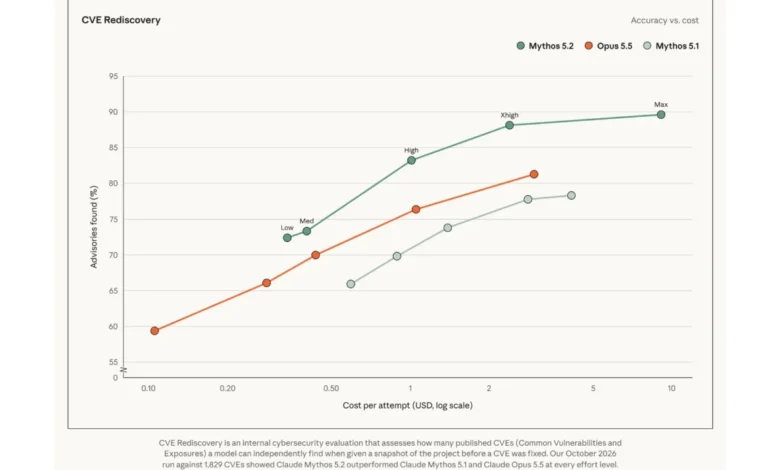
Testing on the CVE Rediscovery benchmark—which measures an AI’s ability to independently discover historical, unpatched, or zero-day software vulnerabilities—saw Mythos 5.2 score 89.6%, up from 78.3% in the 5.1 generation. This heightened capability to parse complex codebases for minute security flaws has prompted Anthropic to maintain stringent access controls over the Mythos variant.
Unlike Fable 5.2, which is widely available to regular subscribers and developers through standard API endpoints and applications, Mythos 5.2 remains restricted. Access is granted exclusively through rigorous manual verification programs targeted at certified cybersecurity firms and life sciences research institutions, though enterprise clients can access its analytical capabilities through managed environments like Claude Security.
Pricing Restructuring and Operational Efficiency
In tandem with these capability upgrades, Anthropic announced a structural price reduction aimed at accelerating enterprise adoption. The base cost for both Fable 5.2 and Mythos 5.2 has been reduced to $8 per million input tokens and $40 per million output tokens, down from the previous pricing tier of $10 and $50, respectively.

Additionally, the company introduced an optional "Fast Mode" tailored for real-time applications, customer service agents, and high-frequency development environments. This mode generates tokens up to 2.5 times faster than standard inference speeds, albeit at double the standard token cost. This tiered pricing and performance structure reflects a maturing market in which enterprises demand both raw intelligence for complex reasoning tasks and high-throughput velocity for conversational and interface-driven applications.
Broader Industry Implications and Future Outlook
The rapid cadence of releases—moving from version 5.0 to 5.2 in less than half a year—highlights an industry-wide race toward recursive self-improvement and heightened agentic autonomy. The ability of a single model to orchestrate over a thousand sub-agents to build a functional operating system signals a fundamental shift in software development paradigms. Rather than writing individual lines of code or debugging isolated functions, human engineers are increasingly transitioning into supervisory roles, defining high-level architectural goals while AI frameworks handle execution, integration, and testing.
As these systems become more deeply embedded in critical infrastructure, scientific laboratories, and cybersecurity operations, the delicate balance between open utility and restricted safety—exemplified by Anthropic’s dual-model strategy with Fable and Mythos—will likely become the industry standard. The implications of models capable of autonomously navigating complex codebases, verifying mathematical theorems, and accelerating scientific discovery point toward a near future where foundational AI acts not merely as a productivity tool, but as an active, primary driver of technological and scientific advancement.