Mastering the Dual-Channel Ecosystem: Why Modern E-Commerce Requires Synchronized Email and SMS Strategies

The modern digital marketplace has fundamentally transformed how commercial enterprises interact with their consumer bases, shifting from generalized broadcast messaging to hyper-personalized communication. When a consumer willingly relinquishes their mobile telephone number at a digital checkout counter or via a subscription pop-up, they are engaging in a transactional exchange that carries far more weight than a standard email opt-in. While an electronic mail inbox functions much like a public corridor—accessible to numerous correspondents and often requiring proactive retrieval—a mobile phone number represents an intimate digital threshold. It is tied to a device that typically rests near its owner throughout the day and night, accompanying them into professional meetings, personal gatherings, and moments of quiet repose.
Despite this profound psychological distinction, commercial founders and digital marketing executives frequently treat these distinct communication channels interchangeably. Industry practices often reveal a polarized approach: companies either broadcast identical messaging across both mediums simultaneously or over-rely on a single channel while allowing the other to remain dormant. Email is frequently favored due to its cost-effectiveness and structural familiarity, whereas SMS adoption is often driven reactively by competitive pressures and the allure of exceptionally high initial engagement rates. However, relying on a singular channel inevitably results in diminished return on investment and strains consumer goodwill. Integrating these mechanisms requires a sophisticated understanding of their distinct psychological and functional strengths to create a cohesive omnichannel marketing framework.
The Structural Divergence of Digital Channels
To construct an effective multichannel strategy, businesses must first recognize the fundamental behavioral differences inherent in electronic mail and short message service platforms. Email provides a spacious digital environment ideally suited for comprehensive narrative development. Brands can utilize this medium to articulate complex launch narratives, showcase products within lifestyle contexts, segment audiences based on historical purchasing behavior, and execute expansive campaigns at minimal incremental cost.
Nevertheless, email inherently suffers from latency. A commercial campaign typically arrives in an inbox already crowded with dozens of competing unread messages, remaining dormant until the recipient deliberately chooses to review their correspondence—an action that may occur hours later or not at all.
Conversely, SMS exhibits an entirely different operational dynamic. Text messages consistently achieve rapid engagement, frequently being opened within seconds or minutes of delivery, thereby cutting decisively through standard digital noise. However, the constraints of the medium are severe. Senders are typically limited to a fraction of a sentence with virtually no space for extensive explanations, and each broadcast incurs direct carrier costs. Over-utilizing SMS rapidly transforms a welcome brand touchpoint into an intrusive nuisance, accelerating subscriber fatigue and opt-out rates. Consequently, neither channel serves as an effective standalone solution; rather, their true efficacy emerges when their respective limitations are counterbalanced by the opposing medium.
Channel Taxonomy: Aligning Message Urgency with Platform Capability
Establishing an efficient operational rhythm requires organizations to categorize incoming messaging opportunities based on a singular, critical metric: temporal expiration. Determining whether information possesses a strict expiration timeline dictates its appropriate distribution channel.
Messages that maintain their relevance over extended periods are ideally routed through electronic mail. This category encompasses the introduction of new product collections, founder correspondence, educational guides designed to enhance product utilization, and slow nurture sequences engineered to warm cold prospect lists over several weeks. Such communications suffer no degradation in value if they arrive an hour later than anticipated and inherently require unhurried digital space for comprehensive reading.
In direct contrast, time-sensitive alerts demand SMS delivery. Examples include flash sales concluding at midnight, immediate notifications regarding restocked inventory items, and abandoned cart reminders initiated while purchase intent remains high. Such messages forfeit their entire commercial utility if delayed until the following morning. By enforcing this clear operational division, organizations prevent email and text channels from competing for redundant tasks. Email establishes the overarching brand narrative and deep consumer education, while SMS functions as a precision-targeted notification reserved strictly for urgent developments.
Sequential Deployment Versus Simultaneous Broadcast
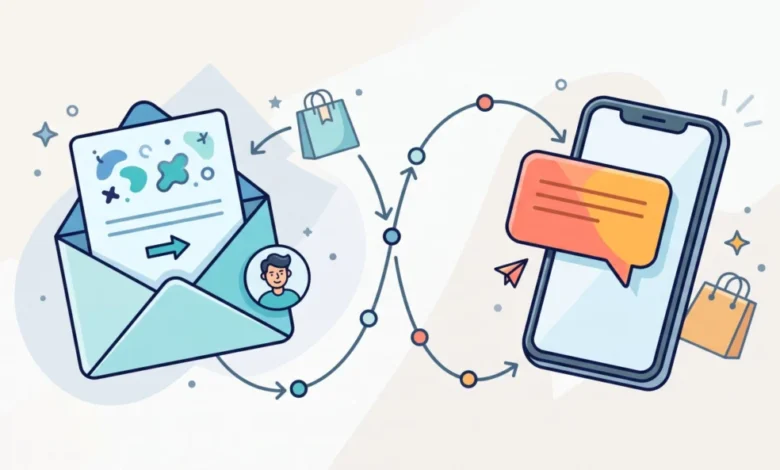
A prevalent operational error observed within automated marketing workflows is the simultaneous deployment of both email and text messages upon a single trigger event. Firing duplicate notifications across both channels at the identical moment fails to enhance conversion metrics, instead expending two distinct consumer touchpoints to deliver a single message. Industry best practices dictate a staggered, sequential approach.
Consider the standard consumer welcome sequence. Under an optimized protocol, electronic mail is dispatched initially to deliver a comprehensive brand introduction—detailing company origins, product categories, and introductory promotional incentives. If the recipient completes no purchase within a subsequent 24-to-48-hour window, a concise, single-segment text message is triggered to provide a gentle, frictionless reminder.
This sequential methodology applies equally to abandoned cart recovery frameworks. Initial electronic mail correspondence serves the heavy lifting phase by displaying specific abandoned items and providing direct navigational links back to the checkout portal. If the transaction remains incomplete several hours later, a brief SMS bridges the conversion gap while purchase motivation remains viable.
Back-of-house operational updates also benefit from strategic bifurcation. Shipping notifications, for instance, are successfully split between channels: an immediate SMS provides instant reassurance with a concise "your order is on the way" dispatch, while full tracking documentation and logistics manifests reside within a supplementary email for future reference.
During high-volume commercial periods—most notably Black Friday and Cyber Monday (BFCM)—cadence adjustments are necessary. Electronic mail carries the primary weight of campaign buildup, promotional announcements, and narrative-driven discounting. Conversely, SMS is deliberately preserved for strictly time-critical milestones, such as the initial launch of sales and the final hours before expiration. Restricting text messaging to high-intent windows preserves subscriber goodwill throughout the most congested retail period of the calendar year.
Data Integration and Unified Platform Architecture
Executing this level of precision sequencing necessitates integrated marketing infrastructure. Relying on disparate software solutions to manage email and text messaging independently frequently results in synchronization failures, cross-channel messaging collisions, and fragmented customer profiles.
Modern enterprise marketing stacks increasingly leverage unified platforms—such as Omnisend—that consolidate email, SMS, and web push notifications within a single automation architecture. This integration allows complex workflows, such as welcome series and abandoned cart sequences, to transition seamlessly from email to text within a singular continuous timeline. Furthermore, centralized data systems ensure that behavioral segments derived from historical purchasing and browsing patterns inform both channels simultaneously, maintaining narrative coherence across all consumer touchpoints.
Market analysts note that organizations launching omnichannel automation frameworks frequently experience diminishing returns when attempting to build extensive campaign structures prematurely. Industry recommendations advise initiating operations with two foundational workflows: the welcome series and the abandoned cart recovery sequence. The welcome series capitalizes on peak initial interest immediately following registration or initial purchase, establishing long-term brand affinity. Simultaneously, abandoned cart automation recovers substantial revenue from prospective buyers whose transactions stalled at the final operational stage.
Once these baseline sequences are optimized and generating consistent revenue, organizations can incrementally expand their automation architecture to include back-in-stock alerts and advanced post-purchase nurture streams.
Consumer Consent, Regulatory Compliance, and Restraint
The integration of SMS marketing into a commercial strategy introduces heightened responsibilities regarding consumer consent and regulatory compliance, governed by legal frameworks such as the Telephone Consumer Protection Act (TCPA) in the United States and international privacy regulations including GDPR.
Unlike email, where excessive message frequency is frequently mitigated by passive deletion or automated filtering, SMS intrusion carries immediate negative consequences. A text message arriving late at night or exceeding reasonable frequency caps frequently prompts immediate opt-out actions. Once a consumer unsubscribes from an SMS list, the brand loses its most immediate and effective conversion channel.
Consequently, industry professionals emphasize that modern consumer consent must be treated as a finite, highly valuable asset. Mandates for sustainable SMS strategies include:
- Maintaining explicit, unambiguous opt-in mechanisms during data collection.
- Ensuring the opt-out process requires no more than a single keystroke or keyword response.
- Strictly respecting geographic time zones to prevent notifications during standard quiet hours.
- Regularly purging disengaged subscribers to maintain list quality and prevent carrier-flagged spam classifications.
Strategic restraint ultimately dictates long-term campaign viability. Maintaining a smaller, highly targeted SMS list comprising genuinely engaged consumers delivers superior financial performance compared to an inflated database characterized by high opt-out rates and consumer fatigue.
Broader Industry Implications and Future Outlook
As consumer expectations regarding digital personalization continue to evolve, the distinction between invasive commercial messaging and welcome brand communication will narrow further. The successful integration of electronic mail and short message service marketing represents a broader shift toward disciplined, data-driven customer relationship management.
By respecting the psychological boundaries of personal communication devices and establishing rigorous operational rhythms, enterprises can maximize revenue generation without compromising consumer trust. Omnichannel marketing, when executed with structural precision, transitions from a generalized broadcast tactic into a refined, harmonious discipline—ensuring that every digital touchpoint serves a distinct, purposeful function within the consumer journey.
Related posts: