What is a ROM estimate and how it serves as a cornerstone for project financial planning


In the complex environment of corporate project management, the ability to forecast resources and financial requirements before a project scope is finalized is a critical, yet notoriously difficult, competency. Among the various methodologies employed, the Rough Order of Magnitude (ROM) estimate stands as the primary tool for high-level decision-making. Unlike a definitive budget, which relies on granular, bottom-up data, a ROM estimate provides a strategic, top-down approximation designed to guide stakeholders through the initial phases of project initiation.
Understanding the Role of ROM in Strategic Planning
The fundamental purpose of a ROM estimate is to determine project viability before significant capital or human resources are committed. In many organizational structures, an executive sponsor or steering committee requires a preliminary financial "ballpark" to authorize a business case. At this early stage, the project team rarely possesses the comprehensive requirements, technical specifications, or vendor quotes necessary for a precise budget.

A ROM estimate bridges this information gap. By leveraging historical data from past projects, expert judgment, and analogous estimating techniques, project managers can present a reasonable cost and time range. It is essential to emphasize that a ROM is not a binding commitment. Instead, it is an informational document that acknowledges the high degree of uncertainty inherent in the early project lifecycle.
The Evolution of Estimating: From Approximation to Precision
The trajectory of project estimation typically follows an inverse relationship between time and uncertainty. At the inception of a project, uncertainty is at its peak, necessitating a wide margin of error—historically cited by the Project Management Institute (PMI) as ranging from -25% to +75%. As the project matures through the planning and design phases, the accumulation of detail reduces this range.
The chronology of a standard project financial lifecycle generally proceeds as follows:

- Initiation/Conceptualization: The ROM estimate is produced to validate the concept and secure initial funding.
- Planning/Refinement: As the work breakdown structure (WBS) is defined, the ROM is replaced by more accurate "budgetary" or "definitive" estimates.
- Execution/Baseline: Once all requirements are finalized and supplier contracts are signed, the project shifts to a fixed-cost baseline.
Data-Driven Approaches and Methodology
To construct a credible ROM estimate, project managers must avoid arbitrary guessing. Instead, they rely on a structured approach to decomposition. The process involves breaking the project into major work packages and assigning a relative effort level—often categorized as low, medium, or high—to each.
For instance, if a project involves software integration, the team might analyze the complexity of the API connections, the volume of data migration, and the number of end-user departments. By applying historical effort metrics to these categories, a total effort estimate is calculated. It is standard professional practice to add a contingency for project management overhead, typically ranging between 15% and 25% of the total labor hours, to ensure the estimate reflects the realities of coordination and communication.
Transparency and the Communication of Risk
One of the most significant pitfalls in project management is the presentation of a single-point estimate as a hard budget. A ROM must always be presented as a range to ensure transparency with stakeholders. For example, a project estimated at £1.2 million should be reported as £0.9 million to £2.1 million.
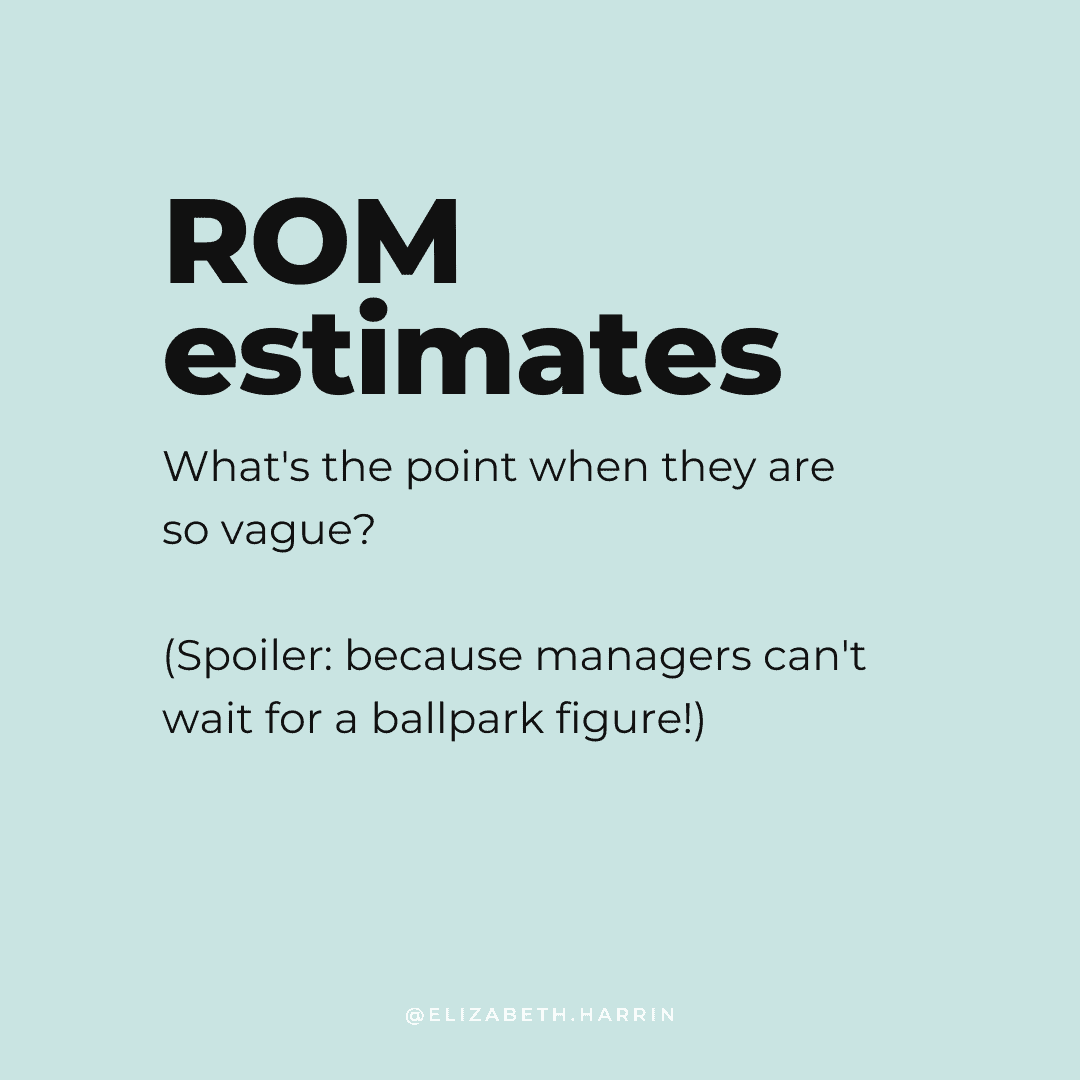
This transparency serves two purposes: it protects the project manager from being held to an unrealistic, single-number commitment, and it forces the steering committee to confront the risks and uncertainties inherent in the project’s early stages. The accompanying documentation must explicitly state the underlying assumptions—such as current market labor rates, hardware costs, and the stability of the project scope—as well as the primary risk drivers that could push the project toward the upper end of the range.
Comparative Analysis: ROM vs. Definitive Estimates
The distinction between a ROM and a definitive estimate is rooted in the level of detail available. A definitive estimate is a bottom-up calculation that utilizes specific quotes, finalized task durations, and verified resource costs. While it is the standard for execution, it is inappropriate for the initiation phase.
The following table summarizes the operational differences:

| Feature | ROM Estimate | Definitive Estimate |
|---|---|---|
| Phase | Initiation / Early Planning | Detailed Planning / Execution |
| Accuracy | Wide variance (-25% to +75%) | Narrow margin (+/- 5-10%) |
| Effort | Low (Top-down) | High (Bottom-up) |
| Purpose | Feasibility / Go-No-Go decision | Budget Baseline / Performance Tracking |
Practical Applications and Industry Standards
In industries such as construction, engineering, and software development, the ROM estimate is an essential tool for vendor management. When an organization puts out a Request for Information (RFI), they are effectively seeking a ROM quote from potential partners. This allows the client to determine if a vendor’s cost structure aligns with their internal expectations before entering the costly and time-consuming process of formal procurement.
However, the effectiveness of a ROM estimate diminishes in environments characterized by high repeatability. For projects where the organization delivers the same service or product repeatedly—such as standard IT infrastructure rollouts—the historical data is often precise enough that a "first-pass" estimate can skip the ROM phase and move directly to a more accurate budgetary model.
Managing Stakeholder Expectations and Revisions
A common misconception is that a ROM estimate is a static document. In reality, it is a living projection. As the project team transitions from initiation to planning, the ROM must be formally retired. Holding onto an early-stage ROM estimate during the execution phase is a primary indicator of poor project governance.

When revisions occur, they should be documented within the project’s RAID (Risks, Assumptions, Issues, Dependencies) log. Explaining why an estimate has changed is a critical component of stakeholder management. As uncertainty is systematically reduced, the "gap" in the estimate should shrink. If a project manager reports a -25% to +75% variance midway through the project, it signals a failure to capture requirements and mitigate risks, rather than a failure of the initial estimating technique.
Broader Implications for Project Governance
The effective use of ROM estimates ultimately reflects the maturity of an organization’s Project Management Office (PMO). Organizations that mandate rigorous, yet flexible, estimation standards see better financial performance. By institutionalizing the use of ranges and requiring explicit documentation of assumptions, firms prevent the "planning fallacy"—the cognitive bias where people underestimate the time and cost of tasks.
The integration of ROM into the organizational culture ensures that executives understand the difference between a high-level forecast and a contractual budget. It fosters a culture of accountability where project managers are encouraged to refine their data continuously. As the project lifecycle progresses, the shift from high-level estimation to precise financial control is the hallmark of professional project management, ensuring that resources are allocated efficiently and that project goals remain aligned with the organization’s overarching strategic objectives. In summary, while the ROM is an early-stage tool, its impact on the long-term health of a project is foundational, serving as the essential first step in a journey toward successful delivery.