ChartMogul Launches MRRaudit to Solve the Perennial Mystery of SaaS Billing Discrepancies

For as long as subscription-based software companies have tracked their financial health, a single, recurring question has echoed across boardrooms, sales calls, and customer support channels: "Why is my Monthly Recurring Revenue in ChartMogul different from what I see in my billing system?" This inquiry, deceptively simple on the surface, has served as a focal point of friction for thousands of Subscription-as-a-Service (SaaS) operators worldwide. The underlying challenge does not stem from software errors or calculation bugs, but rather from a fundamental divergence in how specialized analytics platforms and core payment gateways interpret financial events, edge cases, and transactional histories.
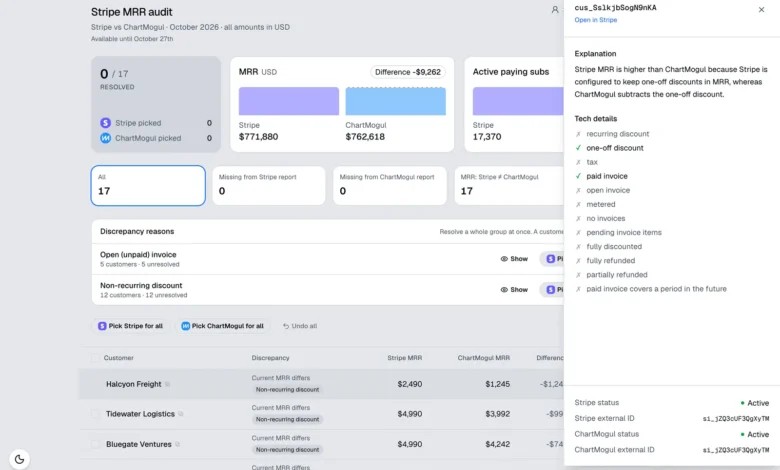
To address this industry-wide pain point, ChartMogul—a prominent subscription analytics and revenue management platform—has officially introduced MRRaudit, a specialized tool designed to automate the laborious process of reconciling discrepancies between Stripe and analytical reporting environments. Spearheaded by insights gathered from years of customer success and sales operations, the newly released utility aims to demystify financial data by tracing every statistical variance back to the specific customer, invoice, and subscription event responsible for the shift. By placing diagnostic capabilities directly into the hands of founders, finance teams, and operations managers, ChartMogul is seeking to eliminate manual spreadsheet audits and restore absolute confidence in recurring revenue metrics.
The Anatomy of a Discrepancy: Why Billing Systems and Analytics Engines Diverge
To understand the necessity of a tool like MRRaudit, one must examine the philosophical and technical differences between how billing gateways and revenue analytics platforms process data. Payment processors like Stripe are engineered primarily to execute transactions, collect funds, issue invoices, and manage payment lifecycle events such as card failures and retries. Their primary metric of concern is cash flow and transactional accuracy at the exact moment of charge.
Conversely, subscription analytics platforms like ChartMogul are designed to measure predictable, recurring revenue over time, adhering closely to recognized accounting standards such as ASC 606 or IFRS 15. This distinction creates inevitable friction when handling complex billing scenarios. For instance, consider a scenario where a customer misses a scheduled payment due to an expired credit card. A billing system might maintain an active subscription status while attempting retries for several days, whereas an analytics platform may apply churn rules immediately or after a defined grace period, temporarily removing that revenue from active MRR calculations.
Similarly, operational workarounds frequently introduce statistical gaps. If a sales team voids an automatically generated annual invoice to replace it with a customized, manually created one-off invoice, the payment gateway might register the modification as a completely separate event rather than a standard subscription renewal. Stripe might continue to report recurring revenue based on the original subscription metadata, while ChartMogul—detecting no matching recurring invoice pattern—reports zero. Other common culprits include partial month prorations, mid-cycle upgrades, retroactive discounts, usage-based billing spikes, and complex multi-tiered pricing exceptions.
Historically, resolving these discrepancies required hours of manual investigation. Sales and support representatives would collaborate with clients to compare systems side-by-side, tracing individual customer ledgers line-by-line to explain why a dashboard reported $50,000 in MRR while a payment gateway indicated $52,400. While this high-touch customer service built trust, it was inherently unscalable and placed a heavy operational burden on both SaaS providers and their subscribers.
The Evolution of Revenue Operations and the Genesis of MRRaudit
The launch of MRRaudit represents a maturation in the operational tooling available to modern digital businesses. Over the past decade, the proliferation of cloud-based software has made subscription models ubiquitous, extending far beyond traditional enterprise software to encompass media, e-commerce, consumer apps, and industrial IoT. As business models grew increasingly sophisticated—incorporating usage-based pricing, hybrid billing tiers, and bespoke enterprise contracts—the complexity of financial reporting scaled exponentially.
Companies routinely alter their pricing architectures, grandfather legacy clients onto legacy tiers, and offer customized discounts to secure enterprise logos. Over a span of three to five years, this accumulation of billing history creates a labyrinth of exceptions. When leadership demands an accurate, real-time assessment of Annual Recurring Revenue (ARR) or MRR for fundraising, board meetings, or strategic planning, finance teams frequently find themselves stymied by conflicting data points.
This exact vulnerability was highlighted by Elliott Fisher, Chief Operating Officer of Lavender, a leading sales email productivity platform. Reflecting on the difficulties his organization faced prior to adopting better auditing frameworks, Fisher noted the paralyzing effect of unresolved financial ambiguities. "Our CEO asked a simple question: ‘What’s our ARR?’ None of us could answer with confidence," Fisher explained. "We had to rebuild four years of Stripe invoice history from scratch. With MRRaudit, we could have found the differences ourselves in a fraction of the time and shown exactly what was behind the number."

The administrative overhead of conducting such forensic accounting manually prompted ChartMogul to productize its internal troubleshooting methodology. By building an automated parsing engine capable of ingesting raw data from Stripe and cross-referencing it against ChartMogul’s calculation logic, the company has transformed a reactive support workflow into a proactive, self-service utility.
How MRRaudit Functions: Transparency and Traceability at Scale
At its core, MRRaudit operates as a specialized diagnostic bridge between payment infrastructure and analytical reporting. Rather than forcing users to guess why two vital financial dashboards display conflicting metrics, the platform systematically ingests data from connected Stripe environments, analyzes the underlying subscription timelines, and groups any observed discrepancies by root cause.
The diagnostic output categorizes variances into clear, plain-language explanations. Whether a gap is driven by a failed payment, a credit note, a refund, a custom discount, or a timing mismatch in invoice generation, the user is presented with an itemized breakdown. Crucially, each identified difference links directly to the specific customer profile, invoice ID, and chronological subscription event that triggered the divergence.
This granular traceability allows financial controllers and operations leads to inspect the exact reasoning behind every cent of variance. For instance, if a variance analysis reveals that a cohort of twenty customers is showing up as churned in one system but active in another, the auditor can click through to view the exact webhook events, retry statuses, and invoice states associated with those specific accounts.
Furthermore, the developers of MRRaudit designed the platform with accessibility in mind. Organizations do not need to possess flawless historical data, nor are they required to maintain an active, enterprise-tier subscription to ChartMogul to begin utilizing the auditing framework. By lowering the barrier to entry, the tool aims to democratize financial transparency, enabling early-stage startups and enterprise corporations alike to audit their revenue pipelines with equal precision.
Broader Implications for the SaaS Industry and Financial Governance
The introduction of automated MRR auditing tools arrives at a critical juncture for the broader technology sector. In recent years, macroeconomic shifts have placed a renewed emphasis on capital efficiency, net revenue retention (NRR), and financial governance. Investors and venture capitalists no longer tolerate "fuzzy math" or unaccounted discrepancies in core SaaS metrics. Due diligence processes during fundraising rounds, mergers, and acquisitions routinely involve rigorous auditing of billing systems and revenue recognition practices.
When discrepancies exist between payment gateways and analytics suites, investors may question the reliability of a company’s financial reporting infrastructure. By automating the reconciliation process, tools like MRRaudit help eliminate ambiguities that could otherwise stall financial transactions or complicate audits.
Moreover, as regulatory scrutiny surrounding digital commerce and recurring billing practices intensifies—with consumer protection agencies increasingly monitoring subscription renewal and cancellation disclosures—maintaining pristine, auditable records of every customer billing event is no longer just a best practice for internal management; it is a vital component of corporate compliance.
By bridging the historic divide between transactional payment gateways and analytical revenue engines, ChartMogul’s MRRaudit signals a shift toward greater accountability and transparency in digital commerce. As SaaS companies continue to navigate increasingly complex pricing models, the ability to instantly trace, explain, and reconcile every dollar of recurring revenue will transition from a competitive advantage to an operational necessity.