Headless BPM vs traditional BPM: The architectural shift redefining enterprise automation

For over two decades, Business Process Management (BPM) has been synonymous with the "vendor-in-a-box" model. Organizations purchased suites that bundled modeling tools, task lists, and reporting dashboards into a single, closed interface. However, the rise of autonomous AI agents—such as Anthropic’s Claude, OpenAI’s ChatGPT, and xAI’s Grok—has rendered this traditional paradigm increasingly obsolete. The core distinction between headless and traditional BPM now centers on a singular, critical question: where does the process logic reside? In traditional models, it is buried within the user interface; in headless models, it is housed within an API-accessible engine, allowing software, scripts, and AI agents to interact with operations as seamlessly as human employees.
The evolution of process management
The history of BPM is a narrative of increasing digitization. In the late 1990s and early 2000s, BPM suites emerged to replace paper-based workflows with digitized forms and rigid routing rules. This was the era of the "human-in-the-loop" model, where every step of a process—from approval requests to data entry—required a human operator to physically interact with a screen.
By 2010, the industry began experimenting with mobile-responsive interfaces and basic REST APIs. Yet, these APIs were often "shallow." They allowed external systems to trigger a process start or retrieve a status report, but the fundamental business logic—such as field validation, conditional branching, and approval gates—remained hard-coded into the vendor’s proprietary front-end. This created a "screen-scraping" dependency; if an automated bot needed to interact with the system, it had to simulate human behavior, which was brittle, error-prone, and prone to breaking whenever the vendor updated their UI.
Traditional BPM: The limitations of the interface-centric model
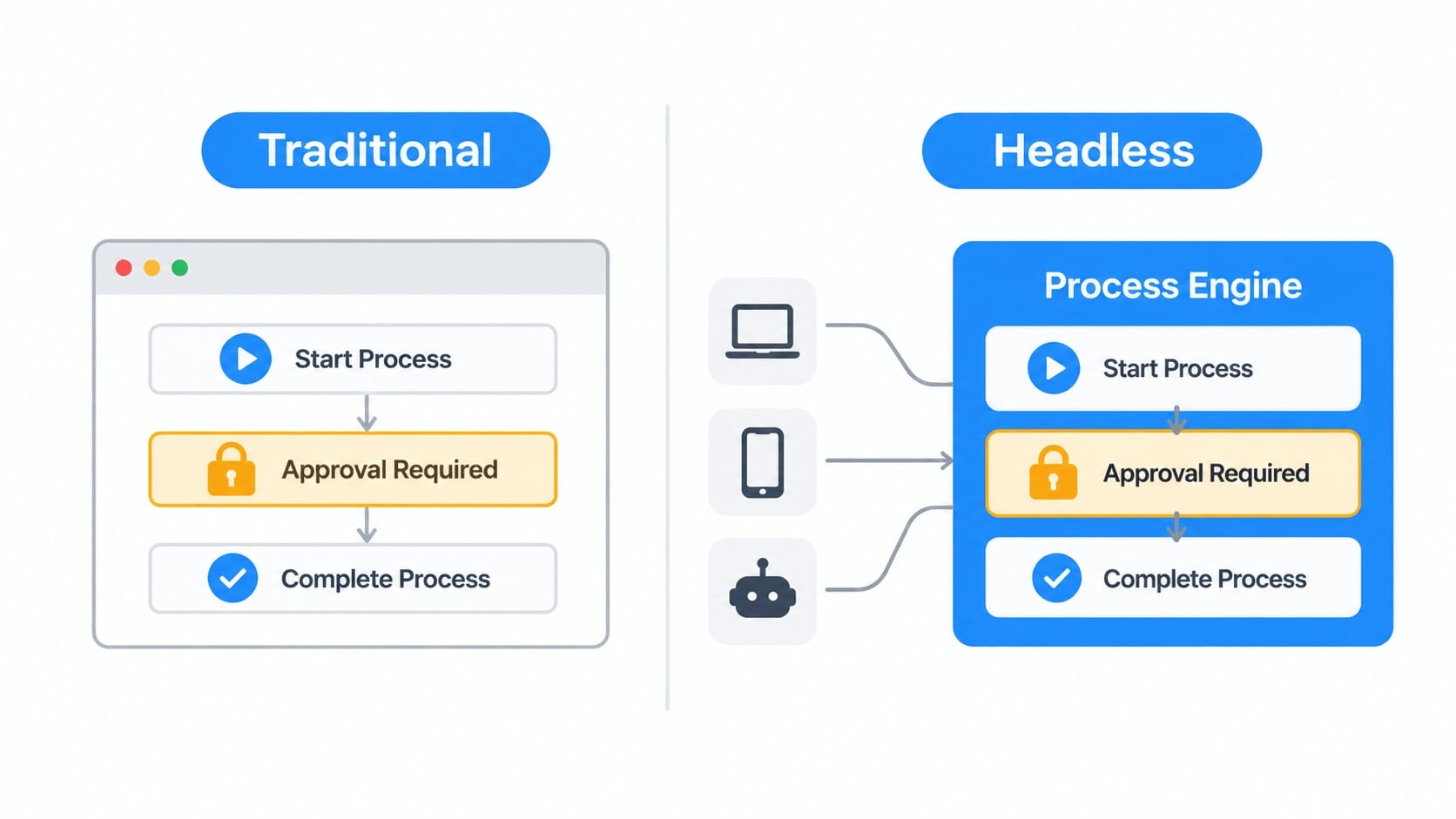
Traditional BPM software relies on a tightly coupled architecture. In this environment, the interface is not merely a tool for viewing data; it is the enforcement mechanism. For instance, if a process requires a manager’s signature, the software hides the "approve" button until the correct user is logged in.
While this model provides a streamlined experience for human workers, it creates significant friction for modern digital infrastructure. Research indicates that when business rules are trapped within a UI, integration costs rise by approximately 40% when companies attempt to scale automated workflows. Furthermore, traditional systems often struggle with "audit fragmentation." When an automated bot interacts with a traditional interface via browser automation, the audit logs often reflect the bot’s activity as a generic system user—or worse, as a human user—obscuring the true origin of the transaction. This lack of transparency is a major compliance risk for organizations operating in highly regulated sectors like finance or healthcare.
Headless BPM: The architectural decoupling
Headless BPM adopts the "headless" philosophy popularized by Content Management Systems (CMS) like Contentful or Strapi. By separating the process engine from the presentation layer, headless BPM transforms the process definition into structured, machine-readable data.
The transition to headless architecture is defined by four technical pillars:
- Data-Defined Processes: Workflows are stored as structured objects (e.g., JSON or XML) that can be programmatically parsed.
- Programmable Lifecycles: Every phase of a process, from initialization to archival, is controllable via API.
- Queryable State: The current status, history, and metadata of a workflow can be retrieved in real-time by any authorized client.
- Engine-Level Enforcement: Rules, permissions, and validation logic reside in the engine itself, ensuring that whether a request comes from a web browser or an AI agent, the outcome remains consistent and compliant.
The AI agent factor: Why the Model Context Protocol (MCP) matters
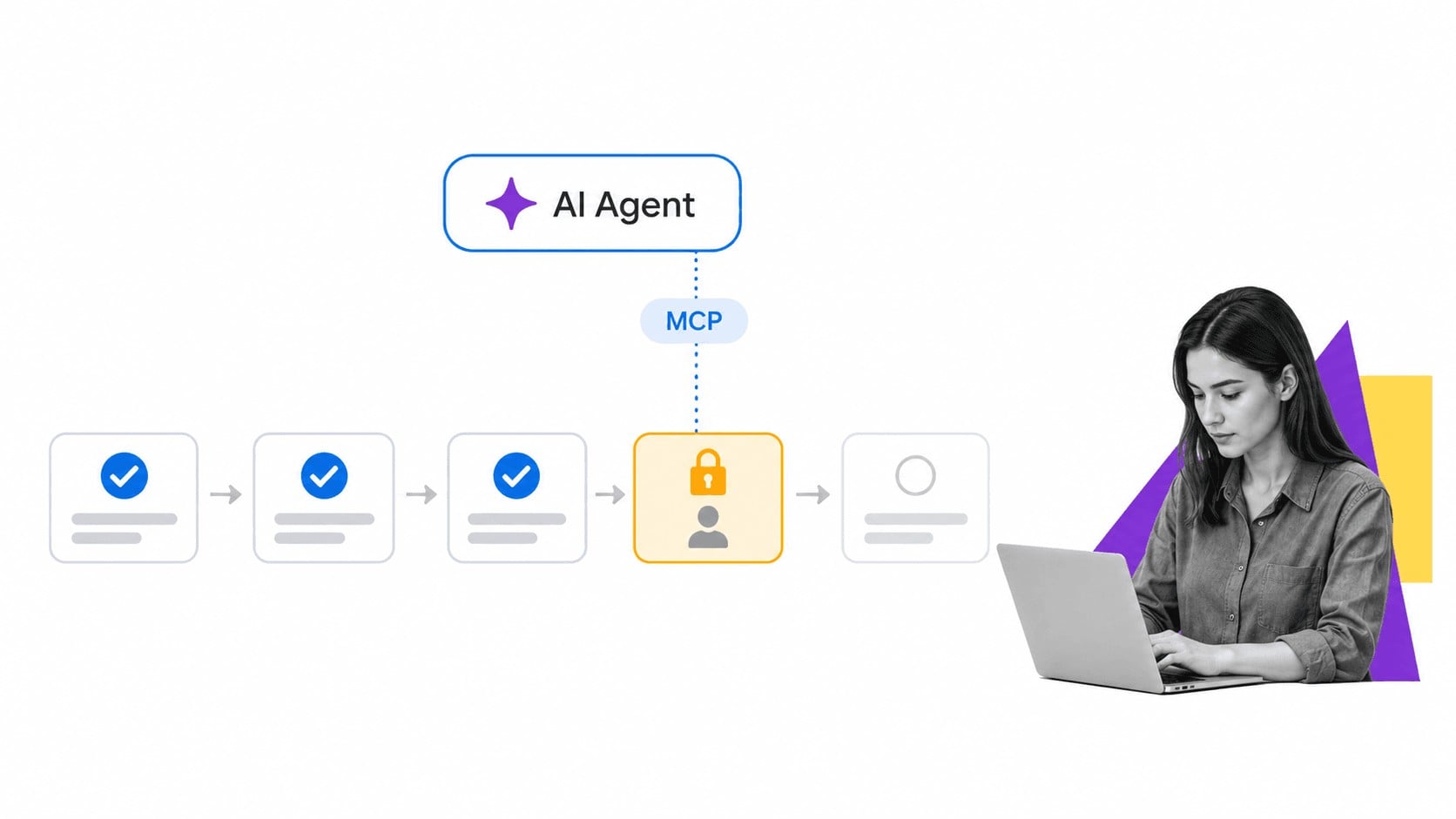
The emergence of the Model Context Protocol (MCP) has accelerated the adoption of headless BPM. MCP, an open standard developed to allow AI models to interact securely with local and remote data, serves as the bridge between large language models (LLMs) and operational backends.
In a traditional BPM setup, an AI agent lacks the "context" required to execute tasks. It cannot see the workflow map or the underlying logic; it can only "see" the pixels of a web page. Conversely, in a headless environment, an agent equipped with an MCP connector can query the engine directly: "What are the required fields for this step?" or "Is this request within the current spending limit?"
Industry analysts suggest that the integration of MCP-enabled headless BPM could reduce the "agent-to-task" failure rate by as much as 70%. When an AI agent can read the process definition as structured data rather than guessing at screen elements, it becomes a reliable, autonomous worker capable of executing complex multi-step processes with human-grade oversight.
Comparative analysis: The eight dimensions of evaluation
When assessing platforms, IT leaders and operations managers are increasingly using the following eight dimensions to determine if a system is truly headless or merely a traditional platform with an added API layer:
| Dimension | Traditional BPM | Headless BPM |
|---|---|---|
| Primary Interaction | Vendor-supplied screens | API-driven engine |
| Logic Location | Client-side (UI) | Server-side (Engine) |
| Audit Trail | Fragmented/UI-based | Unified/Machine-traceable |
| AI Readiness | Low (Browser automation) | Native (MCP/API) |
| Change Management | UI-heavy updates | Definition-level updates |
| Data Format | Proprietary/Black-box | Open/Structured |
| Client Flexibility | Fixed | Extensible |
| Compliance | Subject to UI bypass | Guaranteed by Engine |
Implications for the enterprise
The shift toward headless BPM is not merely a technical preference; it is a strategic imperative. As companies shift toward "agentic workflows," the ability to maintain a single source of truth for business rules is paramount.
For instance, consider an access review process. In a traditional suite, if an organization decides to change the approval threshold, IT must update the form in the designer, update the UI components, and potentially test the integration for any "hooks" that might have been broken by the change. In a headless environment, the rule is updated in the workflow definition once. The AI agent, the mobile app, and the web portal all receive the updated instruction simultaneously, ensuring that compliance standards remain uniform across every touchpoint.
When to choose which model
Despite the advantages of headless BPM, the traditional model remains relevant for specific use cases. Traditional suites are often highly effective for organizations with:
- Uniform Workforces: Companies where all employees perform the same tasks from identical workstations.
- Low Automation Requirements: Organizations where AI agents or custom programmatic integrations are not part of the operational roadmap.
- Turnkey Needs: Businesses that require a "ready-to-use" solution without the need for custom development or API orchestration.
Conversely, headless BPM is the superior choice for organizations experiencing "process fragmentation." Typical indicators include:
- Multi-Platform Work: The need for the same process to be executed via web, mobile, and automated backend services.
- AI Strategy: Active investment in AI agents for routine operations or customer support.
- Complex Compliance: A need for a single, immutable audit trail that captures activity from both human and machine agents.
The future of process orchestration
The industry is reaching a consensus: the user interface is no longer the control center of the enterprise. As AI agents become more prevalent, the value of a BPM platform will be measured by its "callability"—how easily a machine can query, execute, and monitor a process.
Platforms like Process Street are already positioning themselves at the forefront of this shift, offering MCP-ready servers that allow LLMs to interact with complex workflows out of the box. This reflects a broader trend toward "composable operations," where the process engine acts as a programmable backbone for the entire organization.
As businesses continue to navigate the complexities of digital transformation, the decision between headless and traditional BPM will define their agility. Choosing a headless engine ensures that when the next generation of AI agents arrives, the organization is ready to integrate them instantly, rather than being held back by the limitations of a legacy interface. The question for modern leaders is no longer how to digitize their processes, but how to ensure those processes remain accessible to the increasingly autonomous systems of the future.