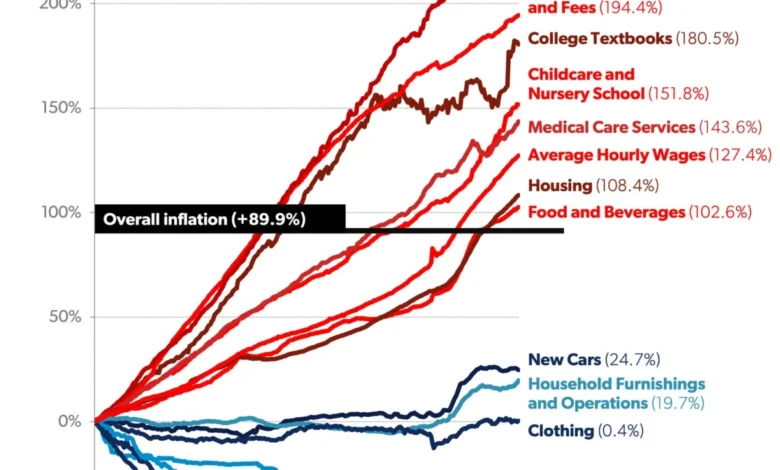
For the past several years, the global economy has operated under an implicit consensus: while the cost of essential goods—ranging from groceries and housing to tuition and insurance—continued to climb, the rapid appreciation of equities, private investments, and real estate assets more than offset the erosion of purchasing power. This wealth effect served as a buffer, allowing households to absorb inflationary pressures with relative equanimity. However, current market conditions indicate that this unspoken agreement has effectively collapsed, ushering in a challenging phase characterized by the simultaneous increase in living costs and the degradation of asset values.
The Macroeconomic Shift and Current Market Trajectory
Following the recent midterm elections, the economic landscape has shifted markedly. Inflation remains persistently elevated, yet the traditional safe harbors for capital—stocks, commodities, and digital assets—have entered a period of sharp contraction. Historically, real estate has served as the final asset class to succumb to such downturns, suggesting that the current pressure on wealth portfolios may be in its nascent stages.

The S&P 500, which reached a closing high of 7,819 on October 6, has experienced a significant retracement, closing at 6,910 on November 20—a decline of approximately 11.6%. Market analysts note that a further contraction of roughly 9.5%, bringing the index to approximately 6,255, would technically classify the market as being in a bear cycle. Concurrently, the NASDAQ-100 (QQQ) recently endured its ninth-worst weekly performance since its 1999 inception, shedding 10.5% of its value, the most severe single-week drop since the volatility of March 2020.
Quantitative Analysis of the Wealth Effect
The mechanism behind the current public frustration is rooted in the reversal of the wealth effect. For a household with $1 million in investments and an annual expenditure of $120,000, a 3.7% inflation rate translates to an additional $4,400 in annual living costs. During the previous bull market, a 20% portfolio gain would have yielded $200,000, effectively covering nearly 45 years of these increased costs. Under those conditions, inflationary pressure was easily ignored.
Conversely, a 12% portfolio decline equates to a $120,000 loss in capital, while the $4,400 inflation-driven increase in living costs remains constant. This creates a dual-pressure environment where households are required to spend more to maintain their standard of living while simultaneously managing a shrinking capital base.

The Earnings Paradox: Growth Amidst Valuation Compression
A unique feature of the current downturn is the divergence between equity prices and corporate earnings. Unlike the 2000 or 2008 financial crises, which were predicated on fundamental systemic failures or profit collapses, current corporate earnings projections remain robust. Goldman Sachs has projected S&P 500 earnings at $375 for 2026, $415 for 2027, and $460 for 2028.
The market correction is therefore not a reflection of diminished corporate profitability, but rather a significant contraction in valuation multiples. The forward price-to-earnings (P/E) ratio of the S&P 500 has plummeted from approximately 23x a year ago to 16.5x today, representing a 29% de-rating. This suggests that investors are recalibrating their expectations regarding the growth trajectory of artificial intelligence-driven productivity and are demanding a higher risk premium for future uncertainty.
Labor Market Implications and Corporate Strategy
As equity valuations compress, corporate leadership is increasingly focused on protecting earnings per share (EPS). In the corporate hierarchy, labor costs typically represent the most significant variable expenditure. Consequently, mass layoffs are emerging as a primary defensive mechanism for firms attempting to maintain margins in a high-inflation, low-growth environment.

Data through October indicates that technology firms announced over 171,000 job cuts—a 21% year-over-year increase—with AI-driven operational efficiencies cited as a leading factor. Economists anticipate that further workforce reductions will likely materialize in the first quarter of the coming year, particularly following the disbursement of annual bonuses. The professional consensus suggests that employees who occupy roles with high costs relative to their output, or those with lower visibility within the organization, are at the highest risk.
Defensive Strategies for Sustaining Financial Health
In an environment where inflation persists and asset values face downward pressure, financial advisors emphasize a four-pillar defensive strategy:
1. Prioritizing Income Stability: In a volatile market, a steady paycheck serves as a primary hedge against inflation. Maintaining professional visibility, demonstrating value through the integration of new technologies, and fostering strong management relationships are essential for job security. For those considering a transition, the negotiation of severance packages—often a more viable route than voluntary resignation—remains a strategic consideration.

2. Protecting Purchasing Power: The strategy of holding debt with low, fixed-rate interest remains sound, as inflation continues to erode the real value of such liabilities. Conversely, liquid assets should be positioned to capitalize on rising interest rates. With the Federal Reserve signaling continued tightening, short-term instruments such as U.S. Treasury bills and high-yield money market accounts offer a risk-free return that was unavailable for much of the previous decade.
3. Valuation-Based Investing: Rather than attempting to time the absolute bottom of the market, investors are increasingly utilizing forward P/E ratios to inform systematic entry points. Disciplined, incremental purchasing at defined valuation tiers allows for the accumulation of assets while mitigating the risks associated with market volatility.
4. Long-Term Capital Allocation: For households with dependents, market corrections are frequently utilized as opportunities to front-load tax-advantaged accounts. Consistent contributions to custodial accounts during periods of market stress serve as a mechanism to build long-term wealth, leveraging the "time in the market" principle.

Broader Economic Outlook and Conclusion
The current economic environment represents a significant challenge to the growth-at-any-cost model that dominated the post-pandemic recovery. The persistence of inflation, coupled with the Federal Reserve’s commitment to rate hikes, creates a restrictive environment for both households and corporations.
While historical trends indicate that bear markets are temporary, the speed of the current repricing suggests that investors should prepare for a period of extended volatility. Analysts suggest that the next two quarters will be critical, as they will reveal whether corporate earnings remain resilient in the face of cooling demand or if the market must undergo further downward revisions.
Ultimately, the present economic landscape serves as a reminder of the importance of maintaining an internal locus of control. By focusing on debt management, professional development, and disciplined capital allocation, individuals can navigate the current uncertainty. As historical data has consistently shown, bear markets serve to filter out excessive leverage and overconfidence, favoring those who maintain liquidity and a long-term perspective. As market conditions continue to evolve, the focus must remain on preservation and the strategic deployment of capital, ensuring that the foundation for future growth remains intact regardless of near-term market fluctuations.