The Honor Tax: How Competitive Allocation Dynamics Shape Retail Investor Outcomes in Modern IPOs

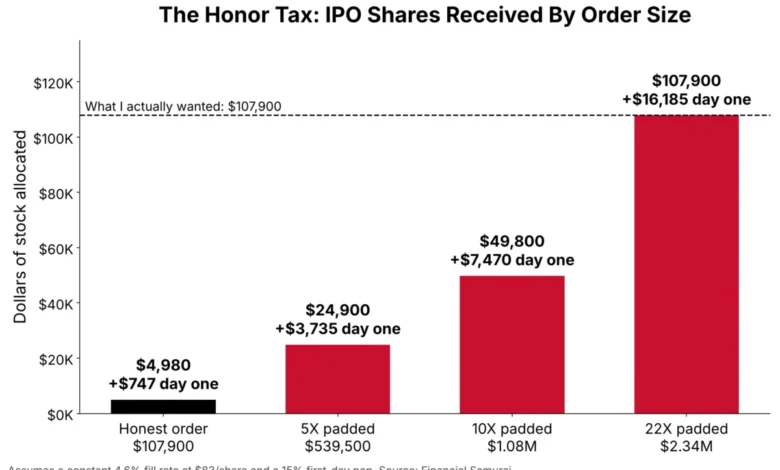
The recent public listing of AI research laboratory Anthropic on the Nasdaq under the ticker symbol ANT has sparked a broader discourse regarding the mechanics of initial public offering (IPO) allocations and the disadvantage retail investors face when adhering to traditional, transparent investment practices. Anthropic, a leader in the generative artificial intelligence sector, entered the public markets amidst significant institutional demand, leaving many retail participants with fractional allocations that fell far short of their indicated interest.
The discrepancy between indicated demand and final distribution in the Anthropic IPO highlights a long-standing practice in financial markets: the systematic inflation of order sizes by institutional and sophisticated investors to account for expected scaling by syndicate desks. While retail investors often approach these offerings with precise, earnest capital commitments, the reality of market mechanics suggests that those who do not adjust their strategies to account for expected oversubscription frequently find themselves sidelined.
Historical Context of IPO Allocation Dynamics
For decades, the IPO allocation process has been governed by syndicate desks at major investment banks. These desks are tasked with balancing the interests of the issuing company—which typically seeks a stable, long-term shareholder base—with the requirements of institutional clients who provide liquidity.
Historically, this system has favored institutional entities that have deep-seated relationships with lead underwriters. The mechanism of "book building" allows underwriters to gauge the pulse of the market. During this phase, institutional investors often submit orders significantly larger than their target position, anticipating that the syndicate desk will apply a "haircut" to the order size based on total demand. This practice is widely understood within the financial industry but remains a point of friction for individual retail investors who operate without the guidance of institutional desk relationships.
The Anthropic Listing: A Case Study in Oversubscription
The Anthropic debut serves as a prime example of high-demand equity offerings in the current market cycle. As an AI-native firm with significant backing from major technology conglomerates, Anthropic attracted intense interest from both institutional and individual cohorts.
Retail investors attempting to secure shares through various brokerage platforms reported fill rates as low as 4% to 5% of their initial indications. For instance, an investor requesting 1,300 shares at a target price of $83 might have received only 60 shares. This indicates that for every $100,000 of demand, investors were receiving roughly $4,600 in actual equity. This massive gap illustrates the "honor tax"—a term used to describe the financial cost incurred by those who operate with full transparency in a market that rewards strategic inflation of intent.
The Institutional Playbook vs. Retail Transparency
The disparity in allocation success is largely attributed to the divergence in strategy. Institutional participants, such as hedge funds and pension funds, utilize sophisticated algorithms and direct lines to syndicate desks to calibrate their orders. These entities understand that the "book" is a reflection of intent, not a binding contract for the full amount.
In contrast, retail investors often approach the process with a sense of moral rectitude or naivety, placing orders that represent their actual liquid capital available for the trade. By failing to account for the inevitable pro-rata reduction, these investors inadvertently price themselves out of meaningful positions. The data from the Anthropic IPO confirms that those who did not apply a significant multiplier to their order volume saw their effective exposure to the stock minimized, often resulting in missed opportunities to capitalize on the typical "first-day pop" associated with high-profile technology IPOs.

Broader Implications for Market Participation
The implications of this phenomenon extend beyond a single IPO. As AI and other high-growth sectors continue to dominate the equity markets, the barrier to entry for retail investors is not merely the availability of capital, but the knowledge of the "rules of the game."
Experts in market structure suggest that the current IPO framework creates a two-tiered system. The first tier, comprised of institutional investors, has access to the information and the historical precedent to "game" the allocation system effectively. The second tier, composed of retail investors, remains subject to the limitations of brokerage-level allotments and a lack of transparency regarding how demand is aggregated.
Critics argue that this system contributes to wealth inequality, as individual investors are consistently barred from meaningful participation in the most significant growth opportunities of the decade. Conversely, market proponents argue that the current system is necessary to ensure market stability and to prevent extreme volatility that might be caused by a flood of retail capital entering the market simultaneously at the point of listing.
The Cost of Fairness: An Economic Perspective
The economic cost of this "honor tax" is quantifiable. If an investor, by playing "fair," secures $5,000 worth of shares instead of the $50,000 they intended, and the stock appreciates by 15% on its first day of trading, the investor loses out on $6,750 in potential immediate gains. Over time, these missed opportunities compound, creating a significant drag on portfolio performance for the retail class compared to those who operate with institutional-grade strategic maneuvers.
Furthermore, this dynamic discourages long-term investment in public equities. When individual investors feel that the system is rigged against them, they may pivot toward alternative assets, such as private equity, cryptocurrency, or real estate, where the entry mechanisms, while different, are perceived as more transparent or meritocratic.
Strategic Adjustments for Future Offerings
To mitigate the impact of the honor tax, financial analysts suggest several tactical shifts for retail investors:
- Leverage Brokerage Relationships: Investors should engage with their brokerages well in advance of a major IPO to understand the specific allocation methodology of that firm.
- Understand the "Book" Dynamics: Recognizing that IPO books are routinely padded allows for more accurate order sizing. Investors must weigh the risk of a full-fill (if they over-order) against the risk of an insufficient allocation.
- Diversification of Channels: Utilizing multiple brokerage platforms can sometimes provide a broader base for allocation, though this requires significant coordination.
- Professional Advisory: In scenarios where high-net-worth individuals are involved, working with wealth managers who have access to institutional-level underwriting desks can help bridge the gap.
Conclusion: Is Transparency Worth the Cost?
The "honor tax" is not necessarily a reflection of unethical behavior, but rather a reflection of a system that rewards those who understand its complexities. While there is a clear moral appeal to honesty and transparency in one’s investment dealings, the practical reality of modern capital markets often punishes those who do not adapt to the prevailing incentives.
As the IPO market continues to evolve, the distinction between "playing by the rules" and "playing to win" will remain a central tension for individual investors. While institutional participants will continue to utilize their scale and access to ensure their interests are met, the retail sector must decide whether the satisfaction of maintaining an "honor code" is worth the tangible loss of wealth and opportunity. Ultimately, the most successful investors are those who can balance their ethical considerations with a pragmatic, informed, and strategic approach to the realities of the financial system.