The Financial Threshold for Urban Stability Analysis of the 408,000 Dollar Income Requirement for San Francisco Families

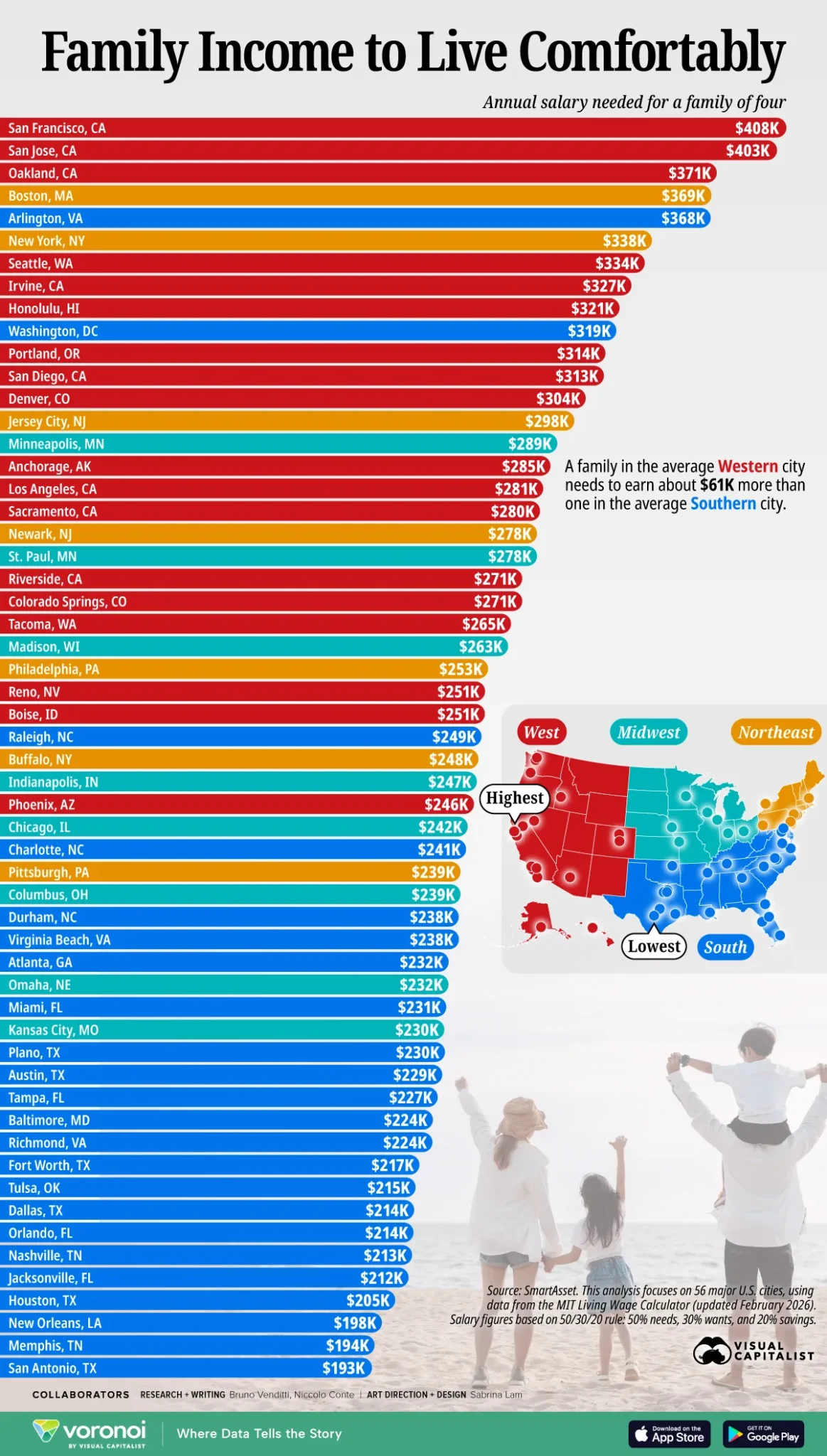
The cost of maintaining a traditional middle-class lifestyle in the United States’ most expensive metropolitan areas has reached a significant milestone, with new economic data indicating that a family of four in San Francisco now requires an annual household income of $408,000 to live comfortably. This figure represents a substantial escalation from previous years, highlighting a widening gap between stagnant median wages and the soaring costs of essential services such as housing, education, and healthcare. For many residents in high-cost-of-living (HCOL) coastal cities, the "middle-class dream"—defined by homeownership, two vehicles, annual vacations, and private education—now necessitates an income that places a household within the top 5% of earners nationally.
The Evolution of Living Costs: A Chronological Perspective
The trajectory of urban affordability has been steep over the past decade. In 2018, financial analysts and cost-of-living researchers estimated that a $300,000 annual income was the baseline for a middle-class existence in cities like San Francisco, New York, and Seattle. At the time, these estimates were met with significant public skepticism, as $300,000 was nearly five times the national median household income. However, by late 2019, following shifts in the macroeconomic climate and rising childcare costs, those estimates were revised upward to $350,000.
The current 2026 data, placing the requirement at $408,000, reflects a 36% increase in the cost of "comfort" over approximately eight years. This equates to a compound annual growth rate (CAGR) of roughly 3.5%. While this figure aligns closely with the long-term averages of the Consumer Price Index (CPI), it masks a more aggressive "personal inflation" rate experienced by families. Unlike the general CPI, which includes volatile but often depreciating goods like electronics and apparel, the household basket for a family of four is heavily weighted toward non-discretionary services. Since 2017, the costs of housing, tuition, and medical premiums in the Bay Area have consistently outpaced the broader inflationary trends of the US economy.
Statistical Breakdown: Taxation and Net Disposable Income
To understand why a $408,000 gross income is necessary, one must examine the corrosive effect of taxation and fixed costs. In a jurisdiction like San Francisco, a household earning $408,000 faces a combined effective federal and state tax rate of approximately 32%. This calculation includes Federal income tax, Social Security, Medicare, and California’s progressive state income tax, which is among the highest in the nation.
After taxes, the $408,000 figure is reduced to approximately $277,440 in take-home pay. This net amount must cover all lifestyle expenses and long-term financial security measures. For many families, the allocation of this income is rigid. A typical high-income budget in a coastal city includes:

- Housing and Utilities: Often exceeding $80,000 to $100,000 annually for a three-bedroom home in a safe neighborhood.
- Education: Private grade school tuition for two children can reach $90,000 per year, a cost that many families choose to bear due to the perceived or actual shortcomings of local public school districts.
- Food and Household Operations: Budgeted at approximately $3,000 per month, reflecting the premium prices of groceries and services in urban hubs.
- Retirement and Savings: Contributing $30,000 to 401(k) plans and $16,000 to 529 college savings plans represents an 11.4% savings rate—a figure considered the minimum for long-term financial independence but below the 20% recommended by many wealth managers.
The Impact of Education and Housing on the Middle-Class Identity
The primary driver of the $408,000 requirement is the "big elephant" in the room: private education. In San Francisco, the decision to opt out of the public school system is a major financial pivot point. If a family utilizes public education, their required income for a comfortable life drops significantly, potentially by $100,000 or more. However, for those who view bilingualism or specialized curricula as essential for their children’s future competitiveness, the $90,000 annual tuition is viewed as a non-negotiable investment.
Housing remains the second most significant barrier. San Francisco’s real estate market is characterized by limited inventory and high demand, forcing families into high-interest mortgages or exorbitant rents. The "comfort" metric assumes a family is not merely surviving but is living in a home that provides adequate space and proximity to employment hubs, which in the Bay Area, commands a significant premium.
Comparative Analysis: The Sunshine and Lifestyle Premium
The $408,000 figure is specific to San Francisco, which currently holds the title of the most expensive city for a family of four. However, the data reveals a broader trend across the United States. Living comfortably in a Western state costs, on average, $61,000 more per year than in Southern states. This discrepancy is often referred to as the "sunshine premium"—the price residents pay for better weather, natural beauty, and access to robust job markets.
Comparative data for other major cities highlights the potential for "geoarbitrage":
- Honolulu, HI: Requires $321,000 (a $87,000 discount compared to San Francisco).
- San Diego, CA: Requires $313,000.
- Los Angeles, CA: Requires $281,000.
- Richmond, VA: Requires $224,000.
- Orlando, FL: Requires $214,000.
Economic analysts point out that relocating from San Francisco to a city like Honolulu can be the equivalent of a $2.2 million boost in net worth, assuming a 4% safe withdrawal rate on the $87,000 annual savings.
Strategies for Financial Mitigation: Geoarbitrage and Income Structuring
For households unable to reach the $400,000 threshold, financial experts suggest three primary levers: increasing income, reducing expenditures, or relocating. However, the modern approach to relocation—geoarbitrage—has become more nuanced. Rather than moving to a different country, many families are finding success through "intra-city arbitrage." This involves moving to a less expensive neighborhood within the same metropolitan area, thereby retaining social networks and career opportunities while reducing housing costs by as much as 40%.
Furthermore, the nature of the income itself plays a critical role in "comfort." W-2 wage earners are taxed at the highest rates. In contrast, those with passive income streams—such as qualified dividends, long-term capital gains, and rental income shielded by depreciation—enjoy a lower effective tax rate (often around 26%). Consequently, a family living on $380,000 of passive investment income may actually have more disposable wealth than a family earning $408,000 in salary.
The Role of Financial Independence and the "Retirement Discount"
A significant finding in recent cost-of-living studies is the "retirement discount." Families who have reached Financial Independence, Retire Early (FIRE) status find that their "comfort number" drops significantly. This is because they no longer need to allocate 15-30% of their gross income toward retirement savings. Once the goal of capital accumulation is met, the cash flow previously diverted to brokerage accounts becomes available for consumption, effectively lowering the gross income requirement for the same lifestyle.
Additionally, the post-pandemic shift toward hybrid and remote work has complicated the definition of "comfort." The ability to work from home has provided a "luxury of time" that some argue is more valuable than a higher salary. For many, the elimination of a stressful commute and the flexibility to engage in mid-day wellness activities have made lower-income tiers more palatable.
Broader Economic Implications and Conclusion
The fact that a top 5% income is now required to sustain a middle-class lifestyle in major American cities has profound implications for social mobility and urban planning. If the "engine room" of the economy—the professional middle class—can no longer afford to live in the cities where they work, these urban centers risk becoming enclaves for only the ultra-wealthy and the subsidized.
The $408,000 figure serves as a stark reminder of the "stealth inflation" that has eroded the purchasing power of the American family. While the headline CPI may suggest moderate price increases, the reality for families managing the costs of housing, education, and healthcare is far more challenging. As these costs continue to rise, the strategies of geoarbitrage, passive income generation, and aggressive tax planning are no longer just for the wealthy; they have become essential survival tactics for anyone aspiring to a comfortable life in the modern American city.