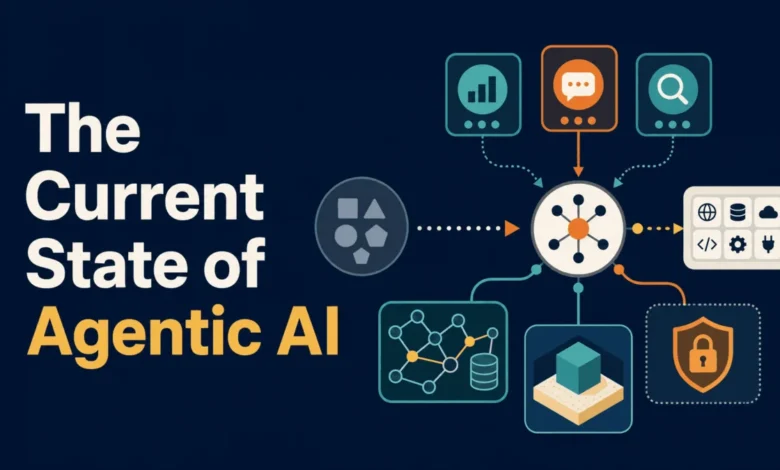
In mid-2026, the landscape of artificial intelligence architecture has undergone a significant transformation, moving away from the complex, monolithic reasoning loops that once dominated development. The current era is characterized by the rise of multi-agent swarms, a more modular and specialized approach, and the crucial standardization of tool protocols through the Model Context Protocol (MCP). This shift represents a maturation of the field, with AI engineers increasingly focused on designing the intricate communication infrastructure for these specialized agents rather than wrestling with the intricate prompting of single, all-encompassing models.
The Fading Era of Monolithic Agents
Just a year prior, in mid-2025, the prevailing method for building AI agents relied heavily on brute-force orchestration. Engineers dedicated considerable effort to manually constructing intricate ReAct (Reasoning and Acting) loops. This involved wrestling with brittle prompt chains and attempting to compel a single, massive language model to simultaneously manage planning, tool execution, and context management. The goal was to simulate a step-by-step thinking process, where the AI would reason, act, and then critique its own output to refine its approach. Patterns like Plan-and-Execute and Reflexion, explored in technical guides from the previous year, exemplified this approach. These external loops used code to force a model through iterative self-correction, aiming to mimic human-like reflection.
However, the rapid advancement of foundation models has fundamentally altered this paradigm. Today’s state-of-the-art models possess native capabilities for test-time computation. They can now generate hidden reasoning tokens, explore multiple solution branches internally, and self-correct before presenting a final output. This inherent reasoning capacity renders much of the external scaffolding built to simulate reflection redundant.
For AI architects, this means a significant reduction in the need for complex orchestration frameworks solely to enable planning. The necessity of using tools like LangChain or LlamaIndex to force models into self-reflection is diminishing, as these methods can introduce unnecessary latency and token overhead. Instead, the focus of the orchestration layer has shifted to critical system functions: efficient routing of tasks, robust state management, and seamless environment execution. The cognitive loop is now primarily an internal function of the model itself, freeing up engineering resources to concentrate on more strategic architectural design.
The Ascendancy of Agent Swarms: Multi-Agent Microservices
With foundation models now adept at their own internal reasoning, the question for production teams has become: what is the optimal responsibility for a single AI agent? The emergent consensus is to delegate as little as possible. The previous approach of attaching dozens of tools to a single, large language model created a significant bottleneck. This limitation was highlighted in analyses advocating for AI orchestration as the new architectural frontier.
Consequently, a growing number of production teams have embraced agentic swarms – collections of smaller, highly specialized agents that communicate via a standardized protocol. Instead of a single agent tasked with managing 50 diverse tools, the modern architecture comprises:
- Specialized Agents: Each agent is designed for a singular, well-defined purpose. For instance, one agent might be dedicated to writing and executing SQL queries, another to analyzing data with Python’s Pandas library, and a third to interacting with a specific API like Stripe.
- Decoupled Reasoning and Execution: The core reasoning capabilities are embedded within the foundation models, while specialized tools are managed by individual agents.
- Inter-Agent Communication: Agents communicate through well-defined protocols, allowing for seamless handoffs and collaborative task completion.
While splitting a monolithic agent into numerous smaller ones might seem like merely shifting complexity, the key insight is that this complexity becomes manageable, testable, and replaceable. This modularity contrasts sharply with the opaque, difficult-to-debug nature of large, integrated agents.
A fundamental pattern emerging within these swarms involves specialized agents designed for distinct functions. Consider a scenario where a user query requires data retrieval and subsequent analysis. A typical swarm architecture might include:
- A Triage Agent: This agent acts as the initial entry point, analyzing the user’s request and routing it to the appropriate specialist. It might possess tools to determine if the query requires database access or analytical processing.
- A Data Fetcher Agent (SQL Agent): This agent is specialized in writing and executing read-only SQL queries against databases. It would be equipped with a tool for query execution.
- A Data Analyst Agent: This agent focuses on processing and interpreting data, likely utilizing libraries like Pandas. It would be equipped with a tool to run Python code within a secure sandbox.
The handoff logic is crucial. When the Data Fetcher agent successfully retrieves the necessary data, it would invoke a TransferCommand tool. This command explicitly directs the context (the fetched data) and control to the Data Analyst agent, initiating the next phase of the task. This pattern ensures that individual agents remain stateless per call, which keeps their context windows lean and cost-effective. It also allows for the utilization of less powerful, more economical models for specific tasks, reserving larger, more capable models for synthesis and high-level routing.
This system-level statefulness, achieved through inter-agent communication and context passing, is paramount, especially when considering how tools are integrated. This is precisely where standardization has made a significant impact.
The Standardization of Agency: The Model Context Protocol (MCP)
Connecting these specialized agents to the real-world systems and data sources that users depend on has historically been a tedious and repetitive process. Before 2025, integrating an API typically involved writing custom JSON schemas for each tool, managing HTTP requests, and meticulously handling arbitrary JSON parsing errors originating from the model. Each new integration demanded a significant reinvention of the same fundamental wheel.
The current state of tool calling is increasingly shaped by the Model Context Protocol (MCP). This open standard has emerged as a universal adapter, bridging the gap between AI models and both local and remote data sources. The MCP simplifies integration by providing a standardized interface for exposing tools and resources.
The evolution from the old paradigm to the current state can be summarized as follows:
| Old Paradigm (Pre-2025) | Current State (Mid-2026) |
|---|---|
| Hardcoded API keys directly into the agent’s environment. | Agents connect to isolated MCP servers for secure access. |
| Engineers wrote custom JSON schemas for every individual tool. | MCP servers automatically expose available tools and resources. |
| Agents directly executed API calls inline within their logic. | Execution occurs on the MCP server, separating concerns. |
This standardization dramatically streamlines the integration process. An organization can now plug a pre-built GitHub MCP server, a Slack MCP server, and a PostgreSQL MCP server into their swarm without the need to develop custom API wrappers for each. While robust credential management on the server side remains a critical concern, the overall integration surface area has been significantly reduced. This allows development teams to focus more on the strategic orchestration of agent interactions rather than the minutiae of API integration.
Continuous Learning via Memory Graphs
One of the most significant promises of agentic AI, as envisioned in earlier roadmaps, was the development of agents capable of learning from their own execution history. This capability is now transitioning into production environments through the implementation of memory graphs. The underlying mechanism warrants careful understanding.
A critical distinction exists between the stateless nature of individual agent invocations and the persistent memory of the system as a whole. While individual agents remain stateless during each call, thereby preserving lean context windows, the system maintains persistent memory through graph databases. Technologies like Neo4j or managed alternatives are integrated directly into the agent’s context pipeline.
When a swarm executes a task, a specialized Memory Agent operates asynchronously in the background. Its sole responsibility is to analyze the main swarm’s trajectory, identify and extract persistent facts, and then update the system’s memory graph. This process moves the focus from traditional prompt engineering to a more sophisticated form of context engineering. The system learns and improves over time without requiring the fine-tuning of the underlying foundation models, a process that is often costly and time-consuming.
The practical implementation of memory graphs typically involves the following steps:
- Execution Trace: The primary swarm agents execute a task, generating a detailed trace of their actions, decisions, and intermediate results.
- Fact Extraction: The Memory Agent analyzes this trace, identifying key facts, relationships, and insights. For example, if a user query involved analyzing customer churn, the Memory Agent might extract the correlation coefficient between churn rate and support ticket volume.
- Graph Update: These extracted facts are then used to update a knowledge graph, creating new nodes and edges or reinforcing existing ones. This graph serves as a persistent memory of the system’s learned knowledge.
- Contextual Augmentation: In subsequent interactions, the swarm can query this memory graph to retrieve relevant past learnings, enriching its current decision-making process and providing more contextually aware responses.
This approach enables a form of continuous learning, where the system compounds its knowledge and improves its performance over time through its own operational experience.
Security: The Expanding Swarm Attack Surface
The proliferation of multi-agent systems interconnected via universal protocols has inevitably expanded the attack surface. Concerns regarding indirect prompt injections, which can hijack automated workflows, have become a primary consideration for enterprise adoption. The swarm architecture, while offering significant advantages, also presents unique security challenges that mirror traditional network intrusion patterns.
The danger lies in the lateral movement of malicious instructions. When Agent A, capable of reading external emails, can transfer context and control to Agent B, which possesses database access, a compromised email can pivot through the entire swarm. This handoff mechanism, fundamental to the utility of swarms, also makes them susceptible to sophisticated attacks.
In response to these evolving threats, several defense mechanisms are converging:
- Contextual Sanitization: Agents are being developed with built-in capabilities to analyze and sanitize incoming context, identifying and neutralizing potentially malicious instructions before they can be acted upon. This involves sophisticated pattern matching and semantic analysis.
- Least Privilege for Agents: Each agent is being granted only the minimal set of permissions and tools necessary for its specific function. This limits the potential damage if an agent is compromised. For instance, a data fetching agent would not have the ability to execute arbitrary code.
- Behavioral Anomaly Detection: Advanced monitoring systems are being deployed to detect deviations from normal agent behavior. Any unexpected actions or communication patterns can trigger alerts and automated mitigation responses.
While these defenses are not yet universally standardized, they represent the active frontier of production agentic security. Any organization deploying swarms into production environments is strongly advised to implement at least one of these measures as a baseline security requirement. The successful adoption of agentic AI at scale hinges on establishing robust security protocols that can keep pace with the evolving threat landscape.
The Path Forward for Agentic AI
The field of agentic AI has rapidly transitioned from an area of academic curiosity to a mature engineering discipline. This evolution is marked by tangible constraints, identifiable failure modes, and critical design decisions at every architectural layer. The foundational primitives of agentic AI – tool calling, routing, and native reasoning – are undergoing rapid refinement and standardization.
The primary leverage for future advancements now resides in the systems layer. This includes the sophisticated design of swarm topologies, the architecture of memory systems to ensure compound knowledge acquisition over time, and the establishment of robust security boundaries that enable these complex systems to operate safely and effectively at scale.
Leading teams are no longer solely focused on creating smarter individual agents. Instead, their efforts are concentrated on building more resilient, specialized, and interconnected swarms. For newcomers to the field, the recommended approach is to select a proven pattern, implement it at a small scale, and meticulously instrument its performance. The architectural intuitions developed through the design and deployment of a three-agent swarm are directly transferable to the complex orchestration of a thirty-agent or even larger system, laying the groundwork for the next generation of intelligent automation.