Transforming Decades of Patient Records Into Better Care: How AI and NVIDIA Are Revolutionizing Clinical Workflows

The landscape of modern medicine is undergoing a profound structural transformation, driven by the convergence of advanced artificial intelligence and high-performance computing. Across pediatric research facilities, oncology departments, and smart hospitals globally, healthcare systems are increasingly turning to AI to alleviate the administrative burdens that consume a significant portion of a clinician’s workday. By automating routine documentation, synthesizing fragmented patient data, and accelerating chart reviews, these technologies are designed with a singular, overriding objective: reducing the time care teams spend on clerical tasks to maximize direct, meaningful engagement with patients.
While the technology operates with unprecedented speed and scale, the foundational framework of modern medical AI firmly maintains that human clinicians remain at the absolute center of decision-making. Physicians and specialists continuously review AI-generated outputs, interpret clinical signals, and guide therapeutic pathways. Powering this generation of healthcare applications are advanced computing technologies developed by industry leaders such as NVIDIA, whose infrastructure provides the immense computational muscle required to process complex medical datasets securely and efficiently. This synergy between human expertise and machine intelligence is redefining what is possible in diagnostic accuracy, clinical research, and personalized patient care.
The Chronic Crisis of Unstructured Medical Data
To understand the scale of the challenge facing contemporary healthcare systems, one must examine the nature of patient medical history. Over the lifespan of an individual, hospitals and health networks accumulate vast repositories of medical data. However, a significant majority of this vital information—often estimated at up to 80%—exists not in structured, easily searchable databases, but in unstructured free text.
Physicians’ clinical notes, detailed operative reports, imaging and pathology reads, nursing logs, and comprehensive discharge summaries form a sprawling, fragmented narrative of a patient’s health. When a patient presents with a complex, chronic, or multi-system condition, understanding their complete medical story requires a clinician to manually review years, and sometimes decades, of disparate charts, notes, and laboratory results. This manual process is not only exceptionally time-consuming but also introduces the risk of human oversight, as critical clinical signals may be buried deep within thousands of pages of historical documentation.
Recognizing this critical bottleneck, healthcare startups and major health systems are deploying specialized clinical reasoning engines designed to ingest, process, and synthesize unstructured medical histories in seconds. Among the pioneers in this space is Dyania Health, a New Jersey-based clinical artificial intelligence company that has developed a proprietary platform known as Synapsis AI.
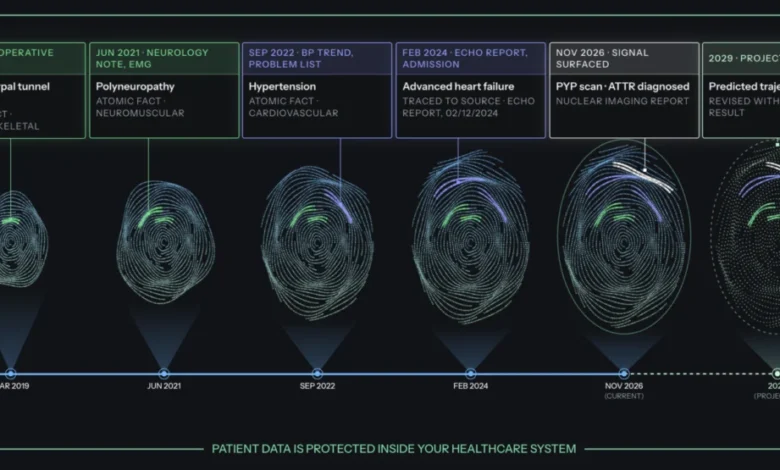
Designed specifically to bridge the gap between historical patient data and actionable clinical insights, Synapsis AI operates as an advanced reasoning engine. Rather than simply keyword-searching documents, the system reads and comprehends every note, report, and laboratory result within a patient’s comprehensive electronic health record (EHR). By contextualizing findings, the engine connects clinical indicators that may be separated by years, effectively answering complex diagnostic and prognostic questions the way a seasoned medical specialist would after a meticulous chart review.
Maintaining Data Sovereignty and Security Within Hospital Infrastructure
One of the most significant barriers to the widespread adoption of artificial intelligence in healthcare has historically been the strict regulatory environment governing patient privacy and data security. Laws such as the Health Insurance Portability and Accountability Act (HIPAA) in the United States, alongside stringent international frameworks like the General Data Protection Regulation (GDPR) in Europe, place heavy restrictions on how protected health information (PHI) can be stored, transmitted, and analyzed.
To address these concerns head-on, modern clinical AI deployments are engineered to prioritize absolute data sovereignty. Synapsis AI, for instance, runs entirely on NVIDIA-accelerated computing infrastructure housed securely inside a health system’s own physical or virtual firewall. By processing a health system’s complete patient records entirely onsite, the architecture ensures that sensitive patient data is never shared with third-party vendors and never leaves the physical or secured digital boundaries of the hospital network.
This local processing model dramatically transforms the day-to-day operations of hospital staff. By shifting the arduous burden of comprehensive chart review away from the desks of clinical and research teams, hospitals can redirect valuable human capital toward patient-facing care. Crucially, however, the AI platform acts strictly as an assistive tool. It does not make autonomous clinical decisions; instead, it surfaces evidence-based insights from historical medical records that a qualified clinician must carefully confirm, validate, and act upon.
The technical backbone enabling this rapid, secure onsite processing relies heavily on sophisticated software development kits and optimization tools. Dyania Health builds and trains its specialized clinical models using NVIDIA NeMo open libraries, which provide the foundational framework for conversational AI and large language model development. Once trained, the company utilizes NVIDIA TensorRT and TensorRT-LLM software to optimize these models, enabling them to execute at maximum speed and computational efficiency directly on the hospital’s local graphics processing unit (GPU) servers.
Real-World Application: The Cleveland Clinic Study
The true utility of advanced clinical reasoning engines is best measured through rigorous real-world implementation. A landmark study conducted in collaboration with the renowned Cleveland Clinic provides a clear window into the transformative potential of this technology.
Between 2005 and 2021, the Cleveland Clinic amassed a massive cohort comprising more than 7,800 patients who had undergone aortic valve replacement surgery. Understanding the long-term outcomes and durability of these implanted heart valves required analyzing not only the immediate surgical reports but also every single echocardiogram, diagnostic scan, and follow-up consultation added to each patient’s record in the years following the initial procedure.
Manually reviewing this colossal volume of data for a cohort of 7,800 patients would typically require years of exhaustive labor by teams of clinical researchers. However, by deploying Synapsis AI, the research team was able to automate and streamline the chart review process across the entire patient population in a fraction of the time.
The AI platform reasoned across every individual record, systematically analyzing post-operative echocardiograms and clinical notes. By correlating these longitudinal data points, the system successfully assisted in building a sophisticated predictive model capable of forecasting valve deterioration and the subsequent risk of reintervention at the three-, five-, and ten-year milestones following an aortic valve replacement procedure.
Dr. Lars Svensson, chief of the Heart, Vascular & Thoracic Institute at the Cleveland Clinic, emphasized the profound implications of this technological integration. "Using technology to bring together and analyze information that can help us predict the duration of implanted heart valves is a promising step towards enhanced outcomes and more personalized care for patients," Dr. Svensson stated.
Broader Implications and Future Horizons
The successful deployment of clinical reasoning engines in complex cardiovascular studies signals a major paradigm shift for medical research and clinical operations alike. The foundational approach demonstrated at the Cleveland Clinic is not limited to cardiology; it can be seamlessly adapted to address virtually any complex healthcare challenge where critical diagnostic or prognostic answers are locked away within unstructured medical records.
Among the most immediate and impactful secondary applications is the acceleration of clinical trial recruitment. Historically, matching eligible patients to specialized clinical trials is a notoriously slow, manual process that results in low enrollment rates and delayed medical breakthroughs. By deploying AI engines capable of instantly scanning thousands of patient charts against complex inclusion and exclusion criteria, hospitals can dramatically accelerate clinical trial matching, bringing life-saving therapies to patients faster than ever before.
Furthermore, these technologies play a vital role in systematically closing persistent care gaps across various medical disciplines, including oncology, endocrinology, and rare disease diagnostics. By continuously monitoring longitudinal health data, AI-driven platforms can alert care teams to missed preventative screenings, emerging disease markers, or recommended follow-up interventions that might otherwise slip through the cracks of a busy healthcare system. Additionally, these systems can automate the labor-intensive population of clinical registries, ensuring that healthcare institutions maintain accurate, comprehensive data for epidemiological research and quality improvement initiatives.
As health systems worldwide continue to grapple with resource constraints, clinician burnout, and rising patient volumes, the integration of secure, locally hosted artificial intelligence represents a vital path forward. By marrying the computational power of NVIDIA technologies with the clinical intuition and oversight of human medical professionals, the healthcare industry is entering a new era characterized by heightened efficiency, reduced administrative fatigue, and, above all, elevated standards of personalized, patient-centric care.