Bridging the AI Implementation Gap: Why Chief Learning Officers Must Shift from Tech Deployment to Adaptive Leadership

The corporate world has embraced artificial intelligence at a velocity that outpaces any prior technological revolution in modern workplace history. Across global markets, organizations have integrated automated systems into day-to-day operations with unprecedented speed. Yet, despite this rapid deployment, a profound disconnect persists between the sheer volume of software installations and actual transformations in how work gets accomplished.
This operational lag is not fundamentally a technical problem requiring advanced coding or superior infrastructure. Rather, it is an adaptive challenge. For chief learning officers and corporate executives, the core strategic question is no longer how to implement artificial intelligence, but rather how to help human workforces adapt, evolve, and thrive alongside it.
The AI Adoption Paradox: High Usage, Low Return
Over the past two years, artificial intelligence has saturated the enterprise ecosystem. By late 2025, data compiled by McKinsey & Company revealed that nearly nine in ten organizations were utilizing artificial intelligence regularly in at least one core business function. From automated customer service portals to sophisticated predictive analytics in supply chain management, the footprint of machine learning expanded exponentially.
However, enthusiasm has consistently outpaced tangible financial returns. Grounded in an analysis of more than 300 enterprise deployments, MIT’s Project NANDA released a sobering report revealing that roughly 95 percent of generative AI pilots produced no measurable profit-and-loss impact. While industry critics initially blamed this phenomenon on a traditional pilot-to-production bottleneck, researchers at MIT NANDA identified a more fundamental barrier: a critical learning gap. Companies successfully adopted the software, but human workers failed to meaningfully alter their operational habits or workflow methodologies.
This disparity highlights a recurring lesson in technological history: success depends far more on organizational alignment and human adoption strategy than on the inherent capability of the software itself. Harvard leadership researchers have long championed the adaptive leadership framework, which dictates that change is the perpetual normal state of modern institutions. This framework establishes a vital distinction between technical challenges—which can be resolved through existing technical expertise and authority—and adaptive challenges, which demand that people learn, adjust, and fundamentally alter their behaviors, values, and loyalties.
Organizations that treat artificial intelligence strictly as a technical challenge consistently overlook its deeper organizational repercussions. They fail to recognize how automated systems alter professional identities, redistribute institutional expertise, blur lines of accountability, and ignite urgent questions regarding who captures the financial rewards and who absorbs the operational risks.
A Chronology of Enterprise AI Integration
To understand the current state of corporate artificial intelligence, it is necessary to examine the rapid chronology of its rollout and the subsequent realization of its limitations.
Phase One: Rapid Prototyping and Deployment (2023–2024)
Following the mainstream commercialization of advanced generative models, organizations rushed to launch localized proofs-of-concept. Driven by fear of missing out, executive boards mandated the rapid acquisition of software licenses. IT departments integrated chatbots, coding assistants, and automated drafting tools across departments with minimal oversight regarding workflow redesign.
Phase Two: The Productivity Illusion and Strategic Reassessment (Late 2024–Mid 2025)
As initial excitement plateaued, executives began demanding return on investment metrics. Enterprise reviews, culminating in findings from institutions like MIT’s Project NANDA, exposed the stark reality that 95 percent of generative AI pilots failed to generate measurable bottom-line profits. Organizations realized that employees were using tools merely as superficial substitutes for existing tasks without driving true operational innovation.
Phase Three: The Adaptive Turn and Human-Centered Integration (Late 2025 and Beyond)
Recognizing that software installation does not equal workforce transformation, corporate leaders began pivoting toward learning ecosystems. Chief learning officers emerged as critical strategic players, tasked with designing frameworks that cultivate critical judgment, psychological safety, and systemic workflow redesign rather than simple prompt literacy.
The Role of Leadership Mindsets in Shaping Adoption
As tools evolve at breakneck speed, traditional training competencies depreciate almost as fast as they are acquired. Consequently, leadership mindsets represent the fundamental built capacity that organizations must cultivate for the artificial intelligence era. A leader’s internal mindset dictates whether they view machine learning as an authoritarian threat to control, a cynical lever for aggressive headcount reduction, or a profound opportunity to redesign work around distinctly human strengths. Furthermore, a leader’s mindset directly shapes how technology is experienced by the employees within their sphere of influence.

To break out of the figurative artificial intelligence cul-de-sac, modern leadership frameworks must transcend basic software training. Organizations require a responsive, multi-dimensional learning ecosystem that empowers employees to openly question algorithmic outputs, develop independent professional judgment, practice novel working methods, preserve essential institutional expertise, and participate directly in workflow redesign.
The Flux 5 Leadership Framework
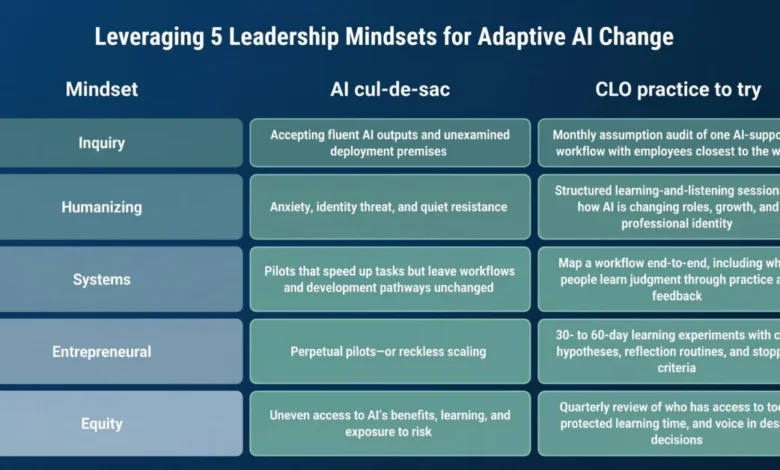
To navigate this transition, organizational theorists introduced the Flux 5 leadership framework, which centers on five distinct mindsets: Inquiry, Humanizing, Systems, Entrepreneurial, and Equity. Together, these interrelated perspectives guide leaders from mere technological adoption toward comprehensive, adaptive workforce development.
- The Inquiry Mindset: Questioning Outputs and Underlying Premises
In an information ecosystem notoriously prone to errors, hallucinations, and biases, an intentional learner stance committed to questioning norms is an indispensable safeguard. Inquiry in the age of automation operates on two distinct levels: the output and the premise.
At the output level, workers must build the disciplined habit of interrogating machine-generated production, comparing automated claims against trusted sources, and identifying missing context. At the premise level, leaders must examine the invisible assumptions embedded in automation decisions. What specific problems are being solved? Whose operational priorities are driving a particular use case? What foundational processes will change once automation takes hold?
For chief learning officers, this requires a transition away from traditional, isolated AI training seminars toward work-embedded learning. Employees learn effectively by systematically comparing software outputs with expert human judgment, sharing observable operational patterns, and developing a disciplined discernment that far exceeds basic prompt fluency. Key operational practices include conducting monthly AI assumption audits, deploying rapid-cycle listening tools to gauge employee usage, and implementing judgment labs where teams analyze real work artifacts side-by-side with algorithmic summaries.
- The Humanizing Mindset: Holding People Through Professional Transitions
Anxiety surrounding artificial intelligence is widespread, pervasive, and entirely rational. Workers are routinely asked to adopt systems that threaten to reshape or eliminate essential components of their professional roles, frequently without transparent communication regarding long-term corporate intent. When executives frame automation solely as a productivity and cost-cutting lever, employee trust deteriorates rapidly, manifesting as knowledge hoarding, minimal compliance, and passive resistance.
A humanizing mindset centers on people, shared purpose, and psychological presence. It requires leaders to actively attend to the complex relationship between emerging technology and professional identity. Drawing on organizational behavior concepts like institutional holding—pioneered by scholar Gianpiero Petriglieri—modern organizations must recognize that adults learn and innovate best when operating within a secure, supportive environment.
Chief learning officers must intentionally protect and redesign the developmental pipelines through which junior employees build fundamental expertise. Because automation often absorbs foundational entry-level tasks—such as baseline writing, preliminary research, and initial data analysis—organizations must deliberately reconstruct alternative pathways for human capability development. Key practices include creating structured spaces to share workforce feedback, issuing transparent organizational intent statements, and safeguarding entry-level professional training grounds.
- The Systems Mindset: Redesigning Workflows and Broader Ecosystems
The most common strategic failure in corporate automation is local optimization: the deployment of a tool that generates isolated efficiencies without positively impacting the broader workflow. This results in impressive usage metrics paired with negligible financial impact.
A systems mindset enables leaders to recognize and avoid this trap by applying core systemic principles, including interconnectedness, synthesis, emergence, and complex feedback loops. If a specific administrative task becomes twice as fast, where does the excess work flow next? What feedback loops will automation inadvertently create or fracture? What happens when machine-generated content increasingly serves as the primary training input for subsequent models?
Chief learning officers play a vital systems role by identifying the hidden developmental consequences of workflow redesign. To succeed, organizations must map operations end-to-end before deploying new tools, understand the learning and mentoring flows embedded within daily tasks, and replace superficial usage metrics with comprehensive outcome measures tied to cycle times, quality, and human capacity.
- The Entrepreneurial Mindset: Disciplined Experimentation and Bounded Curiosity
Enterprises frequently fall into one of two operational traps regarding innovation: they become trapped in perpetual pilot phases characterized by endless testing and zero scaling, or they commit enterprise-wide resources to unproven vendors before understanding the underlying work. Both extremes are mitigated through disciplined experimentation.
An entrepreneurial mindset aligns naturally with a volatile technological landscape. The core inquiry for leaders becomes identifying what new possibilities emerge that were previously unattainable. For learning executives, disciplined experimentation serves as a foundational design principle: pilot programs must generate reusable institutional knowledge rather than merely serving as vendor evaluation checkboxes. Key practices include executing bounded 30- to 60-day experiments with predetermined success criteria, conducting comprehensive learning reviews rather than simple project debriefs, and empowering frontline workers to identify high-value friction points.
- The Equity Mindset: Distributing Gains and Mitigating Risks
Automated systems do not inherently distribute their operational benefits or risks equitably. Access to cutting-edge software, specialized training, and protected time to experiment frequently mirrors existing corporate hierarchies, disproportionately exposing demographic groups with the least organizational power to automated displacement. Furthermore, models trained on historical data regularly reproduce historical biases in hiring, performance evaluations, and client service delivery.
Without deliberate, conscious intervention, artificial intelligence can widen internal socioeconomic and professional gaps while maintaining a facade of objective neutrality. Promoting equity is therefore a critical matter of organizational performance. When employees across all professional levels gain access to advanced tools and continuous learning, the enterprise broadens its collective base of experimentation, insight, and organizational resilience. Key practices include executing quarterly equity reviews on major deployments, democratizing access to learning resources, and establishing strict bias checkpoints for high-stakes human resource decisions.
Broader Implications and Strategic Imperatives
Together, these five interconnected mindsets provide a comprehensive roadmap for people-centered, learning-oriented artificial intelligence integration. Chief learning officers can begin this transition by evaluating which specific mindset their current corporate strategy most severely neglects, followed by establishing a balanced operational cadence of weekly listening sessions, monthly audits, and quarterly equity reviews.
Ultimately, artificial intelligence is not a static corporate destination to be reached and subsequently stabilized. Instead, it is an iterative, self-accelerating learning process that continuously reopens fundamental questions concerning human identity, institutional trust, organizational structure, and professional fairness. As adaptive change remains the defining condition of modern commerce, the role of the chief learning officer is increasingly central to cultivating the critical judgment, systemic awareness, and commitment to human fairness required to build sustainable, long-term organizational value.