Optimizing Transformer Inference through Operator Fusion and Advanced Memory Management


Modern large language models are built from a predictable set of mathematical primitives, including linear projections, attention mechanisms, normalization layers, and activation functions. While these components are conceptually straightforward, a naive implementation—where each operation launches a distinct accelerator kernel and writes intermediate results back to global memory—is inherently inefficient. In high-performance computing environments, such as those running massive transformer models on NVIDIA GPUs, the time spent moving data across the memory bus often dwarfs the time spent on actual arithmetic. This realization has triggered a significant shift in how researchers and engineers optimize neural network execution, focusing on minimizing memory traffic through operator fusion and specialized kernel design.
The Problem with Eager Execution
The standard "eager" execution mode, commonly seen in early versions of PyTorch and other deep learning frameworks, operates by treating each layer as an isolated sequence of operations. For instance, in a standard SwiGLU block, the model performs gate projections, applies a SiLU activation, executes an element-wise multiplication, and finally performs a down-projection. In a non-optimized environment, each of these steps requires the GPU to read from and write to high-bandwidth memory (HBM).
When intermediate tensors are written to HBM, the system incurs a significant latency penalty. As model sizes have scaled into the hundreds of billions of parameters, this "memory wall" has become the primary bottleneck for inference throughput. Engineers have observed that for many layers, the GPU is not compute-bound but memory-bound; the processing units sit idle, waiting for the next set of values to arrive from the cache. To resolve this, the industry has turned toward operator fusion, which combines multiple logical operations into a single, specialized kernel that executes entirely within the processor’s high-speed local memory (SRAM), drastically reducing the need to access the slower global memory.
The Evolution of FlashAttention
A critical milestone in this optimization journey was the development of FlashAttention. Traditionally, the self-attention mechanism, which computes the relationship between tokens in a sequence, required the materialization of a massive attention score matrix. For a sequence length of $T$, this matrix contains $T^2$ elements. As sequences grew longer, the memory required to store this matrix became prohibitively expensive, leading to O(N²) memory scaling that hindered the development of long-context models.
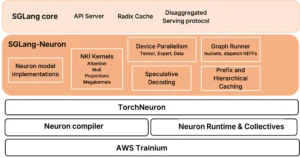
FlashAttention, introduced by researchers at Stanford and later adopted across the AI ecosystem, fundamentally changed this by processing the attention mechanism in tiles. Instead of calculating the entire score matrix at once, the algorithm calculates blocks of scores, updates the softmax statistics incrementally, and accumulates the output in local registers. This approach allows the attention mechanism to function with linear memory complexity relative to the sequence length, effectively bypassing the memory bottleneck that previously constrained context windows. Today, PyTorch’s scaled_dot_product_attention (SDPA) serves as the primary interface for these optimizations, allowing models to automatically select the most efficient backend, such as FlashAttention or cuDNN-based kernels, depending on the hardware architecture and input dimensions.
Paged Attention and Memory Fragmentation
Beyond computation, memory management during inference has emerged as a major operational challenge. In standard autoregressive generation, the Key-Value (KV) cache grows linearly as each new token is generated. Because the length of a generated response is unpredictable, traditional systems pre-allocate a contiguous block of memory for the maximum possible sequence length. This leads to massive fragmentation, where a significant portion of GPU memory is reserved but remains unused, severely limiting the number of concurrent requests a server can handle.
The introduction of PagedAttention, pioneered by the vLLM project, borrowed the concept of virtual memory from operating systems. By dividing the KV cache into fixed-size blocks, PagedAttention separates the logical representation of a sequence from its physical memory layout. A block table maps logical tokens to non-contiguous physical blocks, allowing the system to allocate memory on demand. This design not only eliminates external fragmentation but also enables advanced memory-sharing techniques, such as Prefix Caching, where multiple requests sharing a common prompt can reuse the same physical memory blocks, further optimizing resource utilization.
The Role of Torch.compile and CUDA Graphs
To automate these optimizations, the PyTorch development team introduced torch.compile in recent iterations. This feature leverages TorchInductor, a deep-learning compiler that translates high-level PyTorch code into highly optimized Triton or C++ kernels. Through a process called graph capture, the compiler identifies sequences of operations that can be fused. It analyzes the computational graph, identifies where buffer reuse is possible, and generates a single kernel that performs the work of several dozen eager-mode kernels.
Furthermore, torch.compile integrates with CUDA Graphs to address the "launch overhead" problem. In many inference scenarios, the time required to submit a kernel to the GPU from the CPU (the launch latency) is longer than the execution time of the kernel itself. CUDA Graphs allow developers to record a sequence of operations and then replay that sequence with a single CPU submission, effectively silencing the host-side overhead. When combined with the reduce-overhead mode, this creates a streamlined execution path that is particularly effective for low-latency inference workloads where small batches are common.
Industry Implications and Future Outlook
The shift toward fused kernels and paged memory management has profound implications for the cost and efficiency of deploying large models. By increasing the number of concurrent requests a single GPU can process—a metric known as "throughput per dollar"—these optimizations have directly contributed to the rapid adoption of LLMs in enterprise production environments.
However, these techniques are not a panacea. The benefits of fusion are highly dependent on the underlying hardware architecture and the specific shape of the tensors involved. For instance, excessively aggressive fusion can lead to high register pressure, causing the GPU to reduce the number of active threads (occupancy) and potentially slowing down execution. Similarly, while torch.compile provides significant speedups, it is not always transparent; data-dependent control flow or complex dynamic shapes can cause "graph breaks," forcing the compiler to fall back to less-optimized execution paths.
As the industry moves toward even larger models and more complex architectures, the interaction between software compilers and hardware kernels will only intensify. Future research is already looking at "graph-level" optimizations that span multiple transformer layers, potentially fusing entire blocks of a neural network into single, massive kernels.
For engineers and researchers, the current landscape represents a transition from "black box" deep learning frameworks to a more transparent, compiler-centric paradigm. Success in this environment requires a deep understanding of memory hierarchies, the ability to profile performance bottlenecks effectively, and a nuanced approach to balancing algorithmic purity with hardware-level efficiency. The goal remains constant: to minimize the time the GPU spends waiting for data and maximize the time it spends performing the matrix operations that drive modern artificial intelligence.