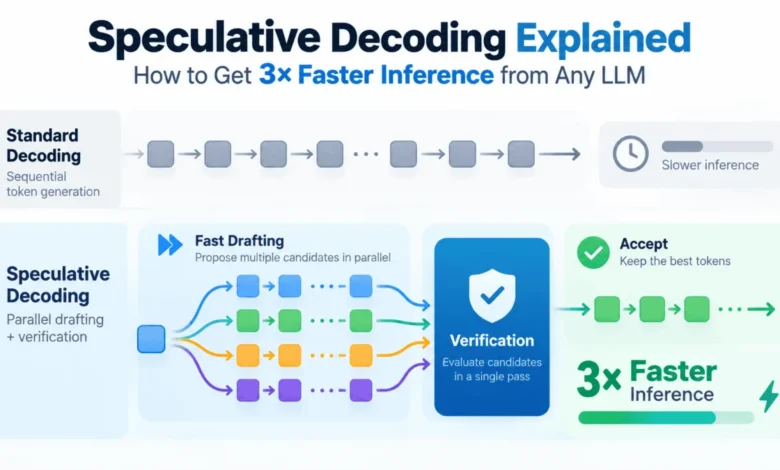
The rapid proliferation of Large Language Models (LLMs) across enterprise environments has brought a critical performance bottleneck to the forefront of AI engineering: the autoregressive nature of token generation. As organizations increasingly rely on models like Llama 3, GPT-4, and Mistral for real-time applications, the latency inherent in sequential processing—where every single token requires a full pass through billions of parameters—has become a significant barrier to user experience. Speculative decoding has emerged as the industry-standard solution to this challenge, enabling inference speedups of 2x to 3x without sacrificing output accuracy or requiring model retraining.
The Latency Crisis in Generative AI
To understand the necessity of speculative decoding, one must first examine the hardware-level constraints of modern AI accelerators. When an LLM generates text, it operates on a "one-token-at-a-time" paradigm. This is an autoregressive process, meaning the model must ingest the entire context window, perform massive matrix multiplications across its weight layers, and then predict the next token.
The primary constraint here is not the raw compute capacity of GPUs like the NVIDIA H100 or A100, but rather the memory bandwidth. Because the model’s weight parameters are stored in VRAM, the system must shuttle gigabytes of data from memory to the compute cores for every single token produced. This results in a "memory-bound" state, where the processor spends the vast majority of its cycles idling while waiting for the next data fetch. This explains why adding more compute power to a server often yields diminishing returns; the bottleneck is the bus, not the chip.
Chronology and Evolution of Decoding Strategies
The concept of speculative decoding gained significant traction in early 2023 following research published by teams at Google and DeepMind. Before this, the industry largely relied on standard greedy decoding or beam search, which remained inherently sequential.
The breakthrough arrived when researchers realized that they could decouple the "drafting" of text from the "verification" of text. By 2024, the technique had evolved from a theoretical research paper into a production-ready component of inference engines like vLLM and llama.cpp. This evolution followed a clear trajectory:
- Initial Concept (2023): The introduction of the "Draft-Verify" loop, utilizing a small, high-speed model to guess tokens and a larger, precise model to validate them.
- Refinement (Early 2024): The emergence of "Self-Speculation" methods like Medusa and Eagle, which removed the need for a secondary model by modifying the architecture of the target model itself.
- Mainstream Integration (Late 2024 – Present): The incorporation of these techniques into the default software stacks of major inference frameworks, making 2x speedups a standard configuration toggle rather than a bespoke engineering project.
The Mechanics of the Draft-Verify Loop
Speculative decoding functions through a sophisticated two-stage pipeline. First, a lightweight "draft model"—often a model with significantly fewer parameters (e.g., a 1B parameter model paired with a 70B parameter target)—generates a sequence of candidate tokens. Because the draft model is smaller, it can compute these tokens in a fraction of the time required by the primary model.
These candidates are then bundled into a single batch and fed into the target model. The target model evaluates the entire sequence in one forward pass. Because modern GPU architecture is designed for parallel throughput, verifying a batch of five tokens takes only marginally longer than verifying a single token.
If the target model agrees with the draft model’s predictions, the entire batch is accepted. If the target model disagrees, it rejects the erroneous tokens and replaces them with its own corrected outputs. Critically, this process is governed by a statistical algorithm that ensures the final output distribution is mathematically identical to what the target model would have produced on its own. The user sees a faster result, but the underlying "intelligence" and logic of the model remain completely unchanged.
Data-Driven Performance Gains
Empirical testing across various benchmarks reveals that the efficacy of speculative decoding is heavily dependent on the "acceptance rate"—the frequency at which the draft model’s guesses align with the target model’s logic.
In environments involving highly structured or predictable content, such as code completion (Python, SQL, C++), acceptance rates often exceed 80%. In these scenarios, researchers have observed performance gains of up to 3x in terms of tokens-per-second (TPS). Conversely, in highly creative or chaotic writing tasks where the draft model struggles to anticipate the target model, the acceptance rate may drop below 50%. Even in these "worst-case" scenarios, the overhead of the draft model is minimal, and the system generally maintains a performance floor equal to, or slightly better than, standard inference.
Beyond Two-Model Systems: Medusa, Eagle, and Prompt Lookup
Recent advancements have focused on removing the operational burden of maintaining two separate model files.
- Medusa (Minimal Extra Decoding Architectures): This approach adds multiple "heads" to the final layer of a pre-trained LLM. These heads are trained to predict several future tokens simultaneously. Since these heads are part of the main model, there is no need for a secondary draft model, reducing the memory footprint by nearly 50% compared to traditional speculative decoding.
- Eagle: Taking a different approach, Eagle utilizes the target model’s hidden states to predict the next token sequence. By leveraging the deep contextual understanding already present in the target model, it often achieves higher acceptance rates than traditional small-model drafting.
- Prompt Lookup Decoding: This is perhaps the most elegant solution for specific use cases. It does not use a model at all. Instead, it scans the input prompt for recurring phrases. If the model is asked to summarize a document, the system "guesses" that the model will repeat specific terminology found in the source text. This is a zero-compute-cost approach that is exceptionally effective for document-heavy workflows.
Industry Implications and Strategic Outlook
For enterprises, the shift toward speculative decoding signifies a transition from brute-force hardware scaling to intelligent algorithmic optimization. Companies that previously required multi-GPU clusters to handle moderate traffic loads are finding that they can achieve similar latency targets on smaller, more efficient hardware configurations by implementing these decoding strategies.
However, industry experts advise a measured approach. In high-density, multi-tenant serving environments—where a single GPU is processing hundreds of requests simultaneously—speculative decoding can actually lead to lower overall throughput. This is because the draft model consumes memory and compute bandwidth that could have been used to process an entirely different user’s request. Consequently, speculative decoding is currently best reserved for low-latency, single-stream applications such as real-time coding assistants, customer support agents, and interactive research tools.
As we look toward the future of AI infrastructure, it is clear that the industry is moving away from the assumption that inference must be a slow, rigid, sequential process. Through innovations like speculative decoding, the gap between human reading speeds and AI generation speeds is rapidly closing, enabling a new generation of fluid, real-time machine intelligence.