How Worldwide Express Leveraged Agentic AI to Unlock $10 Million in Frozen Cash Flow and Revolutionize Logistics FinOps

Worldwide Express, a prominent player in the global logistics sector and a key entity under the ShipStation Global umbrella, has successfully navigated one of the most persistent bottlenecks in the transportation industry: the billing exception. With a footprint that spans over 75 less-than-truckload (LTL) carriers and a customer base exceeding 130,000, the company manages an annual systemwide revenue of approximately $5 billion. However, until recently, this massive scale was hampered by a $15 million monthly backlog of frozen cash flow—capital trapped in unresolved billing disputes that required tedious, manual intervention to rectify.
The logistics industry has long struggled with the "three-way match" process, where purchase orders, goods receipts, and carrier invoices must align perfectly to trigger payment. In the LTL freight sector, approximately 14 percent of these invoices fail to match, leading to an immediate halt in the payment lifecycle. For years, Worldwide Express addressed these discrepancies by outsourcing the task to teams that manually contacted carriers and customers to adjudicate individual claims. This process was not only slow and expensive but inherently unscalable, as each of the 75 carriers operated under unique tariff structures, surcharges, and dispute resolution workflows.
The Chronology of Transformation
The initiative to modernize this workflow began in earnest in June 2025, when Worldwide Express collaborated with the AWS Business Transformation & Value Advisory team. The objective was to perform a comprehensive audit of the Order-to-Cash lifecycle, ultimately identifying 19 distinct areas where automation could provide immediate value.
Recognizing that rule-based Robotic Process Automation (RPA) was insufficient for the nuanced, context-dependent nature of billing disputes, the team pivoted toward an agentic AI framework. By late 2025, the company had moved from the initial assessment phase to full production, a remarkably rapid six-month turnaround for a project of such architectural complexity.
By December 2025, the system was fully operational, utilizing Amazon Bedrock to power a trio of specialized AI agents. These agents were integrated directly into the company’s internal Transportation Management System (TMS), known as SpeedShip. By early 2026, the company was already reporting a 75 percent reduction in active billing exceptions, a 4-week acceleration in time-to-cash, and a $10 million one-time infusion of free cash flow.
Architectural Precision: The Multi-Agent Approach
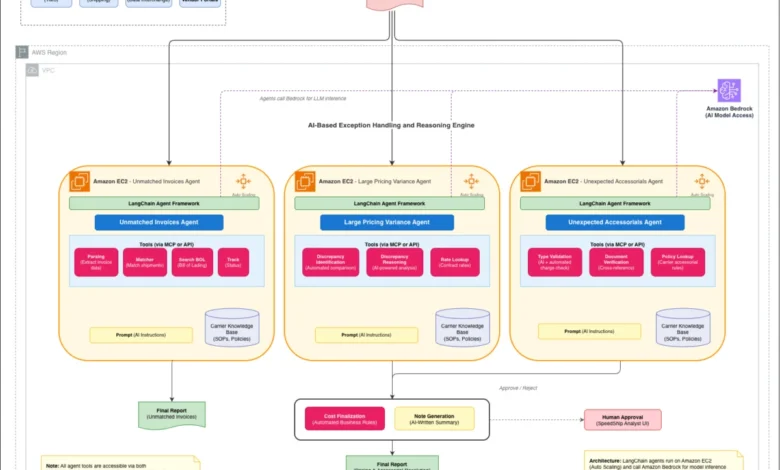
The core of the solution lies in its departure from traditional, monolithic software. Instead of a single "black box" algorithm, the architecture utilizes three distinct, specialized AI agents, each designed to handle specific categories of billing disputes. This modularity ensures that if the logic for one carrier’s surcharge policy changes, the entire system does not need to be rebuilt—only the specific knowledge base or agent instruction set requires an update.
The system is hosted on Amazon Elastic Compute Cloud (Amazon EC2), which provides the necessary computational engine to support the orchestration logic. This setup allows the Worldwide Express engineering team to maintain granular control over decision-making boundaries. Every action taken by an agent is fully auditable, a critical requirement for a financial operation that handles millions of dollars in freight charges.
The agents operate by pulling data from a curated "Carrier Knowledge Base." This database acts as a single source of truth, containing tariff rules, surcharge definitions, and standard operating procedures for each of the 75-plus carriers. Before an agent makes a recommendation to resolve a dispute, it cross-references the invoice against this carrier-specific data. This ensures that the AI’s output is not merely a guess, but a reasoned decision grounded in the specific contract and policy documents of the carrier involved.
Ensuring Accuracy through Human-in-the-Loop Design
In the initial stages of the rollout, Worldwide Express maintained a strict "human-in-the-loop" protocol. Every recommendation generated by the AI was routed to a FinOps analyst through the existing SpeedShip user interface. This period served a dual purpose: it allowed the team to verify the accuracy of the AI’s logic and fostered internal confidence in the new technology.
As the system matured, it achieved an accuracy rate exceeding 99 percent, allowing for the transition to bulk approval for standard disputes. This evolution was supported by robust observability tools. Dashboards now track the automation rate by carrier, error rates, and the frequency of human overrides. When an analyst rejects a recommendation, the system logs the feedback, which is then used to retrain the agents’ instruction prompts. This recursive improvement loop has created a self-optimizing ecosystem that continues to increase its automation coverage over time.
Industry Implications and Financial Impact
The broader implications of this deployment extend well beyond Worldwide Express. For the logistics and supply chain sector, this case study serves as a proof-of-concept for the viability of agentic AI in high-volume, low-margin environments. Many logistics firms have historically been hesitant to automate financial processes due to the high cost of errors and the complexity of carrier contracts. However, the $1 million in annual cost savings achieved by Worldwide Express—coupled with the 60x first-year return on investment (ROI)—suggests that the barrier to entry for AI-driven FinOps has significantly lowered.
Nathanael Pearson, VP of FinOps at Worldwide Express, noted that the speed of the new system has fundamentally changed the firm’s financial agility. "We’ve automated more than 40 percent of weekly billing exceptions, significantly reducing costs and accelerating billing cycles from days to minutes," Pearson stated. The result is a more liquid balance sheet, with roughly $10 million more in customer billings being released on a weekly basis than was previously possible.
Future Trajectory: Expanding the AI Footprint
The success of the billing exception project has set the stage for further technological expansion within the company. Worldwide Express is currently exploring the application of similar agentic frameworks to other components of the Order-to-Cash cycle. By proving that the model can handle the complex, carrier-specific variables of freight shipping, the firm has established a blueprint for automating virtually any process that requires a combination of data retrieval, policy interpretation, and standardized action.
For the wider industry, the lesson is clear: the path to successful AI adoption is not through massive, overarching transformations, but through well-scoped, problem-specific automation. By starting with the most repetitive and time-consuming exception types and proving the accuracy of the AI before scaling, logistics companies can effectively bridge the gap between traditional manual workflows and modern, automated operations.
Conclusion
The Worldwide Express deployment stands as a definitive case study in modern enterprise AI integration. By combining the reasoning capabilities of Amazon Bedrock with a rigorous, human-supervised architecture, the company was able to solve a multi-year financial bottleneck in less than six months. As the company continues to refine its models and expand its agentic capabilities, it is likely to remain at the forefront of the logistics industry’s digital transformation. The ability to turn days of manual work into minutes of automated processing is not just a technological win; it is a competitive advantage in an industry where speed and capital efficiency are the primary drivers of growth.
As other organizations look to replicate these results, the focus remains on the foundational elements that made this project successful: clean data, clear decision boundaries, and a commitment to maintaining human oversight until the machine proves its reliability. With the infrastructure now in place, Worldwide Express is well-positioned to continue scaling its operations, setting a high benchmark for the future of logistics finance.