Accelerating Software Development Cycles with Amazon Bedrock AgentCore Session Endpoints

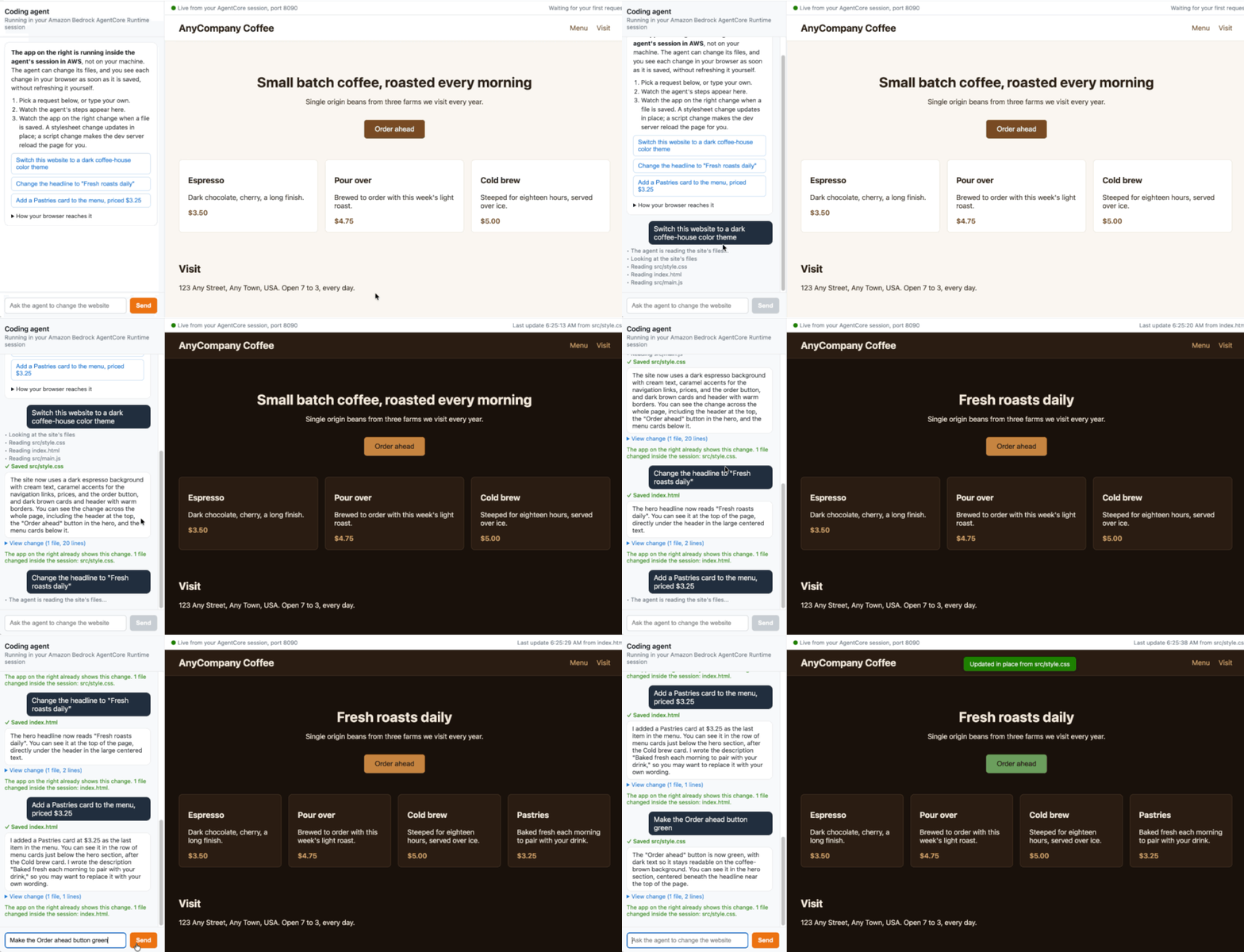
The landscape of generative AI-driven software engineering is undergoing a fundamental shift, moving from static code generation to interactive, real-time application development. A significant bottleneck in this evolution has been the feedback loop; traditionally, coding agents required developers to manually deploy applications to external environments before they could be tested or reviewed. Amazon Bedrock AgentCore is now addressing this latency with the introduction of Session Endpoints, a capability that enables developers to stream, review, and refine web applications directly from within the isolated microVM environments where the agents operate. By bridging the gap between agent-led creation and human validation, this technology promises to compress the iterative design cycle from hours to seconds.
The Evolution of the AI Coding Loop
In the traditional development lifecycle, coding agents function as standalone entities that produce code blocks, which are then vetted through human-in-the-loop deployments. This process often involves committing code to a repository, triggering a CI/CD pipeline, and waiting for a cloud deployment—a workflow that can take several minutes or even hours for a single UI change.
With the integration of Session Endpoints, Amazon Bedrock AgentCore shifts this paradigm. By providing an authenticated, secure URL that forwards HTTP traffic and WebSocket connections directly to an agent’s internal session, developers can observe a live preview of their application as it is being built. As the agent modifies files, the integrated development environment—such as a Vite-powered server—pushes updates to the browser in near-real-time. This eliminates the need for repeated manual deployments and allows for immediate course correction, effectively turning the agent into a collaborative pair programmer rather than a simple code generator.
Technical Architecture and Operational Flow
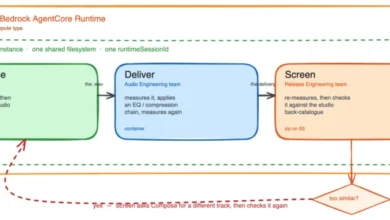
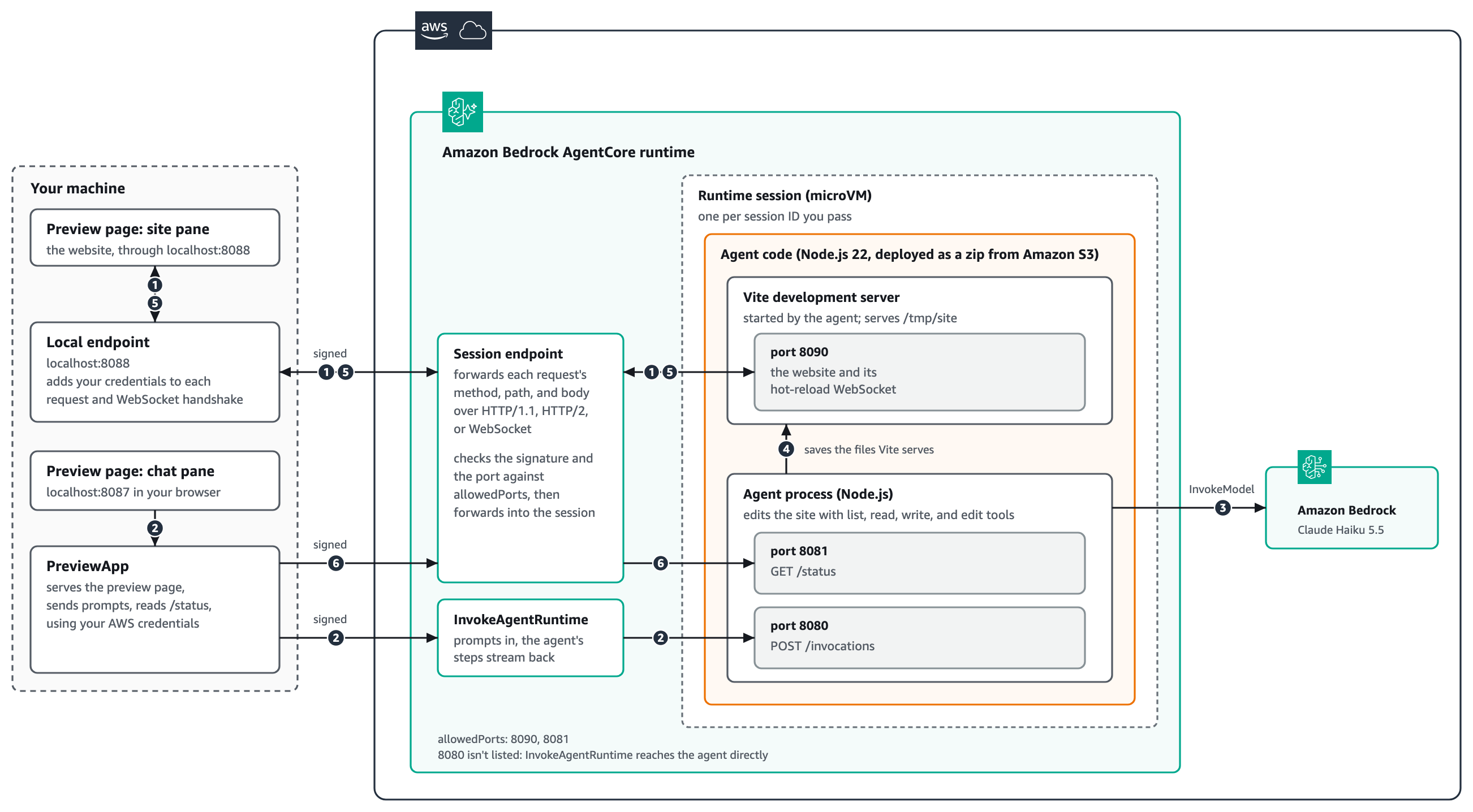
The underlying mechanics of Session Endpoints rely on an isolated, secure architecture designed for ephemeral development sessions. Each session runs within its own microVM, ensuring that the agent’s execution environment remains partitioned from other workloads. When a developer initiates an agent session, the Amazon Bedrock AgentCore runtime generates a specific session-scoped URL.
This URL is not merely a public gateway; it is a highly controlled interface. Security is managed through AWS Identity and Access Management (IAM) and Signature Version 4 (SigV4) protocols, ensuring that every request is cryptographically signed and authorized. For developers working within browser-based environments, the AWS SDK provides a local proxy client that automatically injects these credentials, allowing standard browsers to interact with the agent’s internal ports without sacrificing security.
The system allows developers to explicitly define "allowed ports" (ranging from 8000 to 12000), ensuring that only necessary services—such as a Vite web server or a diagnostic status endpoint—are exposed. This granularity prevents the unauthorized exposure of the agent’s internal management tools while providing enough flexibility to serve complex, multi-component applications.
Chronology of an Agent-Driven Update
To understand the practical impact, consider a standard request sequence for a UI modification:
- Prompt Initialization: The user submits a request through the preview application, such as "Change the navigation bar to a dark theme."
- Agent Processing: The agent receives this instruction through the primary
InvokeAgentRuntimechannel. It utilizes built-in file manipulation tools to read the existing CSS and HTML source files. - Execution and Modification: The agent applies the requested changes, updating the relevant files on the local filesystem of the microVM.
- Hot-Reloading: The development server (e.g., Vite) detects the file modification and triggers a hot-reload event via a WebSocket connection.
- Real-Time Rendering: The updated state is pushed through the Session Endpoint and the local proxy client, rendering the change in the user’s browser without requiring a page refresh.
This sequence typically completes in under three seconds, depending on the complexity of the file system operations. Such speed is transformative for product teams that rely on rapid prototyping, as it allows for multiple iterations within the span of a single meeting.
Implications for Enterprise Development
The introduction of Session Endpoints signals a broader move toward "In-Place Development," a strategy where the development environment, the build server, and the production preview converge into a single, managed session. Industry analysts have noted that the primary barrier to the widespread adoption of AI coding agents has been the "integration tax"—the time and effort required to integrate AI outputs into existing, complex codebases.
By providing a controlled sandbox, Amazon Bedrock AgentCore reduces the friction of testing. Furthermore, because these sessions are ephemeral, the risk of "configuration drift"—where a test environment becomes cluttered with obsolete files—is mitigated. Once the session ends, the environment is decommissioned, leaving no lasting footprint. This ephemeral nature is particularly advantageous for security-conscious organizations, as it minimizes the attack surface of development environments that would otherwise persist indefinitely.
Security and Compliance Considerations
A common concern with exposing internal agent sessions is the risk of unauthorized access. Amazon Bedrock AgentCore mitigates this through a multi-layered security approach:
- Authentication: Every request, including WebSocket handshakes, must carry valid IAM credentials. Knowledge of the URL alone is insufficient to gain access to the session.
- Auditability: Every interaction with a Session Endpoint is logged via AWS CloudTrail, providing a transparent audit trail of who accessed which port and when.
- Resource Isolation: The execution role assigned to the agent can be scoped to specific S3 buckets or other AWS resources, ensuring that even if an agent is compromised, the blast radius is contained within the microVM.
For teams handling proprietary code, these controls provide a necessary bridge between the convenience of cloud-based AI development and the rigorous security requirements of an enterprise environment.
Broader Industry Context
The competitive landscape for AI coding platforms—including offerings from major cloud providers and independent startups—is increasingly focusing on the "developer experience" (DX) of AI. While initial efforts focused on the quality of code generation (the "intelligence" of the model), the current focus has shifted toward the "utility" of that code. Providing a way to bridge the gap between a model’s output and a live application is a major differentiator.
By abstracting away the infrastructure overhead, Amazon Bedrock AgentCore allows developers to focus on product features rather than deployment configurations. This shift is expected to accelerate the development of "agentic" applications, where the agent is not just writing code but also managing the lifecycle of the service it creates.
Future Outlook
As these tools mature, we can expect to see further integration with established IDEs and collaborative platforms. The ability to "share" a Session Endpoint URL with a teammate—subject to proper IAM permissions—could facilitate real-time pair programming, where multiple stakeholders view the agent’s progress simultaneously.
The technical requirement to configure allowedPorts and ensure the application binds to 0.0.0.0 represents a minor hurdle for initial setup, but the trade-off is a robust, production-grade interface that supports diverse protocols, including gRPC and server-sent events. As the ecosystem of AI-ready tools continues to expand, the integration of session management into the core workflow of software engineering will likely become the standard for professional development, marking the end of the "copy-paste-deploy" era of AI software development.