Amazon Unveils SGLang-Neuron to Accelerate High-Performance AI Inference on AWS Trainium Hardware

Amazon has officially announced the public availability of SGLang-Neuron, a strategic integration that enables developers to leverage the SGLang framework directly on AWS Trainium hardware. This release, facilitated through a collaboration between RadixArk and Annapurna Labs—the Amazon-owned silicon design arm responsible for the Trainium and Inferentia chips—marks a significant expansion of the AWS machine learning ecosystem. By providing a seamless interface that allows existing SGLang workflows to run on custom silicon, Amazon is positioning its proprietary hardware as a high-performance alternative to traditional GPU-centric AI infrastructure. The integration is delivered through AWS Deep Learning Containers, ensuring that enterprise-grade stability and deployment speed remain at the forefront of the developer experience.
The Strategic Context of SGLang and Trainium
The landscape of generative AI has shifted rapidly from simple model experimentation to the demand for massive-scale inference production. SGLang has emerged as a preferred framework for developers due to its efficient handling of large language model (LLM) serving, prompt engineering, and complex request scheduling. Historically, however, the vast majority of high-end AI acceleration was tethered to CUDA-based environments.
AWS Trainium was developed to break this dependency, offering a cost-effective, energy-efficient platform specifically tuned for training and deploying deep learning models. By marrying the software versatility of SGLang with the specialized compute power of Trainium, AWS is addressing a critical bottleneck in the AI value chain: the need for software that can extract the full performance potential of non-GPU accelerators without requiring engineers to rewrite their entire codebase.
Technical Architecture and Execution Model
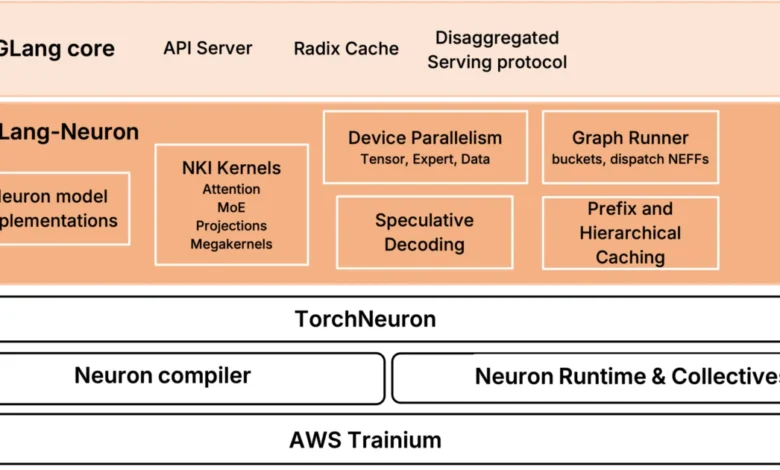
The integration is built on an out-of-tree plugin design, a deliberate architectural choice that ensures the SGLang core and Trainium support can evolve independently. This modularity allows for faster iteration cycles, as developers do not need to wait for full framework updates to implement new features specific to the Neuron SDK.
At the core of this execution path is the registration of the Neuron platform within SGLang. By setting the environment variable SGLANG_PLATFORM=neuron, the server initializes a specialized backend that delegates model execution to Trainium hardware. The SGLang core remains responsible for high-level tasks—such as request lifecycle management, RadixAttention for prefix caching, and scheduling—while the plugin handles the heavy lifting of model-specific execution, Mixture of Experts (MoE) routing, and graph compilation.
The utilization of torch.compile is a cornerstone of this performance strategy. By incorporating kernels written with the Neuron Kernel Interface (NKI), SGLang-Neuron bridges the gap between high-level PyTorch code and low-level hardware instructions. This allows the system to treat Trainium as a native PyTorch device, minimizing the cognitive load on developers transitioning from other hardware backends.
Scaling Through PD Disaggregation
One of the most technically demanding aspects of modern AI inference is the handling of long-context windows and high-throughput concurrent requests. SGLang-Neuron supports Prompt-Decode (PD) disaggregation, a sophisticated technique that separates the prefill phase (processing the input prompt) from the decode phase (generating the output tokens).
In a typical production environment, the prefill phase is computationally intensive and memory-bound, while the decode phase is latency-sensitive. By decoupling these, SGLang-Neuron allows architects to scale resources independently based on the specific bottlenecks of their models. The KV cache is transferred between the prefill and decode servers via the NIXL protocol, which operates over the Elastic Fabric Adapter (EFA). EFA provides low-latency, high-bandwidth interconnects that are essential for maintaining the performance gains realized by this disaggregated approach, ensuring that token generation speeds remain competitive even under heavy, unpredictable loads.
Industry Implications and Market Positioning
The arrival of SGLang-Neuron is not merely a software update; it represents a fundamental pillar in Amazon’s broader strategy to commoditize AI compute. For many years, the industry has suffered from "vendor lock-in" regarding hardware-software stacks. By supporting an open-source-aligned framework like SGLang, Amazon is signaling that it is committed to an open ecosystem where customers have the freedom to migrate workloads to Trainium without sacrificing the performance or convenience of established frameworks.
Data from early testing indicates that this integration allows organizations to maintain their existing operational habits. Because the SGLang API remains consistent regardless of the underlying hardware, engineering teams can shift workloads from GPU-based instances to Trainium-based EC2 instances with minimal refactoring. This operational portability is expected to drive adoption among enterprises that are currently struggling with the rising costs of traditional AI hardware and are seeking to optimize their spend on high-scale inference tasks.
Chronology of Development
The path to this release reflects the rapid pace of AI infrastructure development. Throughout early 2024, the focus shifted toward optimizing the Neuron SDK to support the latest Transformer architectures. Following the maturation of the Neuron Kernel Interface, the collaborative work between RadixArk and the AWS Annapurna team intensified during the summer months, focusing on the stability of the plugin interface. The introduction of the Deep Learning Container (DLC) format was the final step in ensuring that the system could be deployed in seconds rather than hours, meeting the rigorous demands of modern CI/CD pipelines.
Looking Ahead: Performance and Contributory Growth
The public release of SGLang-Neuron is accompanied by a suite of documentation designed to onboard developers into the AWS Trainium ecosystem. The repository currently hosts instructions for supported models and validated configurations, providing a clear roadmap for organizations looking to integrate the solution into their production environments.
The technical community is already viewing this release as a bellwether for the future of AI infrastructure. As model sizes continue to grow, the ability to effectively parallelize work across specialized silicon will become the primary differentiator for cloud providers. Amazon’s decision to open this interface to the community suggests a long-term commitment to transparency and co-innovation.
Looking forward, analysts expect to see increased performance benchmarks emerging from the SGLang-Neuron community as users begin to push the limits of Trainium’s scalability. Furthermore, the modular nature of the plugin architecture ensures that as newer, more powerful iterations of Trainium hardware become available, the transition for existing SGLang users will be seamless.
Conclusion
The availability of SGLang-Neuron represents a pivotal moment for developers leveraging AWS infrastructure. By providing a familiar, efficient, and scalable interface for running models on Trainium, Amazon is effectively lowering the barrier to entry for high-performance AI inference. Whether through the implementation of PD disaggregation for long-context tasks or the utilization of native PyTorch operations for standard serving, the framework provides the necessary tools for modern AI scaling. As the ecosystem continues to evolve, the collaborative spirit between the SGLang core team and AWS underscores a shared vision: that the future of artificial intelligence will be defined by software-defined hardware agility and the democratization of high-performance compute resources. For developers and enterprises alike, the call to action is clear: the integration is ready for testing, and the potential for cost-optimized, high-throughput inference is now a tangible reality within the AWS cloud.