Navigating the Remote Workforce Revolution: How Artificial Intelligence is Transforming Work-from-Home Jobs


The global employment landscape has undergone a seismic shift over the past decade, culminating in a hybrid and remote work model that is now a permanent fixture of the modern economy. As millions of professionals operate outside traditional office spaces, another technological revolution has emerged in parallel: the rapid integration of artificial intelligence (AI) into daily business operations. According to workplace insights shared by industry leaders like Harikrishna Kundariya, co-founder and Director of eSparkBiz, this convergence of remote work and AI is not a fleeting trend, but a fundamental restructuring of professional responsibilities, skill expectations, and organizational productivity.
To understand the current state of work-from-home (WFH) jobs, it is essential to examine the background context of this evolution. Prior to 2020, remote work was often viewed as a niche perk or an occasional accommodation. The subsequent global health crisis forced organizations across all sectors—from finance and marketing to software development and customer support—to rapidly adopt digital-first infrastructure. Once the logistics of remote operations were stabilized, businesses quickly sought ways to maximize efficiency within these decentralized networks. Enter generative AI, machine learning algorithms, and automated data processing tools. Initially introduced to streamline basic administrative chores, AI has quickly graduated to a core operational layer that fundamentally alters how remote tasks are executed, supervised, and evaluated.
At its core, AI impacts remote work by eliminating repetitive, time-consuming tasks, thereby allowing distributed employees to redirect their cognitive energy toward high-impact, strategic initiatives. Industry data indicates that professionals utilizing generative AI and automated workflow systems save an average of several hours each week on data organization, document summarization, and baseline research. For remote workers, who must often navigate asynchronous communication and self-managed schedules, this efficiency translates into accelerated project delivery and improved work-life balance.
However, this technological leap has triggered a notable evolution in skill requirements. Modern employers no longer evaluate remote candidates solely on their ability to manage time autonomously or navigate basic virtual collaboration software. Instead, job descriptions increasingly emphasize a hybrid skill set: technological literacy, big data comprehension, cybersecurity awareness, and, crucially, AI tool proficiency.
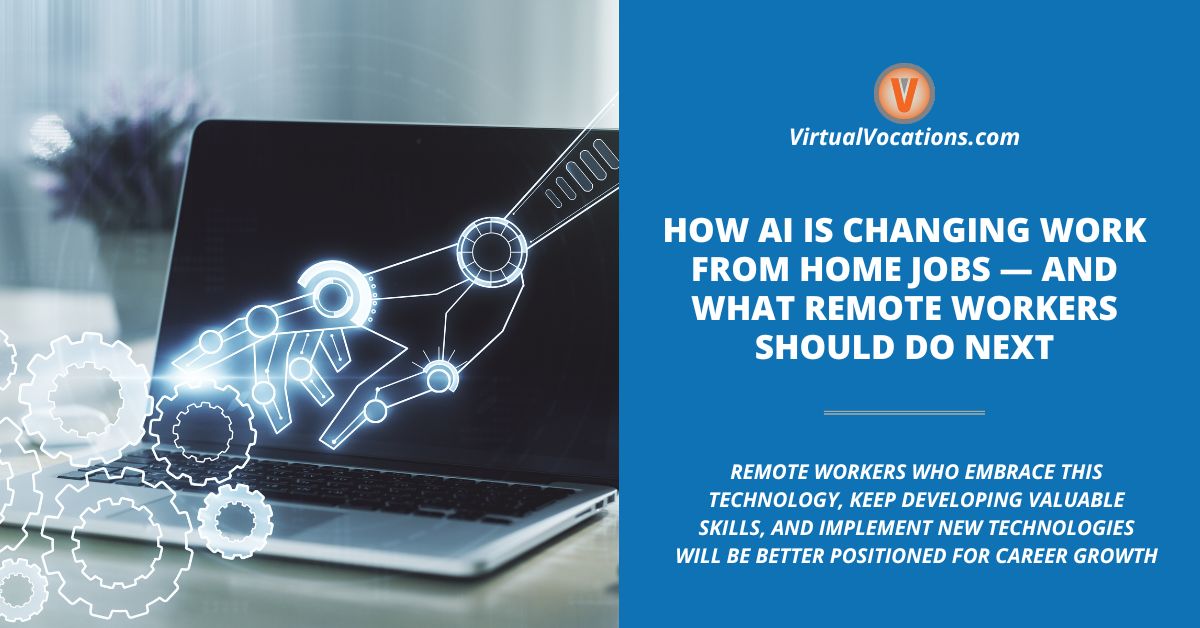
Conversely, as routine duties are increasingly automated, the value of inherently human capabilities has skyrocketed. Employers report a surging demand for emotional intelligence, complex problem-solving, creative direction, and empathetic leadership. In a remote environment where face-to-face oversight is minimal, workers who can seamlessly blend technical AI literacy with high-level human judgment are finding themselves uniquely positioned for career advancement.
The integration of artificial intelligence into decentralized workflows has also unlocked entirely new career paths that did not exist a few years ago. Organizations expanding their AI infrastructure require specialized personnel to execute, manage, supervise, and optimize these complex systems. Consequently, the remote job market has seen an influx of emerging roles, including AI-driven content strategists, prompt engineers, machine learning trainers, and specialized remote data governance managers. Companies are continuing to allocate significant capital toward digital transformation, forcing remote professionals to acquire targeted technical expertise if they wish to tap into these lucrative new employment verticals.
Decision-making processes have likewise been revolutionized by machine learning frameworks. Remote professionals—whether operating in sales, marketing, operations, or project management—are frequently tasked with synthesizing massive volumes of disparate data. Modern AI-powered analytical dashboards can process and contextualize these metrics in real time. Rather than relying on intuition alone, remote workers can now leverage predictive analytics to draft proposals, forecast market trends, and make informed operational decisions with unprecedented speed and accuracy.
Because technological standards shift continuously, continuous upskilling has transitioned from a professional recommendation to an absolute survival requirement for remote employees. Digital workflows and proprietary software update at a relentless pace. To remain competitive in a borderless talent pool, remote professionals must actively engage in ongoing education, whether through accredited online certification programs, industry webinars, or internal corporate training modules. Those who fail to update their technical repertoires risk professional obsolescence as employers gravitate toward agile, tech-forward candidates.
In specialized sectors such as content creation, marketing, and communications, AI tools have drastically compressed production timelines. Writers, designers, and editors now utilize advanced algorithms for rapid ideation, initial research drafts, and structural editing. Nevertheless, industry analysts emphasize that AI-generated output still lacks authentic narrative depth and critical context. Consequently, creative professionals are shifting away from manual execution toward roles centered on curation, brand storytelling, ethical oversight, and nuanced audience engagement.

Customer support and virtual assistance have experienced a parallel transformation. The widespread implementation of sophisticated natural language processing chatbots and virtual assistants has automated baseline troubleshooting, frequently asked questions, and routine ticket management. While this shift has altered the volume of inbound requests handled by human operators, it has elevated the role of human customer service agents. Remote support professionals now focus primarily on high-stakes, emotionally complex client interactions that require genuine empathy, intricate problem-solving, and personalized strategic solutions.
Despite the manifold advantages, the integration of AI into remote work structures is not without risks and challenges. Labor economists and cybersecurity experts frequently cite concerns regarding data privacy, algorithmic bias, and over-reliance on automated systems. Furthermore, the psychological pressure to constantly upskill in order to keep pace with technological updates can contribute significantly to digital burnout among remote workers who already struggle to establish boundaries between professional and personal life.
Addressing these challenges requires a proactive, structured approach from remote professionals. Industry experts recommend a five-pillar strategy for navigating the AI-driven workplace:
First, workers must learn the effective, ethical usage of AI tools, treating software not as an adversary or a total replacement, but as an indispensable productivity partner. Second, they must deliberately cultivate human-centered skills—such as cross-functional communication, empathy, and advanced critical thinking—that algorithms cannot replicate. Third, professionals must maintain a high degree of cognitive flexibility and remain fundamentally open to organizational changes and shifting job descriptions. Fourth, staying updated on industry-specific trends through continuous market research ensures that workers can anticipate technological shifts rather than merely reacting to them. Fifth, professionals must master the art of combining technological speed with human creativity, recognizing that the most successful remote workers are those who extract maximum value from human-machine collaboration.
Looking toward the horizon, the future of work-from-home jobs will not be defined by human displacement, but by professional augmentation. Artificial intelligence is here to stay, and while it will inevitably phase out redundant administrative tasks, it will simultaneously enrich complex job roles and generate novel employment categories. Overcoming the structural hurdles of the modern remote workplace requires a commitment to lifelong learning, resilience, and adaptability. By harnessing AI to amplify their unique human capabilities, remote professionals can secure long-term career viability in an increasingly competitive global economy.
Related posts: