The Invisible Incentive: Why Private Companies Are Failing to Capitalize on Executive Equity

Private companies have long utilized equity-based compensation as a cornerstone of their talent acquisition and retention strategies, aiming to align the long-term interests of senior leadership with the financial trajectory of the business. However, new data from the Chief Executive Group’s 2026–2027 CEO & Senior Executive Compensation Report reveals a widespread structural weakness: many organizations are failing to translate these complex financial instruments into tangible, motivational value for their executives. While the intention behind granting equity is to foster a sense of "ownership mentality," the lack of regular valuation and transparent communication is effectively neutralizing the potential impact of these incentives.
The Valuation Gap: A Strategic Oversight
In the public markets, equity incentives carry a clear, real-time price tag. Executives at publicly traded firms can monitor their net worth through daily stock fluctuations, creating a visceral connection between corporate performance and personal wealth. In contrast, executives at private firms often operate in a vacuum. Without a publicly traded ticker, the value of their equity stake is frequently opaque, reported only intermittently or based on internal formulas that lack the credibility of independent appraisal.
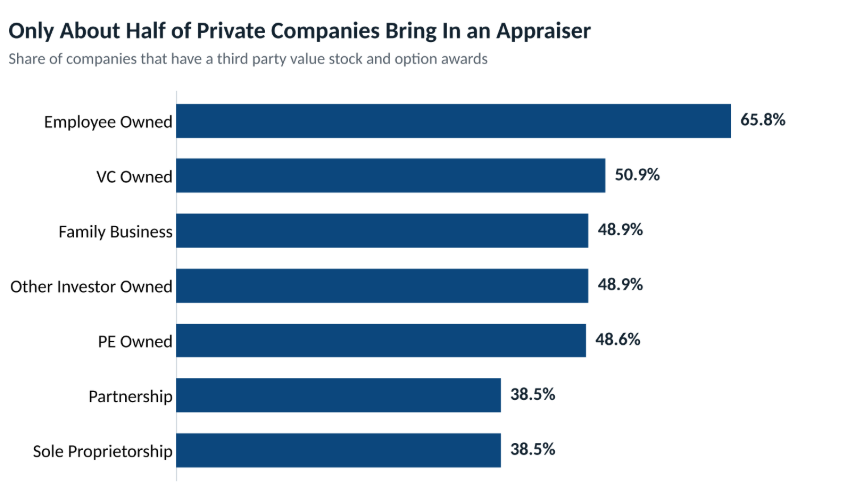
The Chief Executive Group research highlights that only about half of private companies engage an outside party to conduct formal valuations of stock or option awards. Employee-owned companies demonstrate the highest level of transparency, with 66 percent utilizing independent appraisers. Conversely, sole proprietorships and partnerships lag significantly, with only 39 percent opting for external validation. The remaining cohort relies on internal estimates provided by the CFO or administrative staff, or worse, formulas tethered to fluctuating metrics like profit or sales—metrics that may not accurately reflect the true fair market value of the enterprise.
This discrepancy in valuation rigor creates a "visibility gap." If an executive cannot clearly quantify the worth of their stake, the incentive ceases to function as a motivator. It becomes a theoretical future benefit rather than a current, high-value asset, thereby diminishing its power to influence day-to-day decision-making or ensure long-term commitment to the organization.
Chronology of Equity Evolution
To understand the current state of executive compensation, one must look at the historical shift in how private companies incentivize talent. Historically, executive pay was largely cash-centric, with base salary and annual bonuses forming the totality of compensation. Over the last two decades, as private equity and venture capital firms began to dominate the middle-market landscape, the model shifted toward "skin in the game."
The 2010s saw an explosion in phantom equity and stock option programs as firms sought to mimic the success of tech-heavy, growth-oriented startups. However, this adoption was largely driven by the desire to keep compensation costs low in the short term by backloading rewards. By the early 2020s, a maturation period occurred where firms realized that simply granting equity was insufficient; if the executive did not understand the valuation methodology, the retention benefits were negligible. Today, the focus has shifted toward the "communication of value"—the realization that the perception of equity value is as critical as the actual value itself.
Data-Driven Realities of Compensation
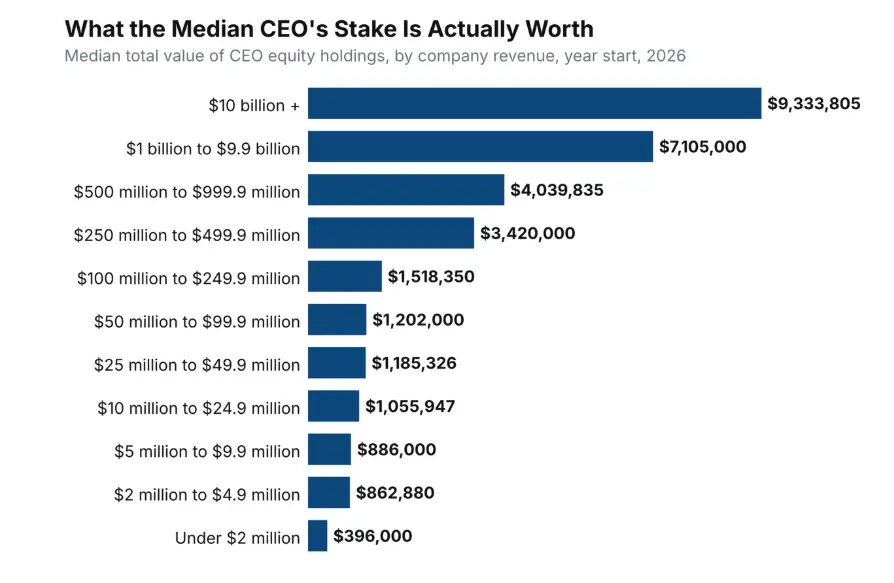
The range of equity value is immense, dictated largely by the scale of the organization. According to the 2026–2027 report, the median stake for a CEO in a company with less than $2 million in revenue sits at approximately $396,000. This figure scales aggressively with company size, reaching a median of $7.1 million for companies in the $1 billion to $9.9 billion revenue bracket.
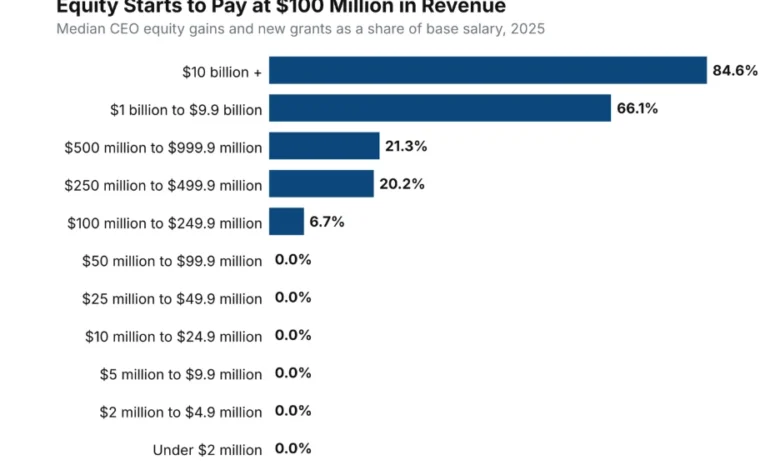
Furthermore, the importance of equity as a component of total compensation grows in lockstep with corporate revenue. For firms generating $100 million to $249.9 million in annual revenue, equity gains and new grants account for roughly 7 percent of the base salary. In the $250 million to $499.9 million range, that figure jumps to 20 percent. By the time a company hits the $1 billion threshold, equity represents 66 percent of the CEO’s total compensation package.
These figures illustrate a striking irony: while equity represents the majority of an executive’s potential wealth at larger private firms, the systemic failure to provide consistent, independent valuations means that this massive asset remains "invisible" on the balance sheet of the executive’s personal financial planning.
Case Studies in Transparency
For companies that have mastered the art of communication, the results are significant. Pete Ensch, CEO of Sani-Matic, a private equity-backed manufacturing firm, provides a blueprint for best practices. Sani-Matic partners with their sponsor to track valuation on a quarterly basis, supplementing this with a formal, independent valuation every year.
Perhaps most importantly, the company has implemented a personalized statement program. Each equity holder receives a document detailing the current value of their stake alongside a "what-if" scenario analysis, demonstrating potential outcomes based on various exit valuations. Ensch notes that this transparency is vital, even when the news is not always positive. "Everybody was doing the same thing, just doing their own math," Ensch observed. "It comes down to the numbers."
In the Midwest, Parr Instrument Company offers a different, yet equally successful, model. Operating for 127 years as an independent entity, the company utilizes an annual independent appraisal. They offer key employees the opportunity to purchase shares at a 40 percent discount to that appraised value. Because this discount creates taxable income, the annual appraisal is not just a tool for motivation—it is a functional requirement for tax compliance. Both Sani-Matic and Parr Instrument underscore a growing trend: requiring executives to invest their own capital. While only 22 percent of companies currently mandate this, it serves to align the executive’s risk profile with that of the shareholders, creating a shared burden of downside risk and a shared bounty of upside gain.
Broader Implications for Private Governance
The lack of rigorous valuation and communication strategies carries significant implications for the long-term viability of private companies. When executives are disconnected from the value of their equity, the compensation structure loses its primary purpose: the alignment of incentives. This disconnection can lead to "short-termism," where executives prioritize immediate cash bonuses over the long-term appreciation of the business, because the long-term reward is too abstract to influence their decision-making.
Moreover, in a competitive talent market, private companies that fail to clearly articulate the value of their equity packages are at a distinct disadvantage. Top-tier candidates, particularly those coming from private equity or public company backgrounds, are accustomed to data-driven compensation. When a prospective employer cannot demonstrate the value of the equity being offered, it can be perceived as a lack of organizational maturity or, worse, a sign of poor financial health.
Strategic Recommendations for 2027
As private company leaders review their compensation strategies for the 2027 fiscal year, the path forward is clear. The priority must be shifting from the granting of equity to the active management of equity perception.
- Formalize Independent Valuations: Move away from internal, formula-based estimations. Engaging a third-party appraiser provides the objective data necessary to build trust with the executive team.
- Standardize Communication: Implement quarterly or annual personalized statements. These documents should clearly articulate the current value of the equity and, where appropriate, model the potential financial impact of various growth or exit scenarios.
- Link Vesting to Meaningful Milestones: While time-based vesting remains the most common strategy, firms should consider increasing the use of performance-based vesting. This creates a direct feedback loop between company growth and executive reward.
- Encourage "Skin in the Game": While not suitable for every company culture, requiring executives to invest a portion of their own capital transforms the equity from a "gift" into a "shared investment," fundamentally changing the mindset of the leadership team.
Ultimately, the goal for private company owners is not necessarily to increase the sheer volume of equity grants or inflate compensation costs. It is to ensure that the existing incentive structure is understood, credible, and fully aligned with the company’s long-term strategic ambitions. In an era where human capital is the primary driver of enterprise value, an invisible incentive is, in reality, no incentive at all. Companies that successfully bridge the valuation gap will be better positioned to attract, retain, and motivate the leadership required to navigate an increasingly complex economic landscape.