Pinecone Nexus Generally Available, Launching a Knowledge Engine to Revolutionize AI Agent Interaction with Enterprise Data

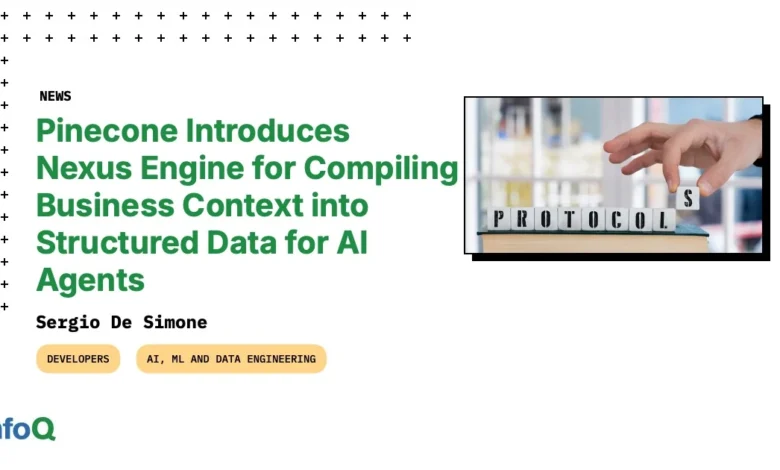
Pinecone, a leading name in vector database technology, has officially announced the general availability of Pinecone Nexus, an innovative "knowledge engine" specifically engineered to empower AI agents by transforming disparate enterprise data into a structured, queryable layer. This strategic move aims to address a critical bottleneck in enterprise AI adoption: the efficient and accurate retrieval of proprietary business context for intelligent agents. By enabling teams to ingest and curate vital business information once for all, Nexus promises to make this context reusable across various AI applications, significantly reducing token costs while simultaneously enhancing the accuracy and reliability of agent responses.
The Evolving Landscape of Enterprise AI and Data Challenges
The rapid advancement of artificial intelligence, particularly large language models (LLMs) and autonomous AI agents, has opened unprecedented opportunities for businesses to automate complex tasks, derive insights, and personalize experiences. While LLMs excel at processing and generating human-like text based on vast amounts of "world knowledge" acquired during their training, their inherent limitations become apparent when confronted with the unique, often sensitive, and highly specific data that defines an enterprise’s operations. This "business context" – encompassing everything from contracts, internal wikis, HR documents, meeting notes, customer support tickets, and financial records – is typically scattered across numerous siloed systems within an organization.
Vector databases, a domain where Pinecone has established significant leadership, have emerged as a crucial component in bridging the gap between LLMs and proprietary data through Retrieval-Augmented Generation (RAG). RAG systems allow LLMs to access and incorporate external information by first finding relevant documents based on semantic similarity. However, even advanced RAG implementations often fall short when dealing with the intricate web of relationships, nuances, and domain-specific logic inherent in enterprise knowledge. Agents attempting to perform complex tasks, such as legal reasoning or financial analysis, often struggle with synthesizing information from multiple sources, understanding implicit relationships, or performing cross-document reasoning. Each query often triggers a new, inefficient retrieval loop, leading to escalating token costs, slower processing times, and potentially incomplete or inaccurate answers due to the unstructured nature of the retrieved data.
Introducing Pinecone Nexus: A Paradigm Shift in Knowledge Management for AI
Pinecone Nexus directly confronts these challenges by introducing a dedicated knowledge layer designed to structure and optimize enterprise data specifically for AI agents. Rather than merely indexing raw documents for semantic search, Nexus focuses on compiling an enterprise’s distributed knowledge into a cohesive, structured format that agents can query directly. This approach fundamentally shifts the token expenditure model: instead of incurring high costs for per-query retrieval and interpretation by the LLM, a significant portion of the processing is moved to a one-time curation step. This pre-processing and structuring of knowledge allows agents to access information much more efficiently and effectively, akin to providing them with a highly organized library rather than a pile of unindexed books.
The conceptualization of Nexus stems from Pinecone’s deep understanding of the AI data stack. Recognizing that enterprises require a layer beyond mere vector search to unlock the full potential of AI agents, Nexus was developed as a "knowledge engine" that not only stores information but also understands its context, relationships, and significance within a specific business domain.
Chronology of Development and Public Release
Pinecone, founded in 2019, quickly became a pivotal player in the AI infrastructure landscape with its managed vector database service. As the AI ecosystem matured and the demand for more sophisticated agentic workflows grew, Pinecone identified the critical need for a solution that could move beyond basic semantic search. The development of Nexus represents a natural evolution of Pinecone’s offerings, building upon its expertise in high-performance data retrieval for AI. Initial discussions and conceptualization likely began in late 2022 or early 2023, as the limitations of pure RAG for complex enterprise tasks became increasingly apparent. The product entered private preview phases, allowing early adopters to test its capabilities and provide crucial feedback, before its public preview announcement and subsequent general availability. The general availability signifies a significant milestone, making this advanced knowledge engine accessible to a broader range of enterprises grappling with the complexities of AI agent deployment.
Key Architectural Components and Functionality
Pinecone Nexus is meticulously designed around several core components that facilitate the structured organization and querying of enterprise knowledge:
- Workspaces: These serve as the top-level containers, logically segregating resources. Typically, a workspace is associated with a specific team, department, or business unit, ensuring data isolation and tailored access control. This organizational structure is crucial for large enterprises with diverse data requirements and varying levels of data sensitivity.
- Contexts: Within each workspace, data is organized into "contexts." A context represents a specific dataset or a defined knowledge domain. For instance, an HR department might have contexts for "employee policies," "recruitment guidelines," and "benefits information." This granular organization allows for precise targeting of information and prevents agents from sifting through irrelevant data.
- Manifests: This is perhaps one of the most innovative and differentiating features of Nexus. Manifests define how raw data sources are ingested and converted into structured knowledge. Crucially, they incorporate subject matter expertise directly into the system. A domain expert can design a "blueprint" within a manifest, specifying the types of artifacts (e.g., "contract clauses," "legal precedents," "product features") and the relationships between them (e.g., "contract clause X references legal precedent Y," "product feature A is dependent on product feature B"). This pre-defined structure eliminates the need for an AI agent to infer the corpus’s structure at query time, enabling it to "inherit" the SME’s understanding, leading to vastly improved reasoning capabilities.
- Data Ingestion Connectors: To ensure seamless integration with existing enterprise data landscapes, Nexus supports a growing array of data sources. Currently, it handles local files, Box, and Microsoft OneLake, with planned support for widely used platforms like Google Drive, Slack, GitHub, Notion, Confluence, and Amazon S3. This broad connectivity is essential for capturing the fragmented nature of enterprise knowledge.
- KnowQL: Once ingested and curated, the structured data within Nexus can be queried using KnowQL, a specialized query language. KnowQL is designed to allow AI agents, chatbots, and recommendation systems to directly access and manipulate the curated knowledge, enabling more sophisticated and accurate interactions than traditional keyword or vector similarity searches alone.
Demonstrated Performance Gains and Early Adopter Success
The impact of Pinecone Nexus has been rigorously tested, with early adopters reporting significant performance gains, particularly in domains requiring complex reasoning and information synthesis. The results underscore Nexus’s ability to tackle challenges that traditional RAG systems struggle with:
- Legal Research: In the demanding legal domain, Nexus demonstrated a remarkable ability to complete all assigned tasks. This starkly contrasts with a mere 6% task completion rate for a general coding agent and 66% for a standard RAG system. The RAG system notably struggled with tasks requiring "doctrine synthesis, cross-case reasoning, and coverage questions" – complex analytical processes that demand assembling coherent answers from multiple, often nuanced, sources. Nexus’s structured knowledge layer, informed by manifests, directly addresses these challenges, allowing agents to navigate and synthesize legal information with greater precision.
- Enterprise Data Management: Similar improvements were observed in enterprise data management tasks, where Nexus achieved an impressive 90% accuracy, significantly outperforming a RAG system that managed only 65% accuracy. Furthermore, the curation cost for Nexus was remarkably low at $0.0038 per document, highlighting its efficiency in preparing data for AI consumption.
- Token Cost Reduction: Beyond accuracy and task completion, a critical economic benefit of Nexus is its substantial reduction in token spend. Pinecone reports that early adopters experienced an approximate ~9-15x reduction in token costs. This dramatic decrease is attributed to shifting the computational burden from expensive, per-query LLM processing to a more efficient, one-time data curation and structuring phase within Nexus. Agents no longer need to spend tokens "figuring out" the structure or relationships within raw documents, as this intelligence is pre-embedded.
These results are particularly significant for industries like financial services and legal research, where accuracy, comprehensive understanding, and cost-efficiency are paramount. The ability to perform complex reasoning tasks accurately and affordably positions Nexus as a transformative tool for these sectors.
Enterprise Readiness and Future Outlook
Pinecone Nexus is designed with enterprise-grade requirements in mind. It includes a preview playground, allowing users to connect their data sources, design contexts, and validate their approach before full deployment. For organizations with stringent regulatory, security, and compliance mandates, Nexus offers Bring Your Own Cloud (BYOC) deployment options. This flexibility ensures that sensitive enterprise data remains within the customer’s cloud environment, addressing critical concerns regarding data residency and security that are often non-negotiable for large corporations.
The introduction of Nexus signals a broader trend in the AI infrastructure market: a move beyond generic vector search towards specialized knowledge layers that cater to the unique demands of enterprise data. While vector databases remain foundational, solutions like Nexus elevate the utility of AI agents by providing them with a more intelligent and structured understanding of an organization’s internal world.
Competitive Landscape and Broader Implications
The market for structuring enterprise knowledge for AI is an emerging yet rapidly evolving space. Several other solutions are also addressing aspects of this challenge, including:
- Cognite: Known for its industrial data operations suite, Cognite focuses on contextualizing complex industrial data to power AI applications in sectors like energy and manufacturing.
- RelationalAI: Specializes in knowledge graphs and relational AI, aiming to provide a powerful platform for reasoning over highly structured data.
- LlamaIndex: While not a "knowledge engine" in the same vein as Nexus, LlamaIndex is an open-source data framework for LLM applications that helps connect LLMs to external data, offering various indexing and retrieval strategies that can be combined to build more sophisticated RAG systems.
Pinecone Nexus differentiates itself through its emphasis on "manifests" and the direct incorporation of subject matter expertise into the data curation process. This allows for a deeper, pre-defined understanding of relationships and entities, rather than relying solely on AI to infer structure at query time. The focus on a "knowledge engine" that compiles distributed knowledge into a structured layer for direct agent querying positions Nexus as a direct answer to the inefficiencies of current RAG implementations for complex, multi-source enterprise reasoning.
The broader implications of Nexus’s general availability are profound. It is likely to:
- Accelerate AI Agent Adoption: By making agents more reliable, accurate, and cost-effective, Nexus could significantly boost their adoption across various enterprise functions.
- Democratize Complex AI: It lowers the barrier for enterprises to build and deploy sophisticated AI applications that require deep domain knowledge, without needing to extensively fine-tune LLMs on proprietary data or rely on inefficient brute-force retrieval.
- Redefine Enterprise Data Management: Organizations may increasingly prioritize structuring and curating their internal data with AI agents in mind, leading to new data governance strategies and knowledge engineering roles.
- Foster Innovation in AI Workflows: Developers will be empowered to create more advanced and autonomous AI agents capable of tackling previously intractable problems, moving beyond simple question-answering to complex decision-making and automated task execution.
- Solidify Pinecone’s Position: Nexus strengthens Pinecone’s position as a critical infrastructure provider in the AI ecosystem, moving beyond just vector search to offer a comprehensive solution for enterprise AI knowledge management.
In conclusion, Pinecone Nexus represents a significant leap forward in the practical application of AI within the enterprise. By systematically structuring and optimizing business context, it addresses a fundamental challenge that has limited the potential of AI agents. Its general availability marks a pivotal moment, promising to unlock new levels of efficiency, accuracy, and intelligence for organizations navigating the complexities of the AI-driven future.