The Paradox of Pay: Aligning Executive Incentives with Strategic Value in Private Enterprises

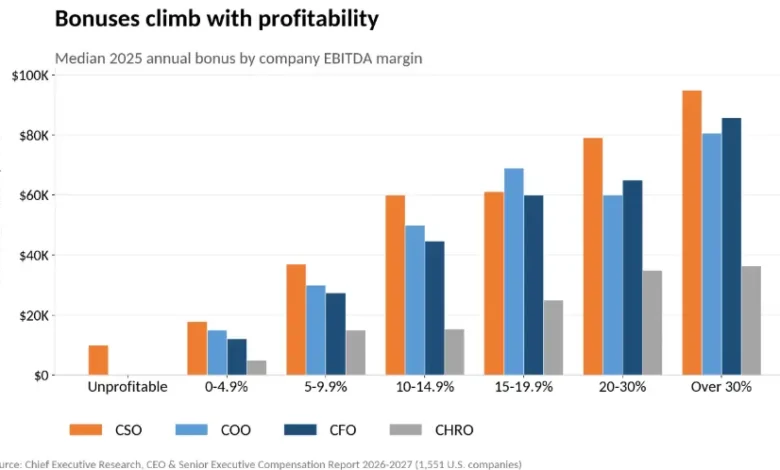
Private-company bonuses are rising sharply in lockstep with corporate profitability, yet new compensation data raises a critical question for CEOs: Are these financial rewards actually driving the behaviors that ensure long-term sustainability, or are they merely retrospective payouts based on favorable market tailwinds? A comprehensive analysis by Chief Executive Group Research, drawing on data from 1,551 U.S. companies, indicates that while the C-Suite is being compensated for growth, the disconnect between individual performance metrics and collective financial results remains a persistent structural vulnerability for private firms.
The Correlation Between Profit and Payouts
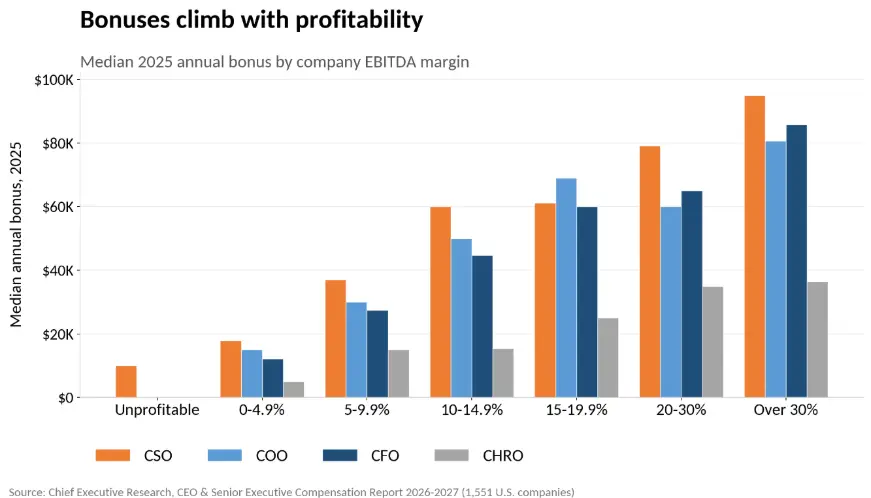
The fiscal landscape of 2025 showcased a stark relationship between EBITDA margins and executive compensation. According to the research, the correlation is not merely incidental; it is systemic. At companies reporting EBITDA margins exceeding 30 percent, the median bonus for a Chief Financial Officer reaches $85,842, while Chief Operating Officers see payouts around $80,625, and Chief Human Resource Officers receive approximately $36,503. Conversely, at firms that failed to achieve profitability in the same calendar year, the median bonus across these roles effectively drops to zero.
This pattern extends to the sales organization, which is often the most direct link to revenue growth. Chief Sales Officers (CSOs) at unprofitable firms saw median bonuses of roughly $10,103, whereas their counterparts in highly profitable environments—those exceeding 30 percent margins—garnered median bonuses of $95,000. This data confirms that private companies are currently operating under a "performance-pay" model that prioritizes top-line and bottom-line growth above all other operational KPIs.
Historical Context and Compensation Evolution
The evolution of executive compensation in private companies has shifted significantly over the past decade. Following the volatility of the early 2020s, private equity firms and independent boards of directors sought to standardize executive pay to ensure that leadership remained tethered to the company’s financial survival. The 2025 data represents the culmination of this trend, where "pay-for-performance" has become the industry standard.
However, historical analysis of compensation structures suggests that this reliance on simple financial benchmarks is a reactive measure. In the mid-2010s, compensation committees often included qualitative metrics, such as employee retention, leadership development, and strategic operational shifts. As the economic environment grew more complex, many boards simplified these plans, gravitating toward EBITDA and revenue growth as "objective" markers. While these metrics are easy to calculate and audit, they often fail to account for the nuance of individual executive mandates.
The Dangers of Homogeneous Incentive Structures
The current reliance on company-wide financial metrics creates a "rising tide lifts all boats" scenario, which can mask the true effectiveness of individual C-Suite members. Consider the hypothetical case of a COO tasked with streamlining supply chain inefficiencies during a period of market contraction. If the COO successfully reduces production costs by 15 percent, they have technically performed at an elite level. However, if the company’s revenue drops due to broader economic forces—factors outside the COO’s control—the resulting dip in EBITDA could lead to a diminished bonus.
This misalignment can lead to "compensation fatigue," where high-performing executives feel their specific contributions are ignored in favor of broader, macro-economic outcomes. Conversely, an executive who occupies a role in a high-growth sector may receive a significant bonus based on market conditions rather than individual strategic prowess. This "luck-based" compensation can create internal friction, as leaders in critical, yet non-revenue-generating functions (like CHROs or operational heads), are left at the mercy of factors they cannot influence.
Segmented Performance Measurement
For a compensation plan to be truly effective, it must distinguish between company-wide results and departmental KPIs. Industry experts suggest that the most resilient organizations are moving toward a hybrid scorecard approach:
- CFOs: Performance should be evaluated against capital allocation effectiveness, liquidity management, and the success of long-term debt restructuring, rather than just raw EBITDA.
- COOs: Metrics should focus on operational efficiency, quality control, and the successful integration of new technologies or processes, which often have a multi-year horizon.
- CHROs: Accountability should be measured by talent retention, leadership succession planning, and workforce productivity metrics that predict future revenue generation.
- Sales Leaders: While revenue is the primary goal, these roles should also be incentivized based on pricing discipline, customer acquisition costs, and the profitability of specific client segments.
By bifurcating these responsibilities, boards can ensure that executives are motivated to perform their specific functions at a high level, regardless of the quarterly financial volatility.
The Long-Term vs. Short-Term Incentive Trap
A significant implication of the current research is the tendency for companies to prioritize short-term gains at the expense of long-term viability. When an executive’s entire variable compensation is tied to a one-year profit target, they are mathematically disincentivized from pursuing long-term investments. For example, a CFO might cut R&D spending to boost this year’s EBITDA, thereby inflating their bonus at the cost of the company’s competitive advantage three years down the line.
To mitigate this, organizations are increasingly adopting multi-year performance plans (MYPPs) and equity-based compensation. These tools serve to align the executive’s personal wealth with the long-term enterprise value of the firm. However, as noted in the Chief Executive Group study, the mere existence of these plans is insufficient. They must be supported by clear, transparent, and attainable targets. If an executive does not understand the path to the long-term payout, or if the criteria for success are opaque, the incentive ceases to function as a motivator.
Implications for Future Leadership
As private companies prepare for the fiscal challenges of the late 2020s, the design of compensation programs will serve as a bellwether for organizational health. The data suggests that companies that continue to rely solely on revenue and EBITDA to dictate bonuses may face a talent drain. Top-tier executives are increasingly seeking organizations that recognize the "hidden work"—the operational improvements and structural changes that do not appear on a P&L statement until several quarters or years later.
For CEOs and boards, the directive is clear: it is time to audit the incentive program. The goal is to shift the conversation from "did we make money?" to "did we perform the work necessary to sustain growth?" This transition requires a shift in internal culture, where performance reviews are seen as strategic tools rather than administrative hurdles.
Conclusion: Rethinking the Compensation Philosophy
There is no singular, universal formula that fits every business, as the complexity of private enterprise demands flexibility. However, the data confirms that there is a profound difference between paying executives for having been part of a profitable year and designing an incentive structure that compels the company to perform better in the future.
CEOs must evaluate whether their current plans are merely distributing profits or actively managing talent performance. If an incentive program ignores the specific, individual contributions of senior leadership, it is failing in its primary purpose. As we move into the next phase of economic cycles, the companies that successfully tie compensation to strategic, multi-dimensional performance will likely be the ones that sustain long-term dominance, while those tethered to the simplicity of annual profit snapshots risk stagnating.
Ultimately, the most effective compensation plans are those that foster a culture of accountability. By refining metrics, incorporating long-term incentives, and acknowledging the distinct value of every C-Suite role, CEOs can transform their bonus structures from simple overhead costs into powerful levers for growth. The research provides the benchmarks; the implementation of these insights remains the final, and perhaps most important, responsibility of the modern chief executive.