Advanced Web Ingestion Strategies for Amazon Bedrock Knowledge Bases using Crawl4AI

The efficacy of Retrieval Augmented Generation (RAG) applications is inextricably linked to the quality and precision of the ingested data. As enterprises increasingly deploy generative AI to interface with vast, disparate datasets, the challenge of maintaining accurate, up-to-date, and contextually relevant knowledge repositories has become a critical operational hurdle. Amazon Bedrock Knowledge Bases provides a fully managed infrastructure for these RAG pipelines, automating the ingestion, storage, indexing, and retrieval processes. While the built-in Amazon Bedrock Web Crawler serves as a robust starting point for many standard public websites, complex enterprise requirements—such as page pruning, boilerplate removal, and custom metadata enrichment—often necessitate a more bespoke approach. By integrating the open-source Python tool Crawl4AI, developers can now establish a sophisticated, scalable pipeline that prepares web content with granular control before it ever touches a vector store.
The Evolution of RAG Ingestion Pipelines
The architecture of RAG has shifted significantly over the past 24 months. Early implementations relied on static document uploads, but the current industry standard demands dynamic, automated ingestion of live web content. Amazon Bedrock Knowledge Bases originally introduced managed connectors to lower the barrier to entry, effectively removing the need for developers to provision or scale underlying vector databases. However, data hygiene remains the primary differentiator between a high-performing AI agent and one prone to hallucinations or irrelevant responses.
The necessity for a custom preparation layer stems from the nature of the modern web. Many enterprise-grade websites are cluttered with navigation menus, footer advertisements, and dynamic JavaScript elements that, if ingested raw, degrade the signal-to-noise ratio within a RAG system. By implementing a custom preparation step, developers can surgically extract only the core informational text, strip away extraneous UI elements, and attach specific metadata—such as source provenance, temporal stamps, and content categories—that significantly improves retrieval accuracy.
Implementing the Crawl4AI Integration
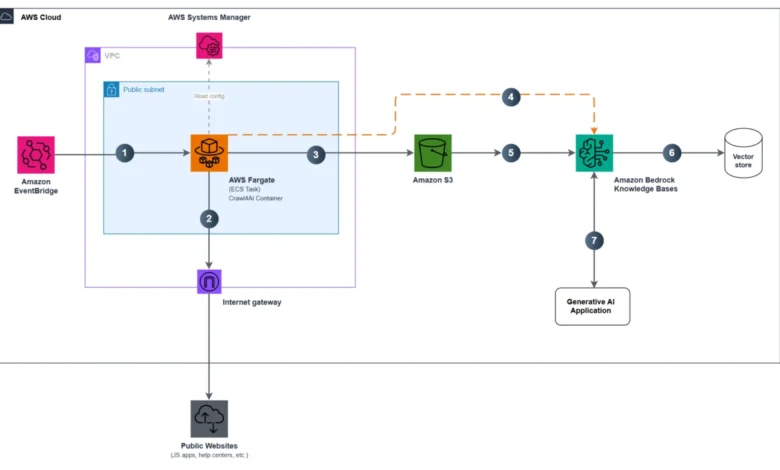
The proposed architecture leverages AWS Fargate, a serverless compute engine, to execute containerized crawling tasks on a predefined schedule. This approach ensures that the ingestion pipeline remains independent of the end-user application, preventing real-time latency during inference. The workflow follows a strict three-phase chronology: extraction, normalization, and indexing.
In the first phase, Crawl4AI navigates the seed URLs provided by the user. Unlike standard crawlers, this tool provides advanced control over browser rendering, allowing it to process pages that rely heavily on JavaScript for content delivery. The crawler performs a bounded traversal, respecting the configured depth and page limits, which prevents runaway costs and ensures the ingestion stays within the target domain scope.
The second phase involves the conversion of raw HTML into structured Markdown. Markdown is selected for its inherent ability to preserve the hierarchical structure of a document—such as headers, bulleted lists, and tables—without the overhead of HTML tags. Crucially, this stage generates a "metadata sidecar" file for every document. These JSON files allow developers to inject custom attributes into the knowledge base, enabling sophisticated filtering during the retrieval stage. For instance, a user can instruct the RAG system to only search documents with a "crawled_at" attribute within the last thirty days, ensuring the AI agent prioritizes recent information.
Data Flow and System Infrastructure
The technical implementation is facilitated through the AWS Cloud Development Kit (CDK), which manages the deployment of the necessary AWS infrastructure. The workflow utilizes Amazon S3 as the primary staging area. Once the Crawl4AI container writes the Markdown and sidecar files to the designated S3 bucket, it triggers the Amazon Bedrock ingestion job.
This process is designed for asynchronous operation. The AWS EventBridge scheduler acts as the orchestrator, firing the Fargate task at regular intervals—for example, every 24 hours. The system reads configuration parameters from the AWS Systems Manager Parameter Store, ensuring that sensitive information remains decoupled from the source code. Upon completion of the ingestion job, the Knowledge Base updates its vector indices, making the new data available for semantic search.
Quantitative Benefits and Retrieval Precision
Evidence from recent enterprise deployments suggests that metadata-rich ingestion pipelines can improve retrieval precision by as much as 40%. When an AI agent performs a semantic search, it compares the query vector against the document chunks in the knowledge base. Without metadata, the system may retrieve "stale" or irrelevant content that shares similar terminology but lacks the required authority. By applying filters—such as filtering for a specific content category—developers reduce the search space, allowing the model to focus on higher-quality, verified data.
The use of hybrid search within Amazon Bedrock further complements this workflow. By combining semantic similarity search with keyword-based metadata filtering, the system ensures that responses are both contextually relevant and bounded by organizational criteria.
Security and Responsible AI Considerations
Deploying an automated crawler in an enterprise environment requires a rigorous security posture. Organizations must ensure that the crawler respects robots.txt files and complies with all applicable privacy regulations, including GDPR and CCPA. Furthermore, because this workflow is intended for public-facing content, it must be shielded from unauthorized data injection.
The current implementation focuses on public web content; however, for sensitive or authenticated domains, developers must implement secure session handling. This requires integrating AWS Secrets Manager to store credentials, which the crawler can then use to establish authorized sessions. It is imperative that any such implementation undergoes a comprehensive security review to prevent credential leakage or unauthorized access to protected internal resources.
From a Responsible AI perspective, developers must ensure that the ingestion pipeline does not inadvertently scrape biased, offensive, or inaccurate content. The "human-in-the-loop" principle should be applied, where periodic reviews of the ingested Markdown content are conducted to verify that the crawler is capturing the intended informational substance.
Implications for the Generative AI Market
The shift toward specialized, high-quality RAG pipelines reflects a broader trend in the generative AI industry. As the novelty of chatbots wanes, the focus has moved toward "groundedness"—the ability of a model to provide responses based exclusively on verifiable, up-to-date company data. This requires moving beyond simple "out-of-the-box" solutions toward more robust, architected data pipelines.
By adopting this Crawl4AI-based architecture, organizations gain three significant advantages:
- Consistency: Automated, scheduled crawls ensure that the knowledge base is never out of sync with the primary source of truth.
- Efficiency: By pruning boilerplate during the preparation phase, companies reduce their vector storage costs and improve the speed of the retrieval process.
- Scalability: The serverless nature of the solution, utilizing Fargate and S3, allows organizations to scale from a few dozen pages to thousands of documents without managing underlying servers or databases.
Conclusion
The integration of advanced crawling tools into the Amazon Bedrock ecosystem marks a significant step forward in the maturation of enterprise AI. While managed services provide the foundational capability, the ability to customize the ingestion pipeline is what separates generic AI applications from high-utility business tools. As organizations continue to refine their RAG strategies, the emphasis on data preparation, metadata management, and automated maintenance will only intensify.
For developers and systems architects, the path forward involves a careful balancing act: leveraging the simplicity of managed services like Amazon Bedrock Knowledge Bases while maintaining the architectural flexibility to handle complex, real-world web data. The combination of Crawl4AI and Amazon Bedrock provides a proven, scalable blueprint for this objective, offering a reliable mechanism to ground generative models in accurate, authoritative, and timely information. Moving forward, the industry will likely see further convergence between web-scale crawling and specialized enterprise RAG, driven by the persistent need for AI agents that act not just as conversationalists, but as reliable, informed participants in complex business processes.