August 2026 Amazon Bedrock and AgentCore Updates Empower Enterprise AI Scalability and Autonomous Systems

The landscape of generative AI underwent a significant transformation in August 2026, as Amazon Web Services (AWS) unveiled a suite of updates to Amazon Bedrock and AgentCore designed to move AI beyond simple text generation and into the realm of complex, autonomous enterprise workflows. With over 225,000 active customers—a cohort that includes more than 80% of Fortune 100 corporations—AWS is shifting its strategic focus from foundational model access to the orchestration of persistent, long-running agentic systems.
A New Era of Agentic Infrastructure
The August updates represent a shift in the philosophy of enterprise AI. Historically, the primary challenge for organizations was the integration of large language models (LLMs) into existing software stacks. Today, the challenge has evolved into the management of "agents"—systems capable of reasoning over vast datasets, maintaining context over extended periods, and executing actions across digital and physical environments.
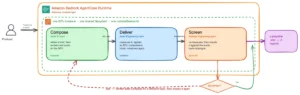
By integrating AgentCore with the open-source Strands Agent Harness SDK, AWS is providing developers with the architectural freedom to build and deploy agents across heterogeneous environments. This move is intended to break the "vendor lock-in" cycle, allowing companies to switch models or deployment frameworks without rewriting their core orchestration logic.
Chronology of August 2026 Developments
The rollout occurred in stages throughout the month, reflecting a systematic approach to enhancing both the intelligence of the models and the governance of the agents:
- Early August: Initial deployment of million-token context windows for GPT-5.6 Sol, Terra, and Luna models, alongside the introduction of native Web Search capabilities within Bedrock.
- Mid-August: Launch of Daybreak Red and Blue security models, providing specialized AI for offensive and defensive cybersecurity workflows.
- Late August: General availability of AgentCore runtime instances on dedicated EC2 hardware, enabling 14-day persistent sessions, and the expansion of AgentCore into the US West (N. California) and Asia Pacific (Hyderabad) regions.
- Final Week: Integration of Strands Robots with LeRobot and Hugging Face, marking the formal entry of these agentic frameworks into physical robotics workflows.
Expanded Contextual Reasoning and Cost Management
A critical bottleneck for enterprise adoption has been the inability of AI to process "working sets" of data—entire codebases or massive regulatory filings—without losing track of instructions. The introduction of million-token context windows for the GPT-5.6 family directly addresses this. By utilizing prompt caching, enterprises can now significantly reduce the cost and latency associated with repeating similar queries, a necessity for firms running high-frequency analysis.
Furthermore, the introduction of native Web Search enables these models to bridge the "training data gap." By accessing real-time pricing, live news, and current documentation, agents can now cite their sources, a requirement for audit-heavy sectors such as finance and legal services.
Financial oversight has been bolstered by new IAM principal cost allocation tools and AWS Cost Anomaly Detection. These tools allow IT departments to map specific AI expenditures back to individual project teams or business units, mitigating the risk of "shadow AI" costs that have plagued many enterprises as they scale their infrastructure.
Cybersecurity and the Daybreak Initiative
The introduction of Daybreak Red and Daybreak Blue is perhaps the most specialized update. Developed in collaboration with OpenAI, these models are tuned specifically for the security operations center (SOC). Daybreak Blue is optimized for vulnerability discovery and incident response, while Daybreak Red facilitates authorized offensive research, such as exploit reproduction.
Industry analysts note that this capability represents a shift in security, moving from reactive patching to proactive, AI-driven defense. By hosting these models within the controlled, zero-operator-access environment of Amazon Bedrock, AWS is providing a secure sandbox for sensitive security workflows that would otherwise be too risky to run on general-purpose public models.
Governance and Temporal Control
The expansion of AgentCore introduces a layer of "Temporal Policies," which govern the sequence of actions an agent can take. This is a vital development for industries operating under strict regulatory frameworks. An agent tasked with managing payments, for instance, can now be restricted by approval gates and rate limits that are enforced at the infrastructure level, rather than relying on potentially fragile application code.
The AWS Agent Registry serves as the central nervous system for these updates. By cataloging agents, skills, and tools, AWS is enabling internal "reusability." Instead of departments building duplicative agents for common tasks—such as data extraction or document summarization—they can now source these capabilities from a governed internal marketplace.
Cross-Regional Deployment and GovCloud Integration
For organizations operating in regulated environments, the availability of Claude Opus 5 and GPT-5.6 models in AWS GovCloud (US) is a major milestone. With zero data retention enabled by default, government contractors and public sector agencies can now leverage the same high-tier reasoning capabilities as commercial enterprises. The inclusion of Amazon Nova Multimodal Embeddings in GovCloud further allows these agencies to build sophisticated retrieval systems that handle video, audio, and image data alongside traditional text-based documents.
The Physical Frontier: Strands Robots
Perhaps the most ambitious extension of the August updates is the integration of Strands Robots. By linking Strands Agents with the LeRobot framework and Hugging Face, AWS has streamlined the pipeline from simulation to physical deployment.
In industrial settings, this means a robotic arm or an autonomous mobile robot (AMR) can be trained in a simulated environment using a specific dataset and then deployed to a physical facility without the need for complex data conversion. The coordination of these systems via mesh-based discovery ensures that fleets of robots can communicate and collaborate, effectively turning a group of independent machines into a cohesive, orchestrated unit.
Implications for the Future of Enterprise AI
The August 2026 updates signal that the "experimentation phase" of generative AI is nearing its conclusion. The emphasis on cost attribution, regulatory compliance, long-running agent persistence, and physical-world integration indicates that the market is moving toward a model of "delegated responsibility."
As AI systems become more capable of managing their own budgets and adhering to complex, multi-step logical constraints, the role of the human operator is expected to transition from "prompter" to "architect." The infrastructure provided by AWS is designed to sustain this transition, providing the guardrails necessary to delegate increasingly high-stakes tasks to autonomous agents.
For enterprises, the implication is clear: the focus is no longer on simply having an AI model, but on having an AI system that is observable, governed, and capable of operating across both the digital and physical domains of the modern enterprise. As the gap between digital reasoning and physical action narrows, the ability to deploy these systems securely and at scale will likely become the primary competitive differentiator in the global economy.