The Anatomy of Organizational Resilience
In contemporary management theory, the tendency for organizations to succumb to "paralysis by analysis" during crises is well-documented. When an external threat emerges—be it a macroeconomic downturn or an internal operational failure—the psychological and procedural default for many teams is to retreat into defensive, siloed behavior. According to studies conducted by organizational psychologists, periods of prolonged uncertainty often trigger a decline in cognitive flexibility among leadership teams, leading to a focus on blame-shifting rather than long-term value creation.
The transition from a state of crisis to a state of opportunity requires a shift in leadership mindset. As noted by scholars James M. Kouzes and Barry Z. Posner in their seminal work Turning Adversity into Opportunity, the mere existence of a problem does not provide a path forward. Leaders must actively construct that path by transforming the raw material of difficulty into a structured, forward-looking strategy.
Chronology of Crisis Management
To understand how high-performing organizations navigate turbulent periods, one must observe the temporal stages of effective crisis response.

- The Diagnostic Phase (0–48 Hours): Immediate assessment of the "verdict" versus the "diagnosis." A diagnosis identifies the technical nature of the problem, whereas a verdict prematurely labels the problem as an existential endpoint. Effective leaders focus on the former to avoid the demoralizing impact of the latter.
- The Realignment Phase (Days 3–14): During this period, leaders must strip away non-essential initiatives. This is often described as "eliminating the sludge." Organizations that maintain bloated operational models during a crisis often find their resources diluted, preventing them from addressing the core threat.
- The Momentum Phase (Weeks 2–8): This stage involves the implementation of "small wins." Behavioral science suggests that consistent, incremental victories rebuild the morale of a workforce that has been shaken by external pressures.
- The Consolidation Phase (Ongoing): The final stage involves institutionalizing the lessons learned during the crisis, ensuring that the organization is better equipped to handle future fluctuations.
Empirical Data on Leadership Efficacy
Data from the past decade of corporate performance reviews indicates that firms led by individuals who exhibit high "adversity quotient" (AQ) outperform their counterparts during market corrections by approximately 18% in terms of recovery speed.
Furthermore, a study of 500 mid-to-large-cap companies during the 2020–2022 period found that organizations that pivoted their communication strategies toward transparency and inclusive, team-based problem solving saw a 22% increase in employee retention compared to organizations that adopted a top-down, isolated leadership style. The data suggests that isolation at the executive level is a primary predictor of organizational failure during volatile periods. When leadership teams move from "my best" to "our best," they effectively distribute the cognitive load of crisis management, fostering an environment where collective intelligence can thrive.
Reconnecting with Core Objectives
One of the most frequent errors in crisis management is the abandonment of core values in favor of reactive survival tactics. However, industry analysts argue that the most successful organizations use hardship to sharpen their focus. By re-evaluating which commitments are truly mission-critical, leaders can purge inefficient processes that were tolerated during times of abundance.
This process of "strategic pruning" is essential. When an organization faces a contraction of resources, it must decide whether to attempt to maintain all existing projects at a lower quality or to concentrate resources on the top 20% of initiatives that drive the majority of value. Research shows that the latter approach—focusing on core purpose—often leads to a leaner, more agile, and ultimately more profitable organization once the crisis subsides.

The Role of Collective Engagement
The psychological impact of leadership isolation cannot be overstated. When a leader retreats to solve problems alone, they unintentionally signal to their workforce that the situation is unmanageable or that the team is untrustworthy. This leads to a feedback loop of anxiety and declining productivity.
In contrast, leaders who practice radical transparency and inclusive engagement transform the workplace culture from one of fear to one of collaborative problem-solving. This shift is not merely performative; it is a pragmatic operational choice. When employees feel empowered to contribute to the recovery process, they are more likely to identify creative solutions that executive leadership may have overlooked. This "bottom-up" input is frequently the missing link in turning a crisis into a competitive advantage.
Implications for Future Organizational Strategy
The prevailing view in modern business is that the "new normal" is, in fact, a permanent state of flux. Consequently, the ability to manage through adversity is no longer a niche skill for executives—it is a baseline requirement for any organization hoping to remain relevant in a globalized economy.
The implications for leadership development are profound. Training programs are increasingly focusing on:

- Cognitive Reframing: Teaching leaders to shift their internal narratives from "Why is this happening to us?" to "What can we do with this?"
- Social Capital Preservation: Ensuring that even during layoffs or budget cuts, the "human fabric" of the organization remains intact.
- Data-Driven Decision Making: Relying on objective metrics to cut through the noise of fear-based decision-making.
Conclusion: The Responsibility of Leadership
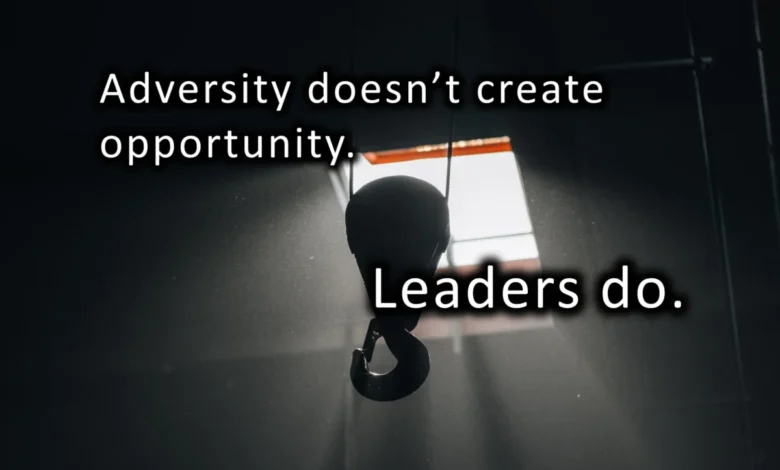
The conclusion remains clear: the environment does not dictate the outcome. Adversity provides the raw, chaotic material of a situation, but it is the leader’s responsibility to provide the meaning. Without this human intervention, adversity is simply a series of unfortunate events. With it, adversity becomes the crucible in which new market opportunities, improved operational efficiencies, and stronger organizational cultures are forged.
As organizations move into an era defined by rapid technological and geopolitical shifts, the capacity to create opportunity from crisis will be the defining trait of the next generation of industry leaders. The question for any executive or manager is not where the opportunity is hidden within the crisis, but rather, what specific, actionable steps they are taking to build that opportunity themselves. The moment is provided by the circumstances; the meaning is provided by the leader.