The Anatomy of the Inference Bottleneck
The deployment of generative AI at scale reveals a fundamental tension in hardware utilization. When a user sends a request to an LLM, the system undergoes two distinct phases: prefill (or prompt processing) and decoding (token generation). Prefill is compute-bound, taxing the GPU’s FLOPs as it processes the prompt context, while decoding is memory-bandwidth-bound, as the GPU must repeatedly fetch the model’s weights and KV (Key-Value) cache from HBM (High Bandwidth Memory) to generate a single token.
Without optimization, these processes create significant inefficiencies. GPU memory becomes cluttered with redundant KV cache data, while requests wait in queues, leading to high tail latencies. In high-traffic scenarios, this inefficiency manifests as "GPU starvation," where hardware sits idle waiting for memory reads, effectively wasting thousands of dollars per hour in cloud compute costs.
A Chronology of Inference Scaling
The evolution of inference optimization has mirrored the complexity of the models themselves. In the early 2020s, inference was straightforward; researchers simply loaded models onto a GPU and ran them. However, as models like GPT-3 and Llama emerged, the industry faced the "context window" wall.
- 2022–2023: The Batching Revolution: The introduction of continuous batching allowed systems to inject new requests into the pipeline as soon as others finished, rather than waiting for an entire batch to complete. This transformed throughput from a static metric to a dynamic, fluid process.
- 2023–2024: Memory Management Innovations: Technologies like PagedAttention gained prominence, mirroring the virtual memory systems used in traditional operating systems. By treating KV cache as a collection of smaller, non-contiguous pages, engineers were able to increase batch sizes by up to 5x.
- 2024–Present: The Era of Disaggregation: We have now entered the phase of architectural separation. Today, high-performance deployments often use "prefill-decode disaggregation," where separate clusters of hardware handle the compute-heavy prompt processing and the memory-heavy decoding tasks.
Navigating the Decision Matrix
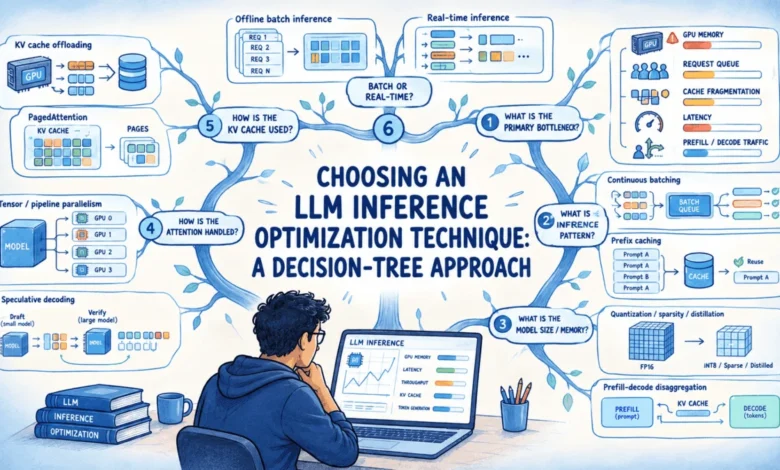
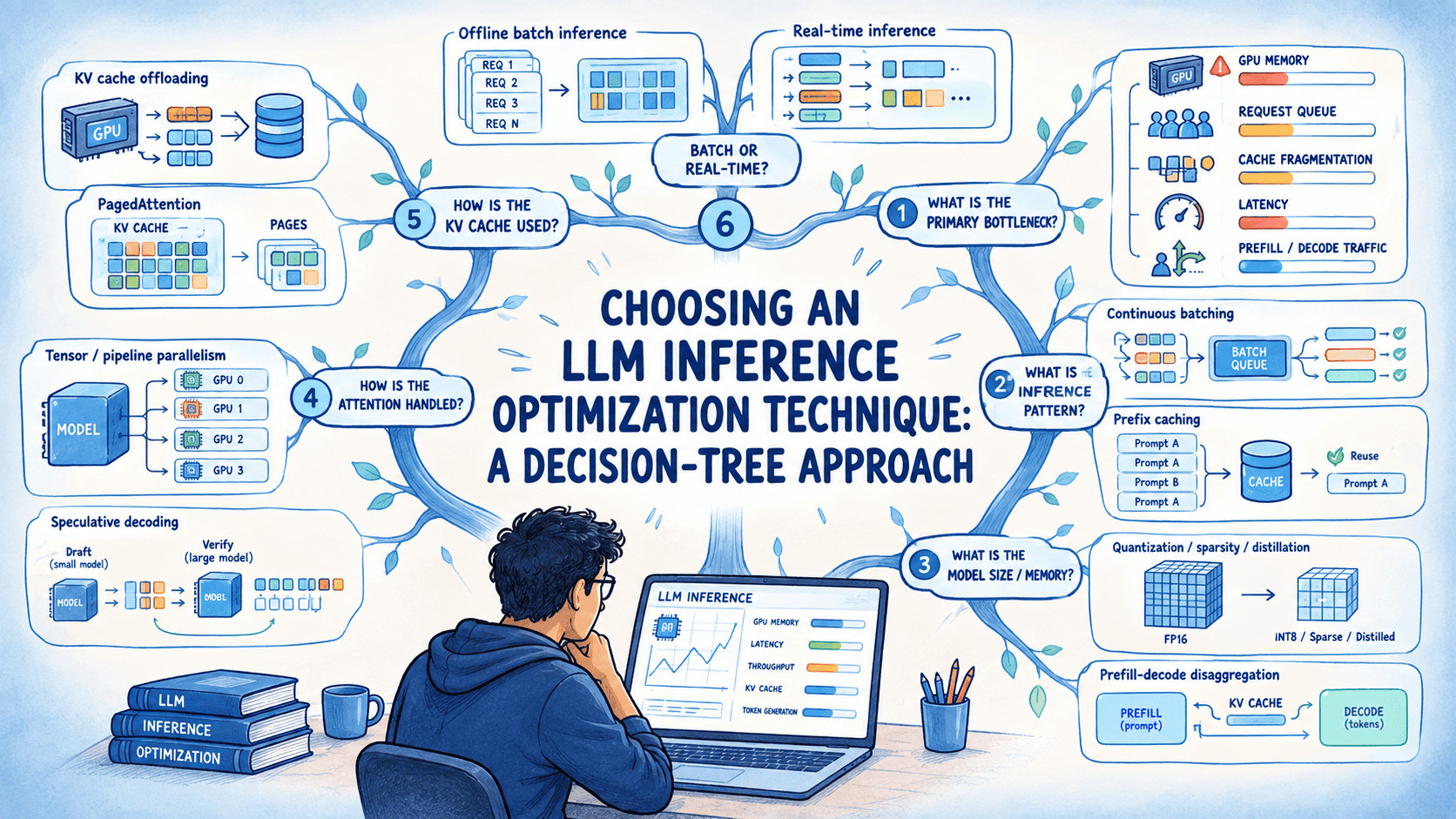
To optimize effectively, engineering teams must work through a six-stage decision tree that evaluates the hardware-software interaction.
1. The Hardware Constraint Assessment
The first step is determining if the model fits within the physical memory limits of the target hardware. If a model consumes 90% of a GPU’s VRAM just to load its weights, there is no room left for the KV cache or the activation tensors. In this scenario, the primary optimization path is model-level compression. Techniques such as quantization (reducing parameter precision from 16-bit to 4-bit or 8-bit) or weight pruning can shrink the model footprint significantly. While these methods introduce a slight risk of accuracy degradation, they are often necessary to unlock higher throughput.
2. Prompt Structure and Prefix Caching
For applications like customer service chatbots or code assistants, users often repeat the same system instructions. Without optimization, the LLM recomputes these instructions for every single request. Prefix caching addresses this by storing the KV cache of shared prompt sequences in memory. When a new request arrives that starts with a known prefix, the system skips the recomputation, leading to near-instantaneous processing for the initial segment of the interaction.
3. Resolving Dynamic Batching Inefficiencies
When traffic is heterogeneous—mixing short, simple queries with long, complex outputs—standard batching fails. The system is forced to wait for the longest request in a batch to finish before proceeding. Continuous batching solves this by allowing individual requests to terminate and exit the batch as soon as they generate an end-of-sequence token, while new requests enter the stream immediately.
4. Memory Fragmentation and PagedAttention
Just as a hard drive suffers from fragmentation, GPU memory can become inefficiently allocated. If an engine reserves a massive, contiguous block of memory for every request based on the maximum possible output length, it wastes gigabytes of memory. PagedAttention, a technique pioneered by the vLLM project, mitigates this by breaking the KV cache into small pages, allowing the system to use all available memory more effectively and thus increasing concurrent user capacity.
5. Optimizing Per-Token Latency with Speculative Decoding
If the priority is "time-to-first-token" and fluid, human-like streaming, speculative decoding is the primary tool. By using a small, "draft" model to predict the next few tokens and having a larger "target" model verify them in parallel, the system can generate multiple tokens in a single clock cycle. This is particularly effective when the draft model has high accuracy.
6. Disaggregation at Scale
For massive enterprise deployments, the final stage is splitting the infrastructure. By routing prefill tasks to high-compute nodes and decoding tasks to high-memory nodes, architects can achieve an optimal balance. However, this introduces network latency, making it an approach reserved for large-scale operations.
Analysis of Optimization Pitfalls
Infrastructure engineers often fall into the trap of over-optimization. For instance, implementing complex speculative decoding on a workload that is already performing well can introduce unnecessary latency due to the overhead of running a second, smaller model. Similarly, quantization is not a "silver bullet." If only weights are quantized while activations remain in full precision, the GPU will spend significant cycles converting data formats, potentially resulting in zero net throughput gain.
Data from industry benchmarks suggests that the most common failure mode is "blind optimization." Before applying any technique, engineers should profile their specific workload. If the KV cache hit rate is near zero, investing in prefix caching is a wasted effort. If batch sizes are not growing, the issue is likely a configuration error in the paging logic rather than a lack of hardware capacity.
Future Implications for Enterprise AI
The trajectory of LLM inference is moving toward "hardware-aware" software. As chips become more specialized—integrating dedicated engines for KV cache management and faster context processing—the software layer will continue to abstract away the complexity of these optimizations.
The ultimate goal for the industry is "zero-touch optimization," where the serving engine automatically detects the nature of the traffic and applies the appropriate techniques—whether it be PagedAttention for fragmented memory or disaggregation for high-volume bursts. Until then, the onus remains on developers to understand the specific bottleneck of their workload. By systematically applying this decision-tree approach, organizations can move from costly, inefficient prototypes to high-performance production systems capable of serving millions of users with minimal latency and optimized infrastructure costs. The roadmap to mastery in this field requires not just an understanding of the models themselves, but a deep, granular grasp of how data flows through the silicon that powers the modern AI era.