Optimizing Agentic Workflows with Decision Models and Amazon Bedrock AgentCore Evaluations

In the rapidly evolving landscape of generative artificial intelligence, the transition from experimental chatbot interfaces to autonomous agents has shifted the focus of development toward robust evaluation frameworks. As enterprises deploy AI agents to handle sensitive tasks ranging from HR inquiries to automated system approvals, the necessity for consistent, measurable performance metrics has become paramount. Amazon Bedrock AgentCore Evaluations now provides a sophisticated infrastructure to bridge the gap between qualitative LLM-based assessment and quantitative, deterministic decision-making, allowing developers to integrate specialized "decision models" into their evaluation pipelines.
The current state of AI evaluation often relies on "LLM-as-a-judge" architectures. While highly capable of processing nuanced, open-ended feedback and providing descriptive rationales, these general-purpose models suffer from inherent variability. Their confidence scores can drift between runs, and their reliance on generative text makes them difficult to threshold for automated, high-stakes decision-making. Conversely, decision models—specialized, smaller architectures trained to output calibrated probability distributions over a fixed set of outcomes—offer a stable alternative. By integrating tools like the hosted Jev model from TypeSafe or the open-source Strands Decider 2B, developers can now achieve a level of programmatic precision previously unattainable in agent testing.
The evolution of these evaluation methodologies marks a significant milestone in the AI lifecycle. Historically, evaluation was an afterthought, often relegated to manual human review or simplistic keyword matching. As agents began performing complex tasks, such as cross-referencing corporate policies with individual employee data, the demand for "trace-level" and "session-level" visibility surged. The integration of code-based evaluators within the AgentCore environment allows developers to intercept agent behavior in real-time, providing a structured data stream that can be interrogated by both generalist LLMs and specialized decision models.
At the core of this integration is the concept of the cascade evaluation pattern. In this architecture, a lightweight, highly calibrated decision model acts as a first-line screening layer. For every agent turn, the decision model assesses whether the response satisfies a narrow, pre-defined rubric—such as whether a response remained on-topic or adhered to a safety policy. Because these models output a concrete probability rather than a generative response, the system can immediately trigger an escalation to a more expensive, general-purpose LLM-as-a-judge only when the decision model’s confidence falls below a specific threshold. This dual-layer approach significantly optimizes computational costs while ensuring that complex failures receive the detailed forensic analysis required for root-cause investigation.
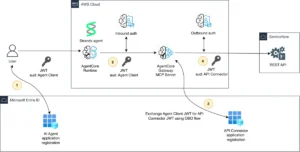
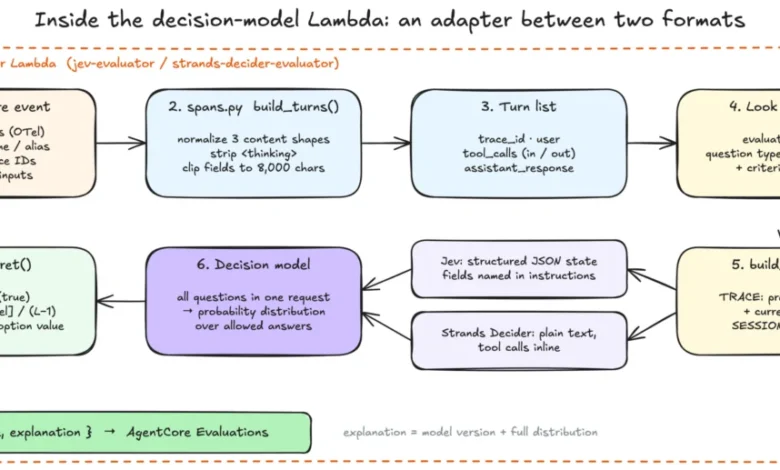
The technical implementation utilizes the Amazon Bedrock AgentCore runtime to capture OpenTelemetry spans, which contain the comprehensive history of the agent’s reasoning process and tool calls. A custom AWS Lambda function serves as the adapter, normalizing these spans into a format digestible by external decision engines. For instance, if an HR assistant agent attempts to access a restricted database, the decision model can process the request-response pair and return a binary probability score. This score is then mapped back into the AgentCore evaluation dashboard, allowing developers to set firm thresholds for production deployment.
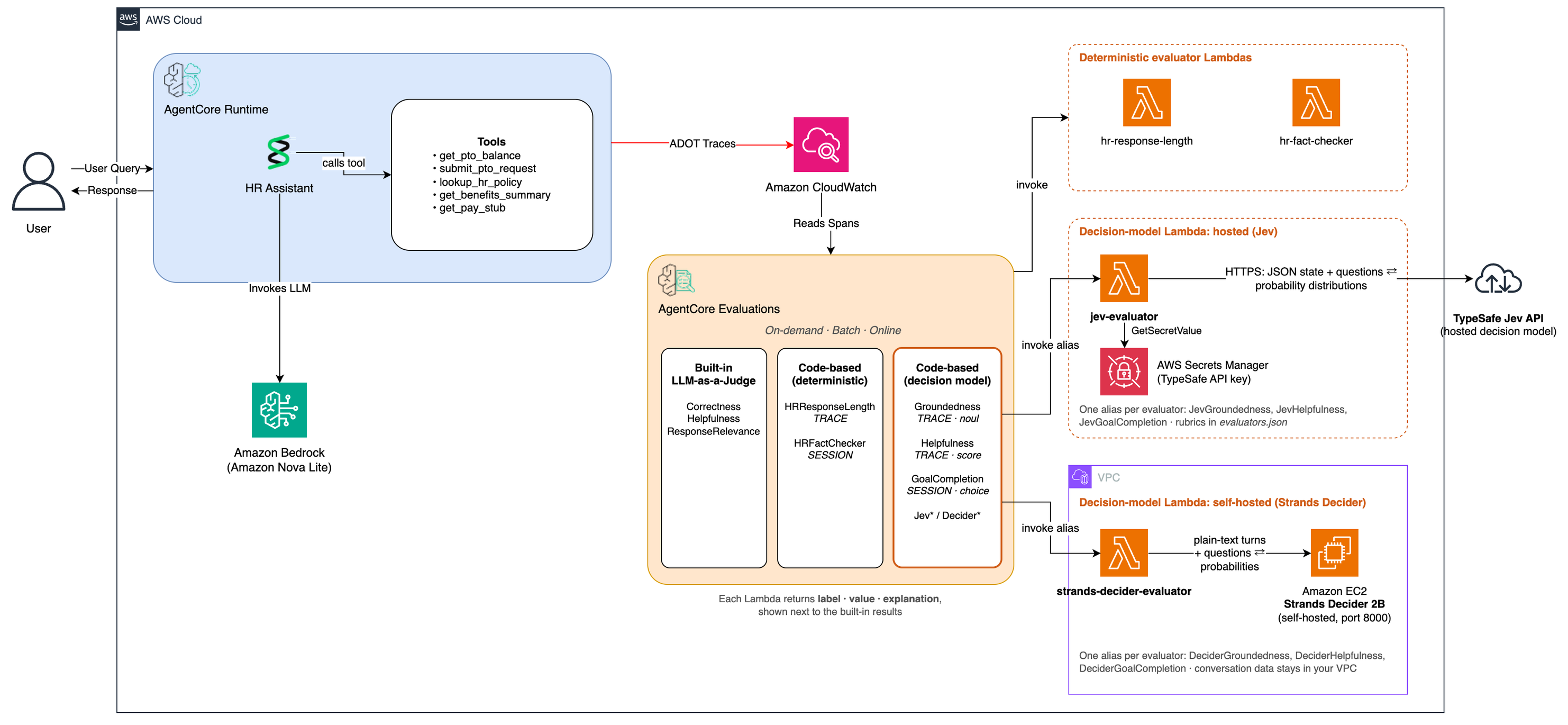
Industry experts observe that the adoption of these models is driven by the need for consistency. In highly regulated sectors such as finance, healthcare, and human resources, the ability to demonstrate a predictable, reproducible evaluation logic is not merely a technical preference but a compliance requirement. The use of the Strands Decider 2B, a 2-billion-parameter model designed specifically for these judgment tasks, provides a transparent alternative to the "black box" nature of massive foundation models. By running the model independently, organizations maintain full sovereignty over their evaluation stack, ensuring that the logic used to gate agent releases is auditable and version-controlled.
The practical workflow for deploying these evaluators involves a rigorous five-step validation process. First, developers must curate a labeled dataset of agent traffic, ensuring that both successful "happy path" scenarios and known failure modes are represented. Second, human expert labels are collected to establish a "ground truth" baseline. Third, both the decision model and the built-in evaluators are executed against these identical inputs. Fourth, the results are analyzed through a comparative lens to determine the model’s precision, recall, and calibration. Finally, this validation cycle is treated as a continuous integration process; whenever the agent’s logic is updated, or the evaluation rubric is refined, the entire suite is re-run to ensure the measurement remains accurate.
Data from early implementations suggest that the decision model approach can reduce false-positive alerts by approximately 30% compared to traditional prompt-based evaluation methods. This reduction is largely attributed to the calibrated nature of the probability output. Unlike a general LLM, which might struggle to differentiate between a "moderately helpful" and "highly helpful" response due to linguistic ambiguity, a decision model is forced to distribute its probability across a fixed, ordered set of levels. This forces a structured output that is far more resistant to the "sentiment drift" often seen in generative evaluators.
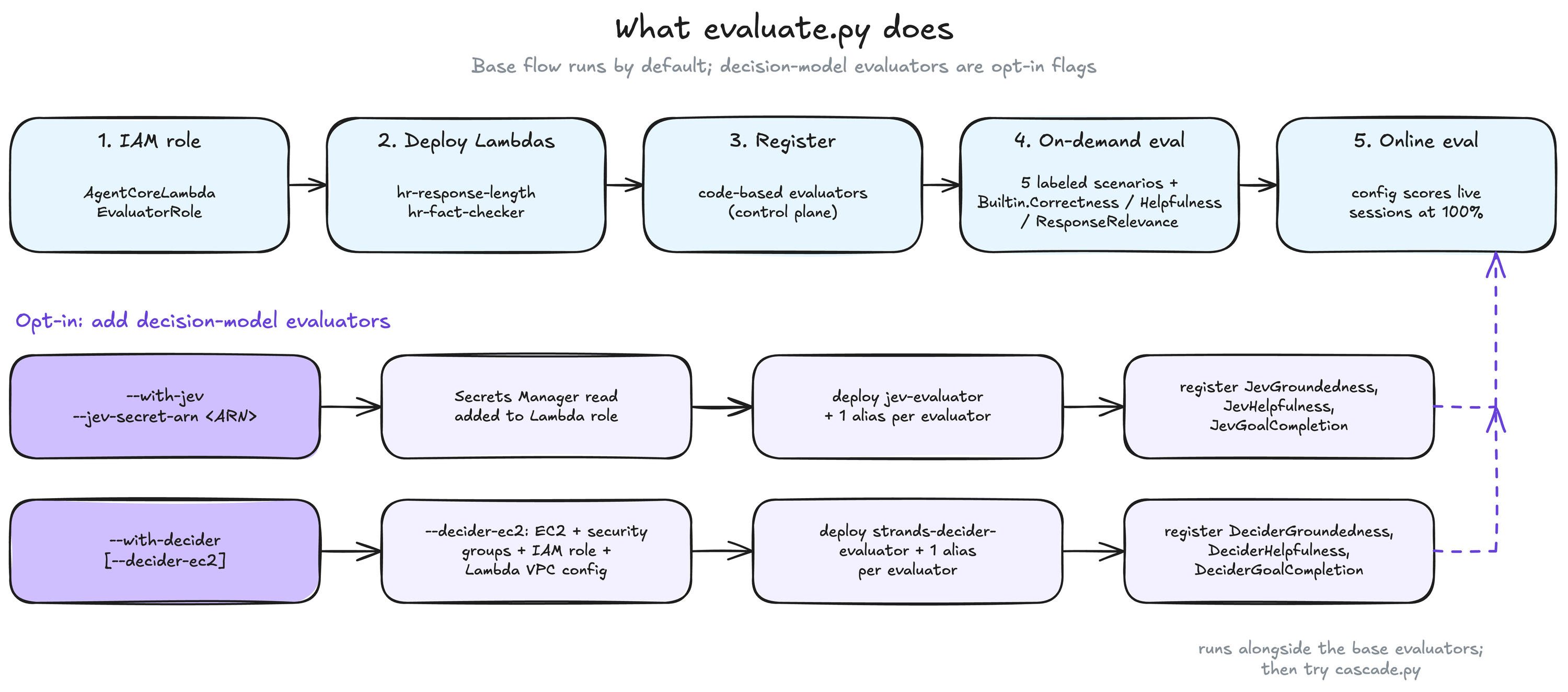
Furthermore, the integration with AWS infrastructure—specifically the ability to auto-provision EC2 resources and Lambda configurations via the AgentCore framework—lowers the barrier to entry for engineering teams. The ability to manage these evaluators as code, rather than as manual prompt-engineering tasks, represents a shift toward "Evaluation-as-Code" (EaC). In this paradigm, evaluation metrics are treated with the same rigor as application source code, complete with versioning, peer reviews, and automated testing.
The implications for the future of AI development are profound. As agents become more pervasive, the bottleneck for deployment will increasingly be the ability to verify safety and reliability. By adopting a tiered evaluation strategy—where decision models handle the high-volume, binary, or structured checks, and LLM-as-a-judge models handle the high-context, qualitative analysis—enterprises can create a self-correcting loop. In this environment, the agent is continuously monitored, and the evaluation system itself is continuously validated against human benchmarks.
From an organizational perspective, this approach mitigates the risk of "model drift," where an agent might begin to hallucinate or violate policy as it encounters new, unseen data in production. Because the decision model provides a quantitative confidence metric, it acts as an early warning system. If the average confidence score of the decision model begins to trend downward over time, it provides an objective signal that the agent’s performance is degrading before that degradation results in a customer-facing incident.
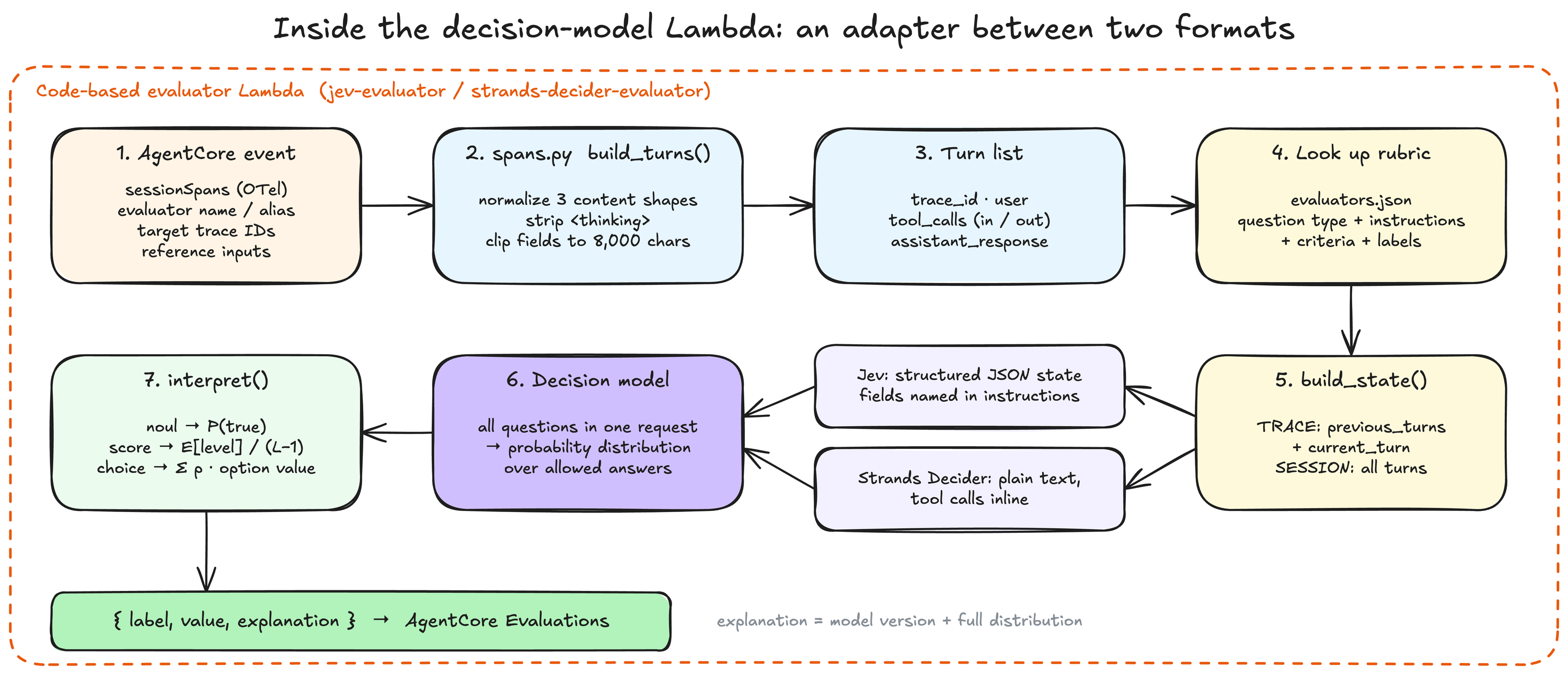
The synergy between TypeSafe’s Jev and the open-source Strands Decider 2B further democratizes this capability. While hosted services provide convenience and rapid deployment, the open-source alternative allows for deployment within isolated VPC environments, a critical feature for organizations with stringent data privacy requirements. The flexibility to choose between these backends allows teams to tailor their evaluation costs and performance characteristics to the specific needs of their application.
In conclusion, the deployment of decision models within the Amazon Bedrock AgentCore environment is more than a technical upgrade; it is a fundamental shift in how organizations approach the governance of autonomous systems. By moving toward a more deterministic, evidence-based evaluation model, developers can build agents that are not only more capable but also more predictable and reliable. As the industry continues to refine these tools, the reliance on ad-hoc testing will likely be replaced by these systematic, integrated evaluation architectures, marking a new phase of maturity in the lifecycle of artificial intelligence agents. The path forward for developers is clear: prioritize the construction of robust, repeatable evaluation pipelines today, and the scalability and safety of future agentic applications will naturally follow.