Investigating Potential CVE-2026-108099 Exploitation With Limited Public Evidence

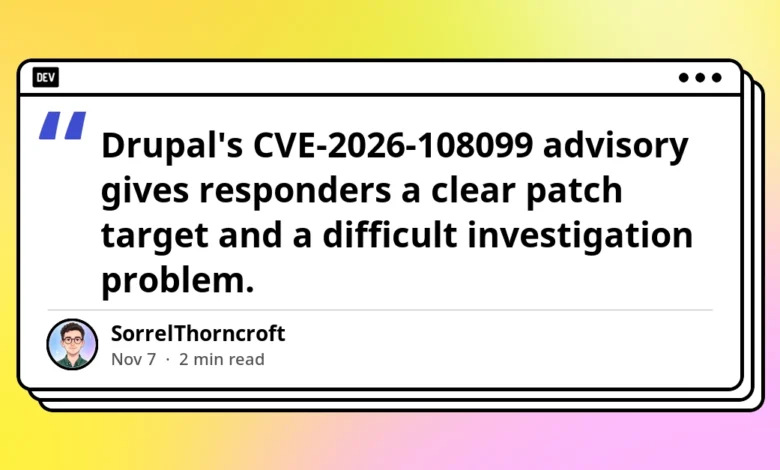
The security landscape for Drupal-based infrastructure has shifted following the disclosure of a critical vulnerability identified as CVE-2026-108099. This flaw, which affects the Entity List module for Drupal, presents a complex challenge for cybersecurity responders: while the patch is readily available, the lack of a public proof-of-concept (PoC) or specific indicators of compromise (IoCs) makes determining the extent of prior exploitation an arduous forensic task. The vulnerability, characterized as a reflection-injection weakness, requires immediate attention from administrators, particularly those managing enterprise-level Drupal deployments where custom integrations are common.
The Anatomy of the Vulnerability
The vulnerability stems from the way the Entity List module handles class selection. By failing to sufficiently sanitize inputs that dictate dynamic class instantiation, the module creates a gateway for reflection-injection attacks. In the context of modern web applications, reflection-injection is a severe security oversight. It allows an unauthenticated attacker to manipulate the application’s internal logic, potentially leading to remote code execution (RCE) if the application’s environment allows for the invocation of dangerous classes or callbacks.
According to the official advisory, SA-CONTRIB-2026-218, the flaw exists in all versions of the Entity List module prior to 3.0.10. The 3.0.10 update introduces the necessary architectural safeguards to restrict how classes are selected, effectively closing the vector. However, the advisory remains deliberately sparse on technical specifics regarding the exploitation chain. This intentional omission is a standard security practice designed to prevent "script kiddies" and opportunistic attackers from weaponizing the vulnerability before administrators have had a reasonable window to patch their systems. Nevertheless, it places a significant burden on incident response teams, who must now hunt for subtle traces of activity without knowing exactly what a malicious request looks like.
Chronology and Patch Deployment
The discovery and subsequent remediation of CVE-2026-108099 followed a rapid timeline typical of high-stakes open-source security disclosures.
- Initial Discovery: Security researchers identified the reflection-injection pattern during a routine audit of the Entity List module’s codebase.
- Advisory Publication: On November 8, 2026, the Drupal security team issued the official advisory, alerting site maintainers to the severity of the issue and providing the path to version 3.0.10.
- Remediation Phase: Immediately following the publication, major hosting providers and enterprise Drupal support firms initiated mass-patching operations to secure high-traffic sites.
- Post-Patch Analysis: By late November 2026, the focus shifted from simple patching to forensic verification, as organizations began questioning whether the vulnerability had been utilized in the wild prior to the public disclosure.
The swiftness of the release highlights the maturity of the Drupal community’s response processes, yet the delay between the existence of the vulnerability and its disclosure is a known window of risk. It is during these periods that sophisticated threat actors often identify and exploit flaws in silence.
Investigating Potential Compromise
Because the exploit chain is not public, incident responders cannot rely on simple intrusion detection system (IDS) signatures. Instead, they must adopt a "consequence-based" investigative approach. This requires looking for the telltale signs of a successful breach, even if the specific injection technique remains opaque.
1. Software Inventory and Reachability
The first step is a comprehensive audit of the site’s dependency graph. Relying solely on composer.json or composer.lock files is insufficient; responders must verify the active code on the server. In complex Drupal environments, modules may be manually patched, modified, or loaded from shared libraries, leading to discrepancies between the declared version and the executed code. Any site running an Entity List version earlier than 3.0.10 must be considered "potentially compromised" until proven otherwise.
2. Analyzing Custom Integrations
The vulnerability is not just in the module itself, but in how it interacts with other parts of the site. Responders should audit custom controllers, forms, and queued tasks that utilize the Entity List module. If these custom components pass user-controlled data into functions that select classes or callbacks, they are likely the primary targets. A manual code review of these integrations is the only way to determine if they provided a path for an attacker to leverage the module’s weakness.
3. Post-Exploitation Forensics
In the absence of a known exploit string, teams should monitor for common post-exploitation behaviors. This includes:
- Unexpected file modifications, especially in the
/modules,/sites/default/files, or vendor directories. - Anomalous spikes in database query volume or unauthorized modifications to system configuration tables.
- Unusual process execution, such as web server processes spawning shell commands or making outbound network connections to unknown IP addresses.
- Creation of new, high-privilege administrative user accounts.
The Role of Evidence Preservation
A common mistake in incident response is the premature rebuilding of compromised environments. While re-imaging a server is a valid recovery step, it destroys the forensic evidence required to determine the attacker’s objectives. Before deploying the 3.0.10 patch, organizations must follow a rigorous preservation protocol. This includes creating bit-for-bit disk images, exporting full application and database logs, and capturing the state of the filesystem.
These records are essential for determining the "blast radius" of a potential breach. If data exfiltration occurred, an organization might have legal or regulatory notification requirements. Without preserved evidence, an organization may be unable to confirm whether sensitive user data was accessed, potentially leading to unnecessary and costly disclosures or, conversely, a failure to report a genuine data breach.
Broader Implications and Exposure
The scale of potential exposure is difficult to quantify with precision. Data from search engines such as ZoomEye indicates that hundreds of thousands of sites are identified as running Drupal, a significant subset of which likely utilize the Entity List module. However, identifying a "Drupal" footprint is not the same as confirming a vulnerable configuration.
The security implications of CVE-2026-108099 extend beyond the module itself. It serves as a reminder that in modular frameworks like Drupal, the security of the application is a function of the weakest component in the ecosystem. Reflection-injection vulnerabilities are particularly insidious because they subvert the application’s intended design. By tricking the application into executing code it was never meant to run, an attacker can bypass traditional web application firewalls (WAFs) that focus on blocking common SQL injection or cross-site scripting (XSS) patterns.
Strategic Recommendations for Organizations
To mitigate the risk of CVE-2026-108099 and similar future vulnerabilities, organizations should adopt a multi-layered security strategy:
- Strict Dependency Management: Utilize automated dependency scanning tools that check not just for known CVEs, but for outdated modules that have not been patched.
- Implementation of Allowlisting: When developing custom code that handles dynamic class selection, developers must enforce strict allowlists. Never allow user input to dictate which class or method is instantiated.
- Enhanced Logging: Standard web server logs are often insufficient for detecting reflection-injection. Organizations should implement application-level logging that records the flow of input through critical decision-making points in the code.
- Regular Audits: Periodic security audits, including static and dynamic analysis, are essential for identifying vulnerabilities in custom integrations that are often overlooked by automated scanners.
Conclusion
CVE-2026-108099 represents a significant, if not "critical," challenge for the Drupal community. While the 3.0.10 update provides a necessary technical fix, the remediation process is only half the battle. The difficulty of confirming past exploitation means that organizations must prioritize forensic diligence and evidence-based investigation. By shifting the focus from simple signature matching to deep-code analysis and behavioral monitoring, security teams can effectively manage the risks associated with this vulnerability. In an era where software supply chain attacks are becoming increasingly sophisticated, the ability to respond to "blind" vulnerabilities—where the exploit method is hidden—will become a defining characteristic of resilient, high-security organizations. The lesson of this event is clear: in the world of web security, the absence of evidence is not evidence of absence, and proactive, informed defense remains the most effective deterrent.
Related posts: