The Fermi Paradox: Why Humanity Still Seeks Answers to the Greatest Cosmic Silence


With a thirteen-billion-year head start on evolution, the universe has offered ample time for complex life to flourish, yet humanity remains without concrete evidence of extraterrestrial contact. This contradiction lies at the heart of the Fermi Paradox, a fundamental question first popularized by physicist Enrico Fermi during an informal lunchtime conversation in 1950. While the Drake Equation suggests the statistical probability of intelligent life in the observable universe is remarkably high, empirical reality presents an unsettling silence.
This profound absence of signals, probes, or visits continues to puzzle astronomers, astrobiologists, and thinkers alike. As science writer Jeff Atwood notes in a recent exploration of the topic, the Fermi Paradox shares conceptual DNA with another human thought experiment: the total absence of verifiable time travelers from the future. Much like the lack of temporal tourists, the quiet cosmos forces researchers to question whether advanced civilizations are impossible, fleeting, or simply operating on a paradigm entirely invisible to modern science.

Historical Context and the Foundations of the Fermi Paradox
The origins of the Fermi Paradox trace back to the mid-20th century, a time of rapid advancement in nuclear physics, rocketry, and early radio astronomy. During a casual discussion at Los Alamos National Laboratory, Fermi reportedly brushed aside complex mathematical formulations of alien probability with a characteristically direct question: "Where is everybody?"
Fermi’s observation highlighted a glaring mismatch between scale and observation. The Milky Way galaxy alone contains an estimated 100 to 400 billion stars, a significant percentage of which host rocky planets within their stars’ habitable zones. Modern space telescopes, such as the Kepler and James Webb Space Observatories, have since confirmed that exoplanets are the rule rather than the exception. Given that the universe is roughly 13.8 billion years old—while Earth is a relative newcomer at 4.5 billion years—older civilizations should have had sufficient time to develop interstellar travel, colonize neighboring star systems, or leave technological artifacts detectable across light-years.
In 1961, astronomer Frank Drake formulated the eponymous Drake Equation to quantify the factors governing the likelihood of communicative civilizations. While the equation itself serves primarily as a framework for discussion rather than a definitive calculation, its variables—ranging from the rate of star formation to the average lifespan of a technological society—frequently yield optimistic projections. Yet, decades of listening campaigns by programs like SETI (Search for Extraterrestrial Intelligence) have yielded no artificial technosignatures.

The Great Filter: Barriers to Cosmic Longevity
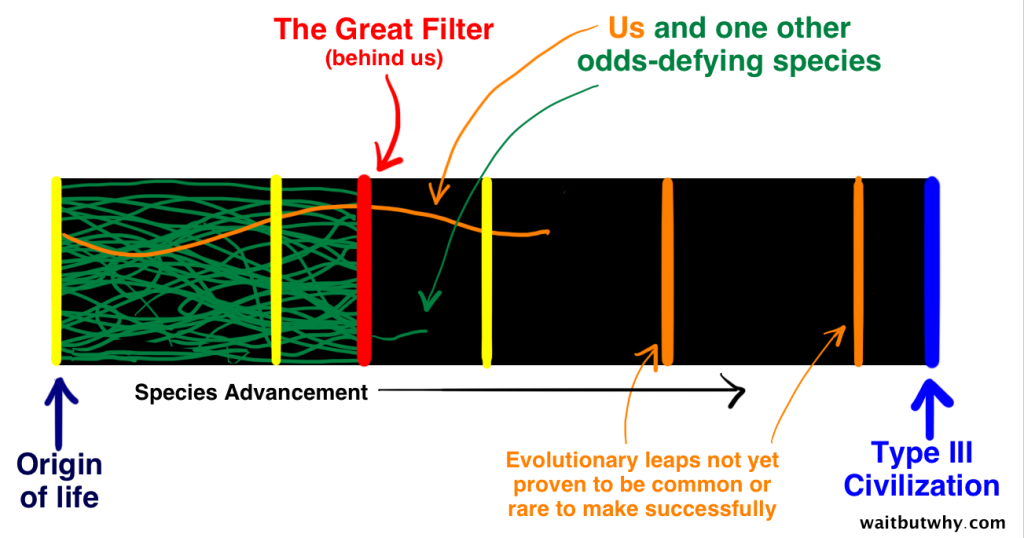
To reconcile high mathematical probability with zero observable evidence, scientists often turn to the concept of the Great Filter, a hypothesis first proposed by economist Robin Hanson. The Great Filter theory posits that somewhere along the evolutionary trajectory from prebiotic chemistry to a Type III civilization—capable of harnessing the energy of an entire galaxy—lies an insurmountable barrier. This filter represents a stage of development that is either extraordinarily improbable to overcome or results in the inevitable self-destruction of the species.
Under this framework, humanity must determine whether the Great Filter lies behind us or ahead of us. If it lies behind us, humanity has achieved a statistical miracle by surviving abiogenesis, the transition to eukaryotic life, and the development of high-level intelligence. If the filter lies ahead, technological societies may routinely self-destruct through nuclear warfare, runaway climate change, engineered pathogens, or artificial intelligence misaligned with human survival before they achieve interstellar expansion.
Analyses of the Great Filter often categorize potential evolutionary roadblocks into distinct phases:

- The Emergence Phase: The transition from non-living organic compounds to self-replicating life forms.
- The Intelligence Phase: The evolutionary leap from simple multicellular organisms to tool-using, sentient beings capable of abstract thought.
- The Technological Phase: The survival of an industrialized society through planetary-scale crises and resource depletion into sustainable interstellar capability.
The Paradigm of Miniaturization: An Alternative Hypothesis
While the Great Filter and planetary self-destruction remain dominant theories, alternative perspectives challenge the assumption that advanced civilizations must manifest through large-scale engineering projects. Traditional science fiction and early astrobiological theories often envisioned advanced extraterrestrial societies constructing Dyson spheres, megastructures, or massive fleets moving between star systems at sub-light speeds.
However, historical technological trends on Earth suggest an inverse trajectory. Over the past century, computing hardware has not grown larger; it has become dramatically smaller, more efficient, and faster. This principle of miniaturization optimizes energy consumption, reduces latency governed by the speed of light, and maximizes operational efficiency.
Prominent astronomers, including SETI Senior Astronomer Seth Shostak, have suggested that mature technological civilizations may naturally pivot away from visible megastructures in favor of nanotechnology, digitized consciousness, or molecular-scale engineering. Shostak notes that the laws of physics favor small machinery, which requires significantly less energy to operate and functions with vastly superior internal communication speeds.
If advanced species systematically transition into nano-scale entities, digital frameworks, or alternate states of information processing, their activities would leave virtually no macroscopic technosignatures for human telescopes to detect. Rather than failing to build interstellar empires, such civilizations may have simply outgrown the physical, planetary-scale existence that humanity currently equates with intelligence.
Implications for Humanity’s Future
The ongoing absence of extraterrestrial contact carries profound implications for how humanity perceives its place in the cosmos. Whether the silence of the universe is attributed to the rarity of life, the inevitability of self-destruction, or the invisible ubiquity of microscopic and digital technologies, the Fermi Paradox serves as both a scientific puzzle and a philosophical mirror.
As observational capabilities improve with next-generation space telescopes and advanced radio arrays, astrobiologists continue refining methods to detect atmospheric biosignatures and faint technosignatures. Yet, until definitive evidence emerges, humanity remains suspended between the statistical promise of a crowded galaxy and the quiet reality of an unpopulated night sky. Whether the future brings discovery or enduring solitude, the search forces a rigorous examination of Earth’s own technological trajectory and the fragility of intelligent life.