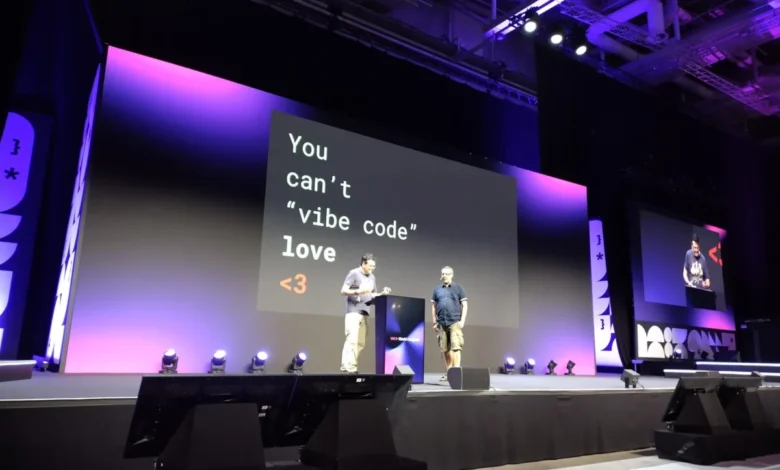
The intersection of human collaboration and artificial intelligence took center stage at the CityCube in Berlin during the WeAreDevelopers World Congress, where Stack Overflow co-founder Jeff Atwood delivered a keynote address alongside early community hire Ben Dumke-von der Ehe. Titled "None of Us Is As Dumb As All of Us: Community And Knowledge Hand In Hand," the presentation offered a retrospective look at the origins of one
of the world’s largest programming repositories while examining the existential challenges facing digital commons in the era of large language models (LLMs).
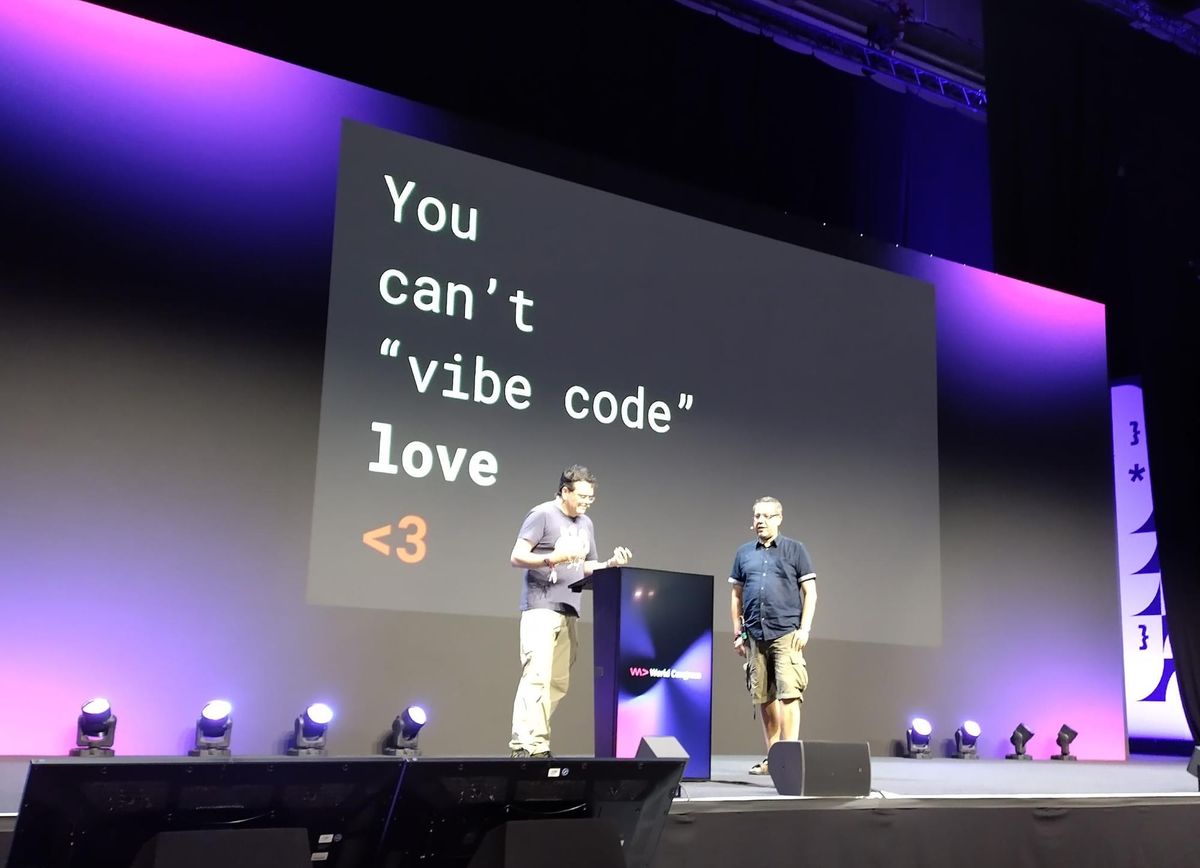
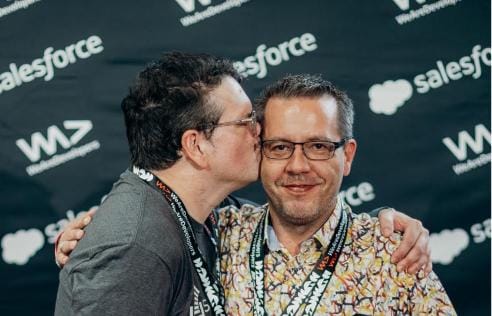
The appearance marked a rare international speaking engagement for Atwood, who conditioned his participation on sharing the stage with Dumke-von der Ehe, a Berlin-based developer who joined Stack Overflow as employee number six in 2010. For Atwood and Dumke-von der Ehe, the presentation served as both a technical retrospective and a personal acknowledgment of how collaborative platforms fundamentally alter careers and communities.
Main Facts and the Berlin Reunion
The presentation, delivered on Friday, July 10, focused heavily on the symbiotic relationship between human-built knowledge repositories and modern generative artificial intelligence. Atwood noted that the long version of his relationship with Dumke-von der Ehe involved mutually transformative career paths, while the short version was characterized simply by "unicorns."
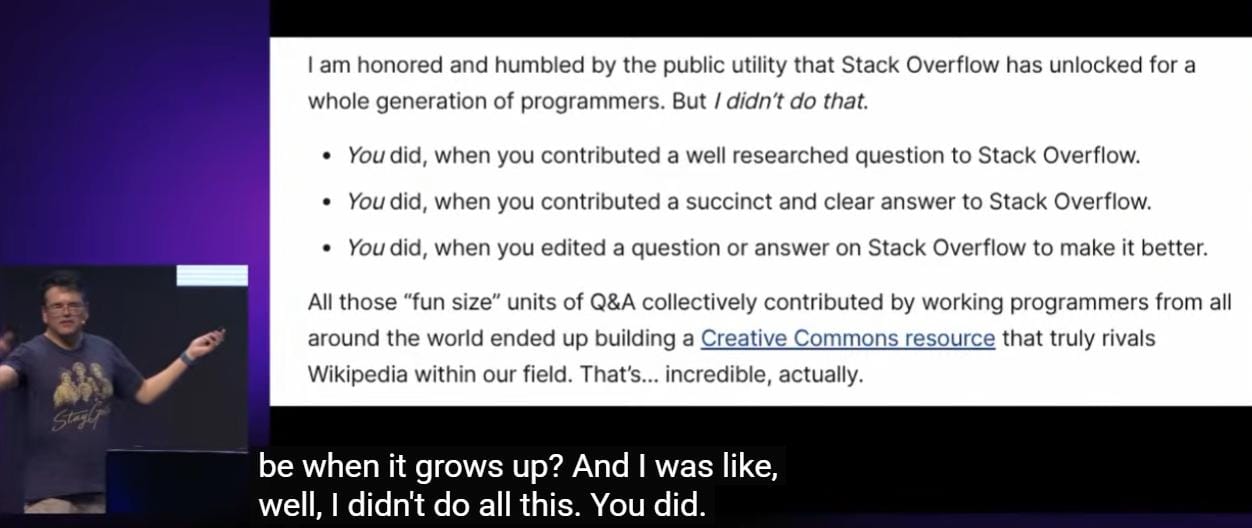
Dumke-von der Ehe’s history with Stack Overflow is deeply intertwined with the platform’s scaling years. Having left the company, returned, and subsequently departed again, his journey represents the transient yet impactful nature of early internet community builders. Atwood openly acknowledged on stage that his primary motivation for taking the Berlin speaking slot was a deep-seated sense of professional and personal gratitude toward Dumke-von der Ehe and the broader community that constructed the Stack Overflow ecosystem.

Central to their discussion was the bedrock Creative Commons license under which millions of programmers contributed their expertise. This legal and ethical framework allowed contributors to build a public commons of technical data that has since become foundational not only for human developers but also for the training data of nearly every major artificial intelligence model.
The Role of LLMs: Efficiency vs. Duplication
Atwood addressed the ongoing transformation of developer workflows driven by generative AI. Rather than viewing artificial intelligence as an adversarial threat to Stack Overflow, Atwood aligned the rise of LLMs with the platform’s original, long-term aspirations.
Historically, Atwood argued, the ideal functioning of a platform like Stack Overflow relies on passive consumption. He noted that if a technical knowledge base operates correctly, approximately 98% of programmers should find the answers they need simply by reading existing search result pages, obviating the need to ask or answer new questions throughout their careers.
Furthermore, LLMs have successfully resolved one of the most persistent structural challenges in large-scale forums: the problem of duplicate questions. In database administration and forum moderation, maintaining a pristine knowledge base becomes increasingly difficult as scale expands. When a platform hosts one million questions, navigating prior art is manageable. However, as databases scale to ten million or one hundred million entries, submitting a truly unique query becomes nearly impossible without inadvertently duplicating existing threads.
Generative AI models have effectively cut this Gordian knot. By utilizing semantic understanding rather than strict keyword matching, LLMs can map newly formulated questions—phrased entirely differently from historical records—directly to established answers. This capability drastically reduces redundancy, accelerates problem-solving, and aligns with the core objective of efficiently transferring technical knowledge.
Broader Impact and Implications for the Digital Commons
Despite the efficiency gains provided by artificial intelligence, Atwood raised a fundamental question regarding the sustainability of the digital ecosystem: What happens to the public commons when programmers transition entirely to private interactions with artificial intelligence models?
The developer communities that nurtured early programmers—providing not just technical answers, but mentorship, collaboration, and a sense of shared purpose—rely on active public participation. Platforms like Stack Overflow served as incubators where individuals like Dumke-von der Ehe could cultivate professional identities through collaborative problem-solving.
As developers increasingly rely on closed, conversational AI interfaces, a critical question emerges regarding the replenishment of training data. Future iterations of artificial intelligence models will require fresh, high-quality, human-validated technical information to maintain accuracy and relevance. Without active, protected public commons where humans continue to debate, test, and document solutions, the pipeline of raw data that sustains modern LLMs risks stagnation.
Moreover, Atwood emphasized the intangible social dimensions of technical communities. Referencing the collaborative spirit that built the platform’s vast dataset, he concluded that while artificial intelligence can streamline coding workflows and optimize syntax, the fundamental human connection—the shared passion for building and learning together—cannot be replicated by algorithms. Protecting and investing in community-driven knowledge spaces, therefore, remains essential not only for the preservation of historical data, but for the continued evolution of the technology sector as a whole.