Amazon Bedrock launches Trusted Access Program API and debuts Enterprise Frontier Safeguards for Anthropic Claude models


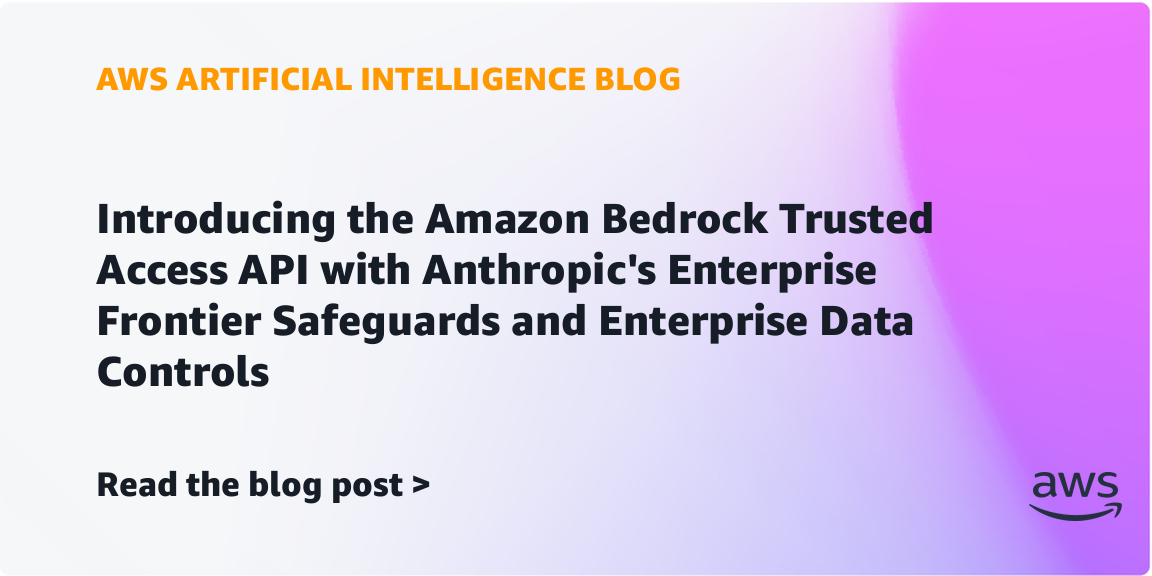
Amazon Web Services (AWS) has officially announced the general availability of the Trusted Access Program API on Amazon Bedrock, a significant infrastructure milestone designed to unify how enterprise customers discover, manage, and enroll in specialized safety and data control programs for generative AI models. This launch coincides with the public preview of two highly anticipated offerings tailored for Anthropic’s Claude model family: Enterprise Frontier Safeguards (EFS) and Enterprise Data Controls (EDC). These tools are engineered to address the stringent security and compliance requirements of industries such as finance, healthcare, and legal services, which have historically been hesitant to adopt large language models due to concerns over data residency and third-party access.
The new Trusted Access Program API acts as a centralized command center for AWS administrators. By consolidating provider-specific offerings into a single interface, it simplifies the complex task of managing safety protocols across an entire organization. Administrators can now leverage existing AWS Identity and Access Management (IAM) policies and Service Control Policies (SCPs) to delegate or restrict enrollment permissions, ensuring that security posture remains consistent with internal corporate governance. As the landscape of generative AI evolves, this API is designed to scale, serving as the future gateway for any additional safety or compliance programs introduced by model providers on the Bedrock platform.
Context and Industry Background
The introduction of these safeguards arrives at a pivotal moment in the enterprise AI sector. As organizations move beyond experimental deployments of generative AI, they are encountering a "trust gap." Frontier AI labs, such as Anthropic, implement rigorous safety monitoring—including automated analysis of inputs and outputs—to prevent model misuse, such as offensive cyber activities or unauthorized agentic behavior. While these safety layers are essential, they have historically relied on model providers retaining certain data to perform this monitoring.
For highly regulated sectors, the concept of a third party retaining prompts and completions—even for the sake of safety—poses a significant barrier to adoption. With the launch of EFS and EDC, AWS and Anthropic are shifting the paradigm from centralized data management to decentralized, customer-controlled architectures. This approach acknowledges that while automated safety monitoring is a requirement for deploying high-capability models like Claude Fable, Mythos, and Opus 5.5, the control over where that data resides and how it is audited must ultimately rest with the end-user.
Chronology and Development Path
The road to this announcement has been marked by a series of incremental security enhancements. Following the initial integration of Anthropic’s models into Amazon Bedrock, AWS introduced interim Zero Data Retention (ZDR) exceptions for specific customers, allowing them to bypass standard data retention policies. However, those temporary measures were limited in scope and did not provide a permanent, scalable solution for enterprise-wide deployment.
The current public preview of EFS and EDC represents the evolution of these interim measures into a formalized product suite. Development of these features involved a collaborative effort between AWS and Anthropic, driven by feedback from over 100 enterprise organizations—including approximately 25 percent of the Fortune 100. This collaborative design process focused on ensuring that the automated safety monitoring required for "frontier" models could exist within a customer’s own infrastructure without compromising the integrity of the safety protocols themselves.
Deep Dive: Enterprise Frontier Safeguards (EFS)
Enterprise Frontier Safeguards (EFS) serves as the most comprehensive control mechanism for data-sensitive environments. When EFS is enabled, the data retention loop is contained entirely within the customer’s own AWS environment. The technical implementation is robust: Amazon Bedrock interacts with the customer’s AWS Key Management Service (KMS) keys and Amazon S3 buckets as a distinct service principal.
Critically, this setup ensures that AWS human reviewers do not access the content for the purpose of safety oversight. Instead, if the automated safety monitoring system detects a potential risk—such as a prompt designed to bypass system instructions—a "Safety Case" is generated. This record is placed directly into the customer’s S3 bucket. The customer’s internal security team then assumes responsibility for reviewing these cases and providing a final determination (e.g., "violation" or "no violation"). This workflow ensures that while the provider maintains the integrity of the model, the customer maintains total visibility and control over their data footprint.
Comparative Analysis: EFS vs. EDC
While both EFS and EDC provide the same underlying safety monitoring, the choice between them is largely a matter of infrastructure preference and compliance overhead.
Enterprise Data Controls (EDC) is positioned as a streamlined alternative for organizations that require strict data retention policies but may not have the resources or desire to manage dedicated S3 buckets and KMS keys for every regional deployment. In the EDC model, retained data is housed in Amazon-managed storage and protected by AWS-managed encryption keys. This eliminates the "bucket management" overhead while still providing the same level of automated safety analysis and customer-led review of flagged activity.
The following table summarizes the strategic differences between these deployment routes:
| Feature | EFS (Customer Controlled) | EDC (Amazon Managed) |
|---|---|---|
| Storage Location | Customer’s Amazon S3 bucket | Amazon-managed storage |
| Encryption | Customer’s AWS KMS key | AWS-managed keys |
| Human Review | Internal team (Customer) | Internal team (Customer) |
| Auditability | Full via AWS CloudTrail | API-based tracking |
| Operational Effort | Higher (requires setup/policy) | Minimal (integrated) |
Broader Implications for AI Adoption
The implications of this rollout extend beyond mere feature updates. By formalizing the relationship between model safety and customer data ownership, AWS is effectively setting a new standard for the "Enterprise-Grade" label in generative AI.
Industry analysts suggest that this move will likely accelerate the adoption of high-capability models in the legal and financial sectors. By providing a clear, auditable trail—where every access event is recorded in the customer’s CloudTrail logs—AWS is addressing the auditability requirements inherent in regulations such as the GDPR, HIPAA, and the various emerging AI governance frameworks globally.
Furthermore, the "Trusted Access" model creates a predictable roadmap for future AI capabilities. Because the Trusted Access Program API is designed to be provider-agnostic, it creates a template for other model providers on Bedrock (such as Mistral or Meta) to eventually roll out similar, customized compliance programs. This modularity reduces the "platform lock-in" risk for enterprises, as the mechanism for governing data remains consistent even as the underlying models are swapped or updated.
Operationalizing the New Controls
To begin using these services, administrators must first utilize the list-trusted-access-programs command via the AWS CLI. The API returns the status of the account, which will categorize eligibility as either eligible, requestable, or restricted. For those in the requestable state, the API provides a statusReason field, which acts as a guide for the necessary prerequisites, such as ensuring that the account is already enrolled in existing cyber-verification programs.
Once approved, the configuration must be applied on a per-region basis. This is a deliberate design choice, reflecting the reality that many global enterprises have data residency requirements that vary significantly between, for example, a US-based operation and a European deployment. By allowing regional configuration, AWS provides the granularity required for multinational compliance.
Conclusion and Future Outlook
The general availability of the Trusted Access Program API and the introduction of EFS and EDC represent a maturation of the generative AI market. The focus has shifted from "can we run these models?" to "how can we govern these models at scale?"
By empowering customers to manage their own safety reviews and retain data within their own security boundaries, AWS is effectively de-risking the use of frontier-class models for the enterprise. As the public preview transitions to general availability in the coming months, the success of these programs will likely be measured by the speed at which organizations in highly regulated sectors migrate their critical workloads to Amazon Bedrock. For now, the integration of these controls into the Bedrock platform provides a clear, actionable path for organizations to leverage the most advanced AI capabilities while maintaining an uncompromising stance on data security and regulatory compliance.