ICONIQ’s 2026 Go-to-Market Benchmark Report Reveals Sales Quotas and Processes Are Amplified, Not Radically Altered, by AI

San Francisco, CA – A recent comprehensive analysis of Go-to-Market (GTM) strategies by venture capital firm ICONIQ, released in mid-2026, indicates that while the integration of Artificial Intelligence has undoubtedly accelerated sales operations, fundamental sales quotas and core selling processes within leading B2B and AI software companies remain remarkably similar to the pre-AI era. The report, which surveyed over 150 GTM executives from early to late-stage companies, suggests that the primary impact of AI has been an amplification of existing structures and expectations, rather than a wholesale reinvention of sales paradigms.
The ICONIQ 2026 GTM Benchmark Report, compiled from data gathered through a rigorous survey of GTM leaders across a diverse spectrum of the B2B and AI software landscape, offers a compelling snapshot of current high-performance practices. The data is specifically curated to represent the strategies employed by fast-growing, well-funded startups that have achieved significant product-market fit. This focus ensures that the benchmarks reflect the cutting edge of successful GTM execution. The sample size for the survey was robust, with approximately 143-149 respondents contributing data depending on the specific question. ICONIQ’s investment strategy, which targets growth-stage companies, naturally leads to benchmarks that skew towards top-tier performers, providing a valuable insight into what constitutes best-in-class GTM operations.
One of the most significant findings is that despite the technological advancements, the underlying economic model for sales compensation has not undergone a material shift. Overall compensation plans and On-Target Earnings (OTEs) have indeed risen, reflecting the increased productivity and higher revenue targets. However, the fundamental economics of paying sales representatives, which typically hover around 20% of the value of deals closed, have remained relatively stable. This suggests that while AI tools are enhancing efficiency and potentially deal velocity, the core financial incentives driving sales performance are still anchored in traditional models.
Cross-Selling and Upselling Take Center Stage
A notable trend emerging from the ICONIQ report is the increased emphasis on expansion revenue, particularly cross-selling and upselling. High-performing companies are significantly more likely to assign direct sales ownership for these crucial revenue streams. The data reveals that 65% of top performers empower their sales teams to own cross-sell initiatives, a marked increase compared to 49% of other companies surveyed. Similarly, 55% of high-performing organizations task their sales representatives with driving upsells, versus 44% of their counterparts. The ownership of renewals also sees a similar pattern, with 37% of high performers including this in their sales remit, compared to 24% of others.
This strategic shift indicates a growing recognition within leading companies that maximizing customer lifetime value is paramount. Instead of solely focusing on acquiring new logos, these organizations are optimizing their sales force to cultivate deeper relationships with existing customers, thereby unlocking additional revenue opportunities. This approach not only contributes to revenue growth but also enhances customer retention and loyalty, creating a more sustainable and resilient business model.
Attainment Rates Soar Among Elite B2B/AI Companies
Perhaps one of the most striking observations from the ICONIQ report is the elevated sales quota attainment rates among top-tier B2B and AI companies. Traditionally, in a standard B2B sales environment, achieving quota often falls within the 65% to 75% range for sales representatives. However, the benchmark data for leading B2B and B2B + AI companies in 2026 indicates attainment rates of an impressive 85% to 90%.
This divergence is particularly significant because higher sales quotas are typically associated with lower attainment percentages. The fact that top AI leaders are concurrently experiencing both increased quotas and higher attainment suggests a powerful synergy between advanced technology and effective sales execution. This phenomenon is not indicative of lowered expectations but rather of enhanced capacity and efficiency driven by AI-powered tools and optimized processes. The report posits that this increased capacity, fueled by AI’s ability to generate more qualified pipeline, allows for higher quotas without a corresponding drop in performance.
Compensation Structures Evolve to Reflect Expansion Focus
The report highlights a clear evolution in sales compensation plans, with a noticeable shift toward incentivizing expansion revenue. As Account Executives (AEs) increasingly take on broader responsibilities that encompass managing and growing existing customer accounts, their compensation structures are mirroring this expanded role.
Companies that are still operating with compensation plans heavily weighted towards new business acquisition (e.g., 80% new business, 20% expansion) are falling behind the curve, according to ICONIQ’s findings. The best-in-class organizations are adjusting their compensation models to offer meaningful incentives for expansion revenue, particularly for AEs managing substantial quotas of $2 million or more. This is driven by the reality that top sales talent, capable of carrying such high quotas, expects their earnings potential to be directly tied to their ability to grow existing accounts. Failure to align compensation with this expanded scope of work risks significant attrition, as ambitious sales professionals will seek out companies that offer more lucrative and comprehensive reward structures. The report identifies this misalignment in compensation planning as a key "gap" between high performers and the rest of the market.
AI-Driven Pipeline Generation as the True Quota Driver
A critical takeaway from the ICONIQ report is the assertion that AI-powered pipeline generation is the true determinant of a quota’s viability and a sales team’s success. The report strongly cautions against simply announcing ambitious quotas without the underlying operational capacity to support them. The effectiveness of any quota is intrinsically linked to the quality and quantity of the sales pipeline that fuels it.
Companies that have successfully integrated AI into their marketing and Sales Development Representative (SDR) workflows are witnessing significant improvements in pipeline conversion rates. Specifically, these organizations are reporting 10 to 11 percentage points more in lead-to-Marketing Qualified Lead (MQL) conversions and an 8 percentage point increase in MQL-to-Sales Qualified Lead (SQL) conversions. This surge in qualified pipeline per sales representative is what enables companies to set higher quotas without jeopardizing attainment rates. The report frames this not as a punitive measure but as a reflection of increased capacity. If pipeline generation does not keep pace with quota increases, a decline in attainment is an inevitable consequence.
Establishing the 2026 GTM Baseline
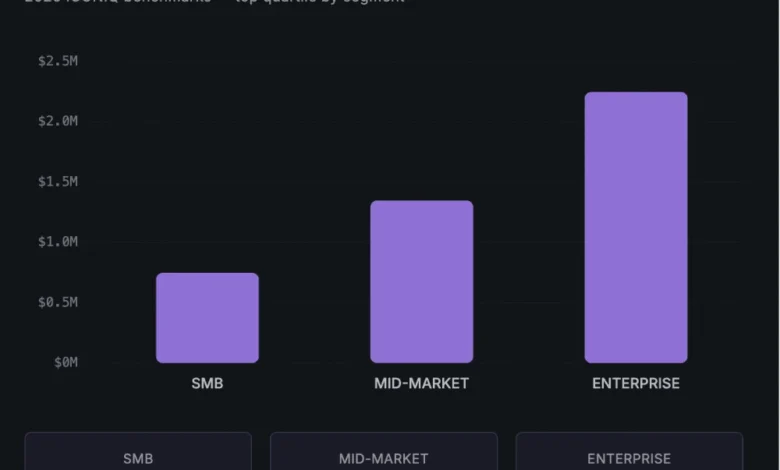
For organizations building their first dedicated sales function or undertaking a strategic review of their existing quota structures, ICONIQ provides a foundational baseline for 2026 GTM operations. The report emphasizes that while enterprise AE quotas below $1.5 million may indicate a potential underestimation of market opportunity, leading to as much as 30% of potential revenue being left on the table, a precipitous jump to figures like $2.5 million without the requisite pipeline generation capabilities and supportive compensation architecture can trigger a significant spike in sales team attrition.
The overarching conclusion drawn from the ICONIQ report is that the widening performance gap between top-tier sales organizations and others is no longer primarily a matter of strategic vision. Instead, it is increasingly dictated by the precision of quota setting, the efficacy of pipeline generation, and the sophistication of compensation plan architecture. These operational pillars, when optimized with the leverage of AI, are the true differentiators in today’s competitive B2B and AI software market.
Broader Implications and Future Outlook
The findings from ICONIQ’s 2026 GTM benchmark report have significant implications for the future of sales organizations in the technology sector. As AI continues to mature and become more deeply embedded in business processes, the expectation is that these trends will only intensify. Companies that proactively adapt their sales strategies, compensation models, and operational infrastructure to leverage AI’s capabilities will likely continue to lead the market. Conversely, those that cling to outdated methodologies risk falling behind, facing challenges in attracting and retaining top talent, and ultimately, missing out on significant revenue opportunities.
The report suggests a paradigm shift where the definition of a "high-performing" sales team is being redefined. It’s no longer solely about individual sales prowess but about the collective ability of the sales organization to harness technology, optimize processes, and strategically manage the entire customer lifecycle. The data points towards a future where sales leaders who can effectively blend human expertise with AI-driven insights and efficiencies will be the ones setting new benchmarks for growth and profitability. The emphasis on expansion revenue also signals a move towards more mature and sustainable growth models, where customer relationships are viewed as long-term assets to be nurtured and expanded upon, rather than transactional engagements. The report’s timing, in mid-2026, positions it as a critical guide for companies looking to navigate the evolving sales landscape and capitalize on the transformative power of artificial intelligence.