Google Ads Integrates Missed Growth Opportunity Insights into Recommendations Tab Beta

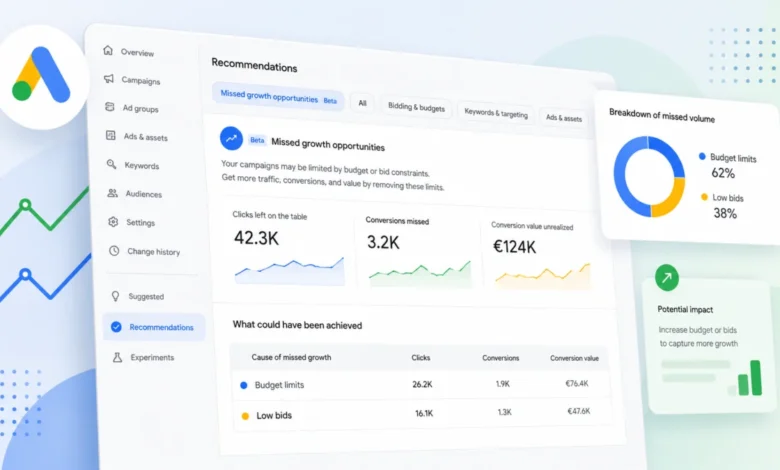
Google Ads has officially transitioned its Missed Growth Opportunity insights from a localized experimental phase into the primary Recommendations tab as a new beta feature. This strategic integration is designed to provide digital marketers and advertisers with a more transparent and accessible view of the potential traffic, conversions, and revenue they are currently bypassing due to specific account limitations. By surfacing these estimates directly alongside existing optimization suggestions, Google aims to streamline the decision-making process for businesses looking to scale their digital presence through data-driven budget and bid adjustments.
The update represents a significant shift in how Google presents performance data. Traditionally, advertisers had to dig through various reporting layers or utilize specific "Labs" tools to understand the cost of their constraints. With this beta rollout, those insights are now front and center, quantifying the "what-if" scenarios that have long been a point of speculation for search engine marketing (SEM) professionals. The tool specifically targets two primary friction points in campaign management: budget ceilings that prematurely halt ad delivery and bid levels that prevent ads from winning competitive auctions.
The Mechanics of Missed Growth Insights
The core functionality of the Missed Growth Opportunity beta revolves around predictive modeling. Unlike standard historical reporting, which tells an advertiser what happened, these recommendations use machine learning to forecast what could have happened if financial or competitive barriers were removed. The feature focuses on three critical performance indicators:
- Traffic Estimates: This metric calculates the additional clicks an advertiser could have garnered had their ads been eligible for more auctions. This is often tied to "Lost Impression Share (Budget)," where a campaign stops running once the daily limit is reached, despite remaining search volume.
- Conversion Projections: By analyzing historical conversion rates and the quality of missed traffic, the tool estimates the number of additional leads or sales that were left on the table.
- Revenue Potential: For e-commerce advertisers or those utilizing conversion values, the tool provides a monetary estimate of the unrealized gross income resulting from current account settings.
By categorizing these missed opportunities into "budget-constrained" versus "bid-constrained," Google provides a clearer diagnostic path. For instance, if a campaign is performing well but hitting its budget by noon, the tool will highlight the specific revenue lost during the afternoon and evening hours. Conversely, if a campaign has an ample budget but is losing out to competitors in high-value auctions, the tool will suggest bid increases to capture that premium traffic.
Chronology and Development of the Feature
The journey of the Missed Growth Opportunity tool began in the Google Ads Labs environment, a testing ground where Google introduces experimental features to a limited subset of users to gather feedback and refine algorithms. Throughout late 2023 and early 2024, select advertisers noticed the tool as a standalone dashboard within the Labs section. During this phase, the focus was on the accuracy of the modeling and the utility of the interface.
In mid-2024, industry observers, including prominent PPC expert Thomas Eccel, noted the migration of these insights from the siloed Labs environment into the main Recommendations tab. This move signals Google’s confidence in the underlying data models and its intent to make these insights a permanent fixture of the Google Ads ecosystem. The transition from a "Lab" experiment to a "Beta" in the Recommendations tab usually precedes a full global rollout, suggesting that the feature will soon become a standard component of the platform’s optimization suite.
Supporting Data and Technical Context
To understand the significance of this update, one must look at the broader context of Google’s "Optimization Score." This score, which ranges from 0% to 100%, is Google’s way of grading how well an account is configured to follow best practices. The integration of Missed Growth Opportunity insights directly impacts how these scores are calculated and perceived.

According to internal Google data often cited in agency briefings, advertisers who engage with the Recommendations tab and improve their Optimization Score see an average increase in conversions. However, the "Missed Growth" feature adds a layer of granularity that was previously missing. It moves beyond generic advice like "add more keywords" and enters the realm of financial forecasting.
The technical backbone of these recommendations is "Impression Share" (IS) data. Impression share is the percentage of impressions your ads receive compared to the total number of impressions your ads were eligible to get. The two main reasons for losing IS are:
- Rank (Bids and Quality): Your ad wasn’t relevant enough or your bid was too low.
- Budget: Your funds ran out before the day ended.
The new beta takes this static percentage and converts it into dynamic, actionable data. If an advertiser sees they have a 40% Lost IS (Budget), the tool now tells them that that 40% equates to, for example, 500 clicks and $2,000 in revenue.
Industry Reactions and Expert Analysis
The reaction from the digital marketing community has been a mix of cautious optimism and professional skepticism. Thomas Eccel, who was among the first to highlight the rebranding of the tool, noted that while the insights are valuable for planning, they are essentially a more aggressive way for Google to encourage higher spending.
Many PPC (Pay-Per-Click) professionals argue that while the data is useful for "directional guidance," it must be validated against third-party analytics and internal business margins. The primary concern is that Google’s models operate on a "vacuum" theory, assuming that every additional click will convert at the same rate as historical traffic. In reality, as budgets scale, marginal returns often diminish—a concept known in economics as the law of diminishing returns.
Furthermore, industry analysts point out that these recommendations are heavily weighted toward Google’s automated bidding strategies, such as Target CPA (Cost Per Acquisition) or Target ROAS (Return on Ad Spend). By showing "missed revenue," Google provides a powerful incentive for advertisers to switch to value-based bidding, which aligns with Google’s long-term goal of automating the entire ad-buying process.
Strategic Implications for Advertisers
The integration of these insights into the Recommendations tab has several immediate implications for how brands manage their digital marketing spend:
1. Enhanced Budget Justification:
Marketing managers often struggle to secure additional funding from finance departments. The Missed Growth Opportunity tool provides a "Google-verified" estimate of what the company is losing by staying at current budget levels. This can serve as a potent piece of evidence in budget negotiations, shifting the conversation from "we want to spend more" to "we are losing $10,000 in revenue every month."

2. Prioritization of Effort:
With dozens of recommendations typically appearing in an account, it can be difficult to know which one to tackle first. By quantifying the impact of budget and bid changes in terms of conversions and revenue, Google allows advertisers to prioritize the "biggest wins" first.
3. The Need for Validation:
Advertisers are warned not to take these estimates as guarantees. The "Missed Growth" projections are based on historical patterns and do not account for external factors like sudden competitor entry, shifts in consumer behavior, or changes in landing page performance. Experts recommend a "test and learn" approach: increasing budgets in small increments to see if the actual growth matches Google’s predicted growth.
Broader Impact on the Advertising Landscape
The move to surface missed opportunities is part of a larger trend in the advertising technology industry toward "prescriptive analytics." Platforms are no longer content to simply provide a stage for ads; they are increasingly acting as consultants, using AI to tell advertisers exactly how to run their businesses for maximum volume.
This trend is also visible in Meta Ads (formerly Facebook) and Amazon Advertising, both of which have introduced similar "opportunity" dashboards. However, Google’s version is particularly impactful because of the high-intent nature of search traffic. When a user searches for a specific product, the "missed opportunity" of not showing an ad is much more quantifiable than in the discovery-based environment of social media.
As Google continues to refine its AI and machine learning capabilities, we can expect these recommendations to become even more personalized. Future iterations may account for seasonality, inventory levels, or even local weather patterns, providing a hyper-granular view of growth potential.
Conclusion: Navigating the New Beta
The "Missed Growth Opportunity" beta in the Recommendations tab is a powerful addition to the Google Ads toolkit. It offers a window into the untapped potential of a campaign, providing a data-backed roadmap for scaling. However, the responsibility remains with the advertiser to interpret this data through the lens of their specific business goals and profitability.
While the tool makes it easier than ever to see the cost of constraints, it also increases the pressure on advertisers to spend. The key to success in this new environment will be the ability to distinguish between a "growth opportunity" that drives genuine profit and one that simply increases volume at the expense of efficiency. As the beta rolls out to more accounts, it will undoubtedly become a cornerstone of the quarterly planning and optimization cycles for digital marketing teams worldwide.