QCon AI New York 2026 Opens Registration, Targeting Production-Ready AI Systems

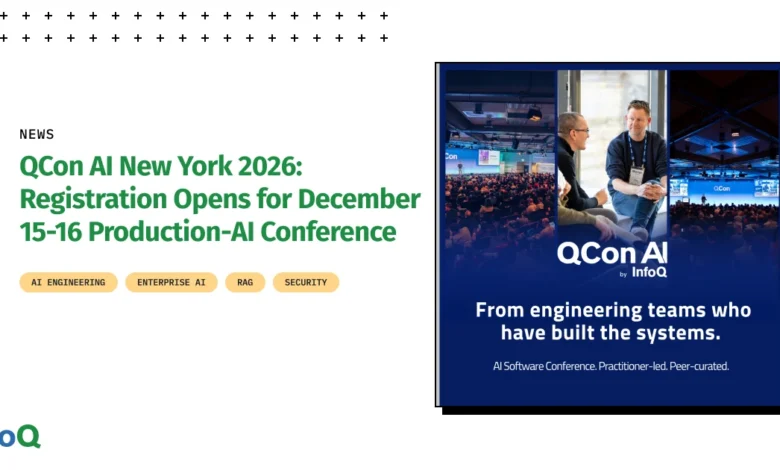
Registration has officially opened for QCon AI New York 2026, a premier two-day conference scheduled for December 15-16, 2026. The event marks a significant return to the New York metropolitan area, taking place at The Westin Jersey City Newport, strategically located just one PATH stop from Lower Manhattan. This conference is meticulously designed for a highly specialized audience: senior software engineers, architects, and engineering leaders who are actively involved in deploying and managing AI systems in live production environments. Its explicit focus distinguishes it from events catering to initial AI adoption discussions, instead zeroing in on the complex challenges and solutions encountered once AI features transition from conceptual demos to robust, real-world applications under significant traffic.
Unveiling the Production AI Imperative
The core philosophy of QCon AI New York 2026 revolves around the operational realities of artificial intelligence. As industries worldwide accelerate their integration of AI, the conversation has shifted from "if" to "how" to successfully scale, maintain, and secure these intelligent systems. Industry reports consistently highlight that while a vast majority of organizations are experimenting with AI, a substantial portion—with some estimates reaching as high as 80%—struggle to move their AI initiatives beyond pilot phases or proof-of-concept into fully operational, value-generating production environments. This gap underscores a critical demand for practical, experience-driven knowledge, which QCon AI New York aims to fulfill.
The program committee has meticulously structured the conference around six pivotal areas of production AI. While specific topics will be detailed in forthcoming announcements, these areas are designed to address common, yet complex, problems that engineering teams inevitably encounter once an AI feature moves past a successful demonstration and must withstand the rigors of real-world traffic and continuous operation. These critical domains typically encompass:
- Scalability and Performance Optimization: Addressing the challenges of making AI models perform efficiently under varying loads, latency requirements, and resource constraints in a distributed system. This includes techniques for model serving, inference optimization, and infrastructure scaling.
- Robustness and Reliability Engineering: Focusing on building AI systems that are resilient to failures, handle unexpected inputs gracefully, and maintain consistent performance over time. This involves error handling, fault tolerance, and continuous monitoring strategies.
- Data Governance and MLOps Pipelines: Delving into the end-to-end lifecycle management of AI models, from data ingestion and feature engineering to model training, deployment, and monitoring. Emphasizing data quality, lineage, versioning, and automated MLOps practices.
- Ethical AI and Responsible Deployment: Exploring the crucial aspects of fairness, transparency, accountability, and privacy in production AI systems. This includes bias detection and mitigation, interpretability techniques, and compliance with emerging ethical AI regulations.
- Security and Threat Mitigation: Addressing the unique security vulnerabilities of AI systems, such as adversarial attacks, data poisoning, and model theft. Strategies for securing AI models, data, and infrastructure throughout the deployment lifecycle.
- Cost Management and Resource Efficiency: Providing insights into optimizing the operational costs associated with running AI in production, including cloud resource management, hardware acceleration, and efficient model design to maximize ROI.
Each of these areas represents a distinct hurdle that can impede the successful deployment and sustained performance of AI. By focusing on these practical aspects, QCon AI New York provides a forum for engineers to share solutions, learn from successes and failures, and ultimately enhance their capabilities in managing sophisticated AI deployments.
A Rigorous, Practitioner-Led Curriculum
The hallmark of QCon conferences for over two decades has been its unwavering commitment to a practitioner-led approach, and QCon AI New York 2026 is no exception. This methodology ensures that all content is driven by real-world experience and offers actionable insights rather than theoretical discussions or promotional pitches. The program committee employs a stringent vetting process for every proposed session, evaluating each against two fundamental questions: "Has the speaker personally run these systems and models in production?" and "Will they openly discuss what didn’t work, alongside what did?"
This rigorous selection criterion ensures that attendees receive authentic, unfiltered accounts from engineers who have navigated the complexities of AI deployment firsthand. Sessions are exclusively chosen by this practitioner committee and are invite-only, a deliberate strategy to maintain the highest quality and relevance of content. Crucially, the main conference schedule is free from sponsored talks or product pitches, preserving the integrity of the educational experience and focusing solely on technical depth and practical application. This commitment to unbiased, experience-driven content is a cornerstone of the QCon brand and a primary reason for its enduring reputation among senior technical professionals.
The Esteemed Program Committee Guiding the Discourse
The intellectual backbone of QCon AI New York 2026 is its distinguished program committee, a group of highly respected experts in the field of production AI. Their collective experience and insight are instrumental in shaping a program that is both relevant and forward-thinking.
The committee is chaired by Eder Ignatowicz, a Senior Principal Software Engineer and Architect at Red Hat AI. Ignatowicz brings a wealth of experience in building and scaling complex AI systems within enterprise environments. His leadership in chairing QCon AI Boston earlier in 2026 further underscores his expertise in curating compelling and valuable content for the AI community. His perspective from Red Hat AI provides a crucial lens on open-source contributions and enterprise-grade AI solutions.
He is joined by Faye Zhang, a Staff Software Engineer and GenAI search tech lead at Google. Zhang’s role at Google, a vanguard in AI research and deployment, offers unparalleled insight into cutting-edge generative AI technologies and their operational challenges within massive-scale search infrastructures. Her contributions are vital in ensuring the program addresses the rapidly evolving landscape of generative AI and its practical implications for production systems.
Completing this formidable trio is Wes Reisz, a Technical Principal Consultant at Thoughtworks and the acclaimed creator and co-host of The InfoQ Podcast. Reisz’s extensive background in software engineering, architecture, and technology leadership, combined with his role in disseminating technical knowledge through InfoQ, makes him uniquely qualified to identify topics that resonate with a senior technical audience. His perspective helps ensure a holistic and impactful program that bridges academic rigor with industrial application.
This diverse and experienced committee ensures that the conference program is not only technically profound but also directly applicable to the challenges faced by engineers operating AI in production today. Their collective vision is to foster an environment of genuine learning and knowledge exchange, free from commercial influence.
Strategic Location for Industry Collaboration
The choice of The Westin Jersey City Newport as the venue is a deliberate one, emphasizing accessibility and an environment conducive to high-level technical discourse. Situated just one PATH stop from Lower Manhattan, the location offers easy access for attendees traveling from across the tri-state area and beyond, leveraging New York’s status as a global hub for technology and finance. Jersey City itself has emerged as a significant tech cluster, providing a vibrant backdrop for a conference focused on advanced AI topics. The proximity to major corporate headquarters and a thriving tech ecosystem facilitates networking opportunities and encourages broader industry engagement. The Westin’s facilities are designed to support intensive learning and collaborative discussions, providing an ideal setting for a conference of this caliber.
Navigating the AI Development Lifecycle: Key Dates
The planning for QCon AI New York 2026 follows a carefully orchestrated timeline, designed to build anticipation and allow attendees to plan their participation effectively. Registration is currently open, offering the earliest access to the event. The initial wave of session announcements is anticipated in August 2026, providing a glimpse into the caliber of speakers and topics. A preliminary schedule will follow in October, allowing attendees to start planning their personalized conference itineraries. The complete program, detailing all sessions, speakers, and timings, is slated for publication by early November 2026, giving ample time for final preparations before the conference kicks off on December 15-16, 2026. This structured release of information ensures transparency and allows the technical community to engage with the content as it unfolds.
Beyond the Podium: Fostering Peer-to-Peer Exchange
Recognizing that some of the most valuable insights emerge from informal interactions, QCon AI New York 2026 is deliberately structured to provide ample opportunities for attendees to engage directly with speakers and fellow engineers. Beyond the scheduled talks, dedicated time slots are allocated for discussions on pressing topics relevant to production AI systems. These discussions often delve into nuanced aspects that cannot be fully covered in formal presentations.
Key discussion areas that attendees can expect to explore include:
- Agent Boundaries: Understanding the scope, responsibilities, and interaction models for autonomous AI agents in complex production systems.
- Evals (Evaluations): Deep dives into advanced techniques for rigorously evaluating AI model performance, robustness, and fairness in real-world scenarios, moving beyond simple accuracy metrics.
- Security: Collaborative discussions on emerging threats to AI systems, best practices for secure deployment, and strategies for proactive threat detection and mitigation.
- Cost Controls: Sharing strategies for optimizing cloud expenditure, resource allocation, and efficiency in running large-scale AI infrastructure without compromising performance or reliability.
These interactive sessions are crucial for building a community of practice, allowing attendees to troubleshoot common problems, share proprietary solutions (within professional bounds), and forge valuable professional connections. The emphasis on peer-to-peer learning reinforces QCon’s commitment to practical, actionable knowledge sharing.
The Broader Landscape of AI Operationalization
The existence and continued growth of events like QCon AI New York underscore a fundamental shift in the artificial intelligence landscape. The initial hype cycle, largely focused on research breakthroughs and theoretical possibilities, has matured into a pragmatic drive towards operationalization. Companies are now grappling with the very real challenges of integrating AI into core business processes, managing its lifecycle, and ensuring its ethical and secure deployment.
The market for MLOps (Machine Learning Operations) tools and services, which directly addresses these production challenges, is projected to grow exponentially, with some forecasts estimating it to reach tens of billions of dollars by the end of the decade. This growth is a clear indicator of the increasing complexity and criticality of putting AI into production. Conferences like QCon AI New York serve as vital platforms for knowledge transfer, helping to accelerate the maturation of MLOps practices and elevate the collective skill set of the global engineering community. By focusing on "what works" and "what doesn’t," the conference directly contributes to reducing the high failure rate of AI projects and unlocking the full potential of AI technologies across various industries. It implicitly offers a "response" from the industry itself: a collective acknowledgment that the greatest challenges in AI now lie in execution and sustained operation, not just invention.
QCon’s Legacy in Technical Excellence
QCon AI New York 2026 is the second of two QCon AI events on the 2026 calendar, following QCon AI Boston earlier in the year, and is part of a broader global series of QCon conferences. For over two decades, QCon has built a reputation for delivering high-quality, in-depth technical content tailored for senior software engineers and architects. Its enduring success lies in its consistent application of the practitioner-led approach, which prioritizes real-world experiences and actionable insights. This legacy ensures that QCon AI New York will maintain the high standards of technical excellence and practical relevance that attendees have come to expect from the QCon brand. The implications for the industry are significant: by providing a trusted forum for sharing cutting-edge operational practices, QCon contributes to the development of more robust, reliable, and responsible AI systems worldwide.
For more information regarding the program, speakers, and registration details, interested parties are encouraged to visit the official QCon AI New York website at newyork.qcon.ai.