The Economic Shift: Why AI Coding Agents Are Poised to Solve the Enterprise Software Crisis

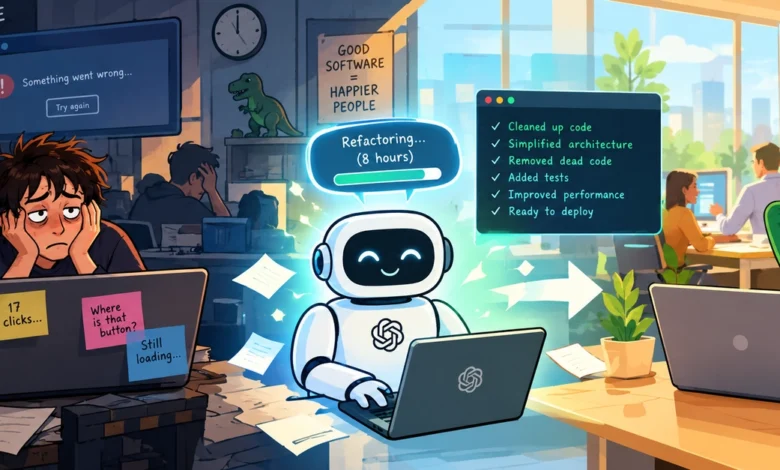
For decades, the standard operating procedure for non-tech enterprises—ranging from legacy banking institutions to government agencies—has been to accept the existence of substandard, cumbersome internal software. While the engineering talent within these organizations is often world-class, the economic realities of development have historically mandated that "good enough" is the only sustainable target. However, the emergence of advanced coding agents is fundamentally altering the cost-benefit analysis of technical debt, potentially signaling the end of an era defined by bloated, inefficient, and frustrating enterprise applications.
The Historical Context of Enterprise Technical Debt
To understand why enterprise software is often perceived as "shoddy," one must examine the incentive structures that have dominated the corporate landscape since the early 2000s. Historically, internal systems were viewed not as products, but as utility-like infrastructure. Much like electricity or plumbing, the primary requirement was that the system simply remained functional.
Throughout the 2010s, as companies underwent rapid digital transformation, the pressure to ship new features grew exponentially. According to a 2022 report by the Consortium for Information & Software Quality (CISQ), the cost of poor-quality software in the United States reached approximately $2.41 trillion annually. This figure includes the costs of failed development projects, maintenance of legacy systems, and, significantly, the lost productivity of employees forced to interact with inefficient interfaces. Despite these astronomical figures, the internal mandate remained clear: prioritize the product roadmap over structural refactoring. Because employees in these environments are essentially "captive users" who cannot migrate to a competitor’s internal platform, organizations faced little market pressure to improve the user experience (UX) of their back-office tools.
Chronology of a Systemic Problem
The degradation of internal systems usually follows a predictable trajectory. In the early stages of a platform’s life cycle, the architecture is clean and performant. As business requirements evolve, "feature creep" sets in. By year five, the system typically accrues significant technical debt—code that works but is difficult to maintain. By year ten, the original architects have often departed, leaving a codebase that few current engineers fully understand.
This creates a "feature-lock" scenario. Adding a simple, requested feature might require three weeks of work because the underlying architecture is brittle and prone to regression. Management, seeing only the high cost of implementation, often delays these requests. Consequently, the software becomes a patchwork of workarounds, leading to the "dinosaur problem": a system that is functionally operational but operationally obstructive.
The Psychological and Economic Cost of Inefficiency
The aggregate impact of poorly designed software is a significant, if often overlooked, drain on the global economy. If an organization employs 10,000 workers and each loses an average of 15 minutes per day navigating clunky workflows, the company is essentially hemorrhaging over 600,000 hours of labor annually.
Beyond the raw time-loss, there is a documented psychological toll. Research into human-computer interaction (HCI) has repeatedly shown that friction in digital tools leads to increased cognitive load, decreased job satisfaction, and lower morale. A 2023 survey by the Enterprise Software Council noted that 62% of employees in non-tech sectors reported that their internal tools made them feel "actively frustrated" on a daily basis. When employees spend the majority of their day fighting their own tools, the company-wide push for "engagement" and "wellness" often feels performative to the workforce. In essence, while firms spend millions on offsites and leadership training, they simultaneously force employees to endure environments that actively degrade their professional momentum.
The Emergence of AI-Assisted Remediation
The arrival of AI-powered coding agents—automated systems capable of analyzing, refactoring, and documenting legacy code—is currently challenging the traditional "three-month refactor" business case. Historically, a comprehensive code cleanup required a senior engineer to be pulled from the delivery roadmap, creating a massive opportunity cost. If the business needed a new customer-facing feature by September, the internal refactor was almost always sacrificed.
AI agents are changing this calculus by lowering the labor intensity required for structural improvements. While these tools do not replace the need for human engineering oversight, testing, or architectural judgment, they can accelerate the mundane, repetitive aspects of refactoring—such as updating dependencies, simplifying complex conditional logic, or writing documentation for undocumented legacy modules. What once required a three-month budgetary commitment can now, in some cases, be achieved in a fraction of that time.
Industry Reactions and Strategic Implications
Major enterprise software vendors and consultancies are beginning to adjust their strategies in response to this shift. Leading CIOs have begun incorporating "AI-driven maintenance" into their 2025 technology budgets. The focus is no longer exclusively on building new features; it is on "modernizing the existing footprint" without inflating headcount.
"We are seeing a pivot," notes a lead analyst at a major cloud infrastructure firm. "The conversation has moved from ‘how do we build more’ to ‘how do we make what we have work better.’ The economic viability of high-quality code is higher today than it has been at any point in the last two decades. Companies are finally realizing that technical debt isn’t just a cost on the balance sheet—it’s a constraint on organizational speed."
Fact-Based Analysis of the Future Landscape
The long-term implications for the enterprise are profound. As the barrier to entry for high-quality software maintenance drops, the "dinosaur problem" will likely begin to resolve. If coding agents can successfully reduce the cost of refactoring, organizations will be able to maintain cleaner, more intuitive systems as a matter of standard practice rather than as a desperate, emergency intervention.
This transition suggests that the competitive advantage in the next decade will not necessarily go to the firm that writes the most code, but to the firm that maintains the most efficient, user-friendly digital environment. By automating the cleanup of legacy systems, enterprises can shift their human talent away from "fighting the system" and toward higher-value creative and strategic tasks.
Furthermore, this shift addresses the generational divide in corporate management. As younger, digital-native leaders move into executive roles, the "utility" view of software is being replaced by a "product" view. These leaders understand that the internal software environment is as critical to employee retention and output as the physical office space.
The ultimate promise of the current wave of AI development is not necessarily the creation of a new, bloated layer of features, but the restoration of the software we already rely on. By reducing the reliance on "shit code"—code that is fragile, opaque, and cumbersome—businesses can finally align their digital reality with their operational ambitions. For the first time in the history of the modern enterprise, the economic incentive is finally beginning to favor quality over sheer volume, marking a critical inflection point for the global labor market.