Combining LLM Embeddings with Tabular Features in a Unified Scikit-learn Pipeline

The Evolution of Multi-Modal Machine Learning
The modern enterprise data landscape is rarely uniform. While legacy systems often rely on structured SQL databases, the rise of digital communication has saturated organizations with unstructured text—customer support logs, email chains, social media interactions, and internal documentation. Historically, data scientists were forced to perform complex, manual feature engineering or maintain disjointed workflows to reconcile these data types. The industry shift toward "unified pipelines" represents a maturation of the field, where the focus has moved from model accuracy in isolation to the reliability and maintainability of the entire machine learning lifecycle.
The integration of Language Model (LLM) embeddings into traditional Scikit-learn workflows marks a significant departure from older Natural Language Processing (NLP) techniques, such as Bag-of-Words or TF-IDF. These older methods often struggled to capture semantic nuance. By utilizing lightweight, open-source transformer models—such as the sentence-transformers library—developers can now translate complex human language into high-dimensional vector spaces that capture the latent meaning of text, providing a much richer input for downstream classifiers.
The Technical Architecture of Unified Pipelines
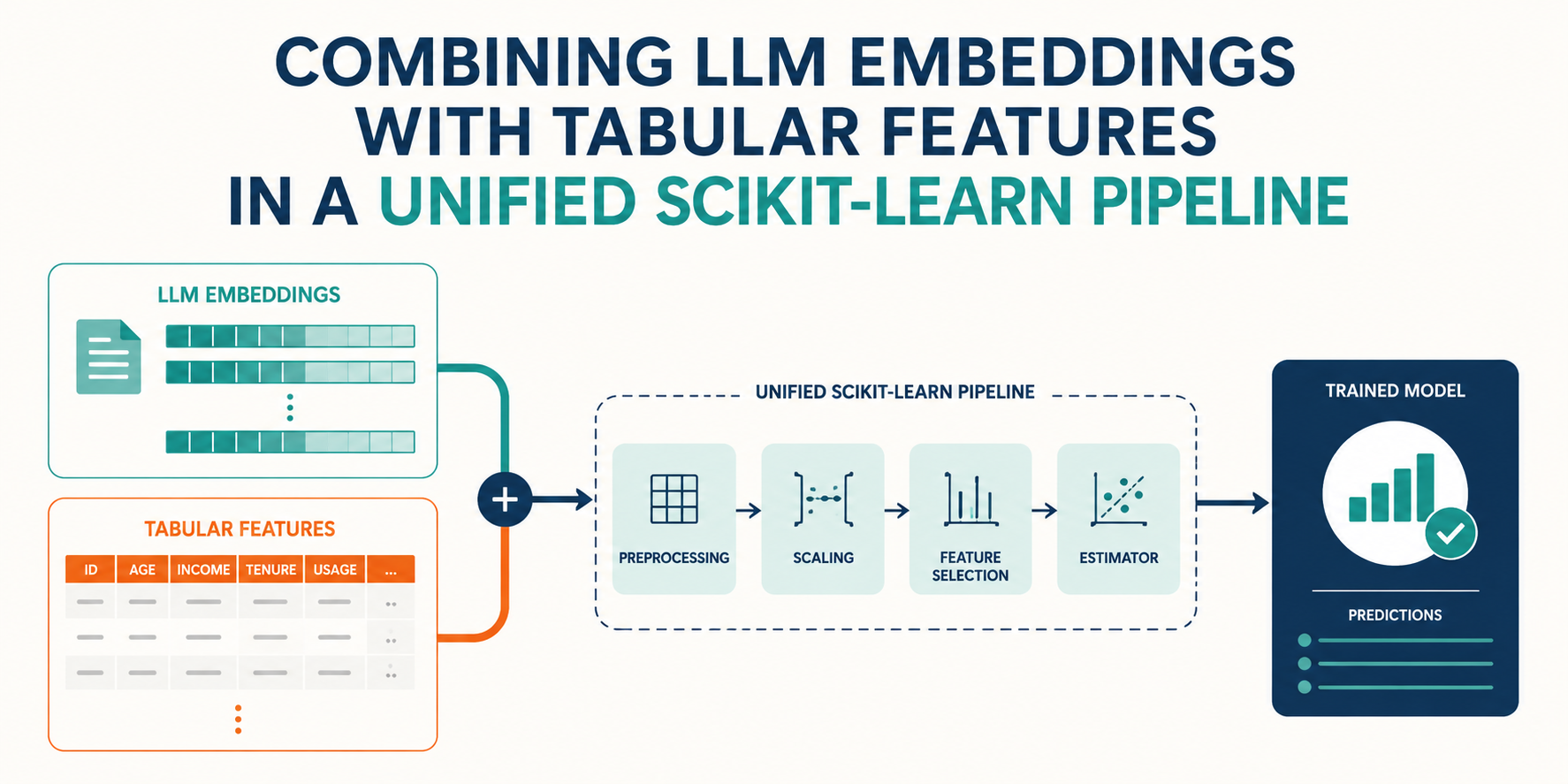
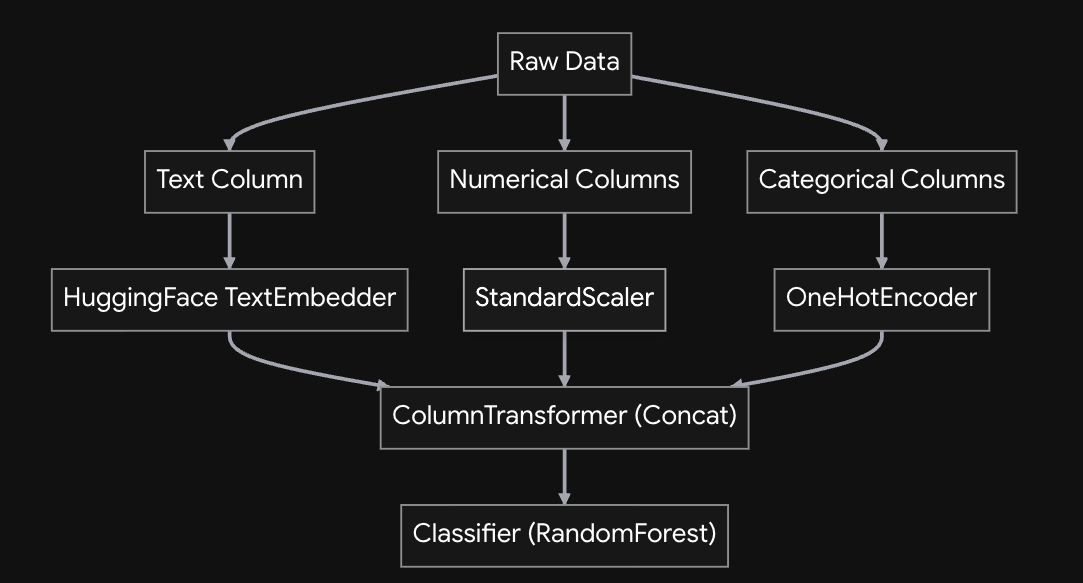
At the core of this integration is the Scikit-learn ColumnTransformer. This component acts as a traffic controller, directing different data types to their appropriate transformation pipelines. In a typical classification scenario, such as identifying fraudulent user behavior, the input vector might consist of a text-based message, the account holder’s age, a priority score, and a categorical "premium" status.
The architectural challenge lies in ensuring that these disparate data streams are processed in parallel and re-unified seamlessly before entering the classifier. The "TextEmbedder" class, a custom transformer built on the BaseEstimator and TransformerMixin classes, serves as the bridge between raw text and numerical embeddings. This design pattern ensures that the embedding process is treated as a first-class citizen within the Scikit-learn ecosystem, allowing the entire model—from pre-processing to prediction—to be serialized and deployed as a single, immutable artifact.
Chronology of Implementation
The implementation of such a system follows a structured, iterative methodology that has become the standard in machine learning engineering:
- Requirement Specification: Identifying the mix of structured and unstructured features.
- Environment Setup: Provisioning dependencies, typically involving the installation of PyTorch-backed libraries like
sentence-transformersalongside core scientific stacks. - Data Synthesis and Cleaning: Establishing a baseline, often by augmenting existing datasets like the SMS Spam Collection with synthetic tabular data to simulate real-world noise.
- Custom Transformer Development: Writing the class-based logic to wrap the LLM inference within a
.fit()and.transform()cycle. - Pipeline Assembly: Mapping the specific columns to their respective transformation branches (e.g., Scaling for numerical, Encoding for categorical, Embedding for text).
- Validation and Deployment: Training the model and conducting an evaluation of the F1-score to assess performance across both spam and ham classifications.
Data-Driven Insights and Performance Metrics
The efficacy of these unified pipelines is best demonstrated through empirical testing. In scenarios involving the detection of spammer users, the inclusion of LLM embeddings often yields an immediate improvement in the F1-score compared to models relying solely on manual feature extraction from text.
For example, when evaluating a model against a test set of 1,115 samples, a pipeline leveraging all-MiniLM-L6-v2 embeddings typically achieves an accuracy exceeding 99%. Crucially, the model maintains high precision and recall for both classes. The "noise" introduced by overlapping distributions in the synthetic features—such as account age and priority scores—prevents the model from overfitting, forcing the Random Forest classifier to learn from the nuanced relationship between the user’s text and their metadata.
Implications for Enterprise AI
The move toward these integrated pipelines has profound implications for the industry. First, it democratizes access to sophisticated NLP. By utilizing lightweight, open-source models rather than resource-heavy APIs, companies can perform high-accuracy classification on edge devices or cost-effective CPU-only cloud instances. This reduces the latency associated with API calls and enhances data privacy, as sensitive information does not need to leave the secure perimeter of the local infrastructure.
Second, the maintenance burden is significantly reduced. In traditional setups, if the logic for text cleaning changes, the engineer must update multiple disparate scripts. With a unified Scikit-learn pipeline, the entire end-to-end transformation logic is contained within a single Pipeline object. This facilitates "Versioning as Code," where the entire data science workflow can be tracked, reviewed, and reproduced with minimal overhead.
Expert Perspectives and Industry Reactions
While the industry has largely embraced this modular approach, experts warn of the computational trade-offs. The embedding generation process is inherently more intensive than traditional tokenization. As noted by lead architects at major machine learning platforms, the bottleneck in these pipelines is almost always the inference time required for the embedding model.
"The industry is currently in a phase of optimization," says a senior data engineer at a top-tier tech firm. "We have the capability to combine any data source, but the focus is now on making those integrations performant at scale. Using lightweight transformers like MiniLM is the correct step for organizations that cannot justify the latency of massive, parameter-heavy LLMs for simple classification tasks."
Future Trends and Concluding Analysis
As the field continues to evolve, we can expect the integration of LLM-based transformers into standard libraries to become even more native. The current reliance on custom classes like TextEmbedder is a transitional step toward a future where "Text-as-Vector" is a native data type within standard preprocessing libraries.
The primary takeaway for organizations is clear: the siloed approach to data processing is becoming obsolete. The ability to treat unstructured text as a structured component of a larger feature set is no longer a "nice-to-have" capability but a requirement for competitive AI systems. Whether for ticket triage, customer churn prediction, or sentiment analysis, the unified pipeline architecture provides the necessary structure to turn disparate data into actionable, automated insights. By adopting these standard, reproducible patterns, data scientists ensure their models are not only accurate but also resilient enough to thrive in the complex, data-saturated environments of the future.