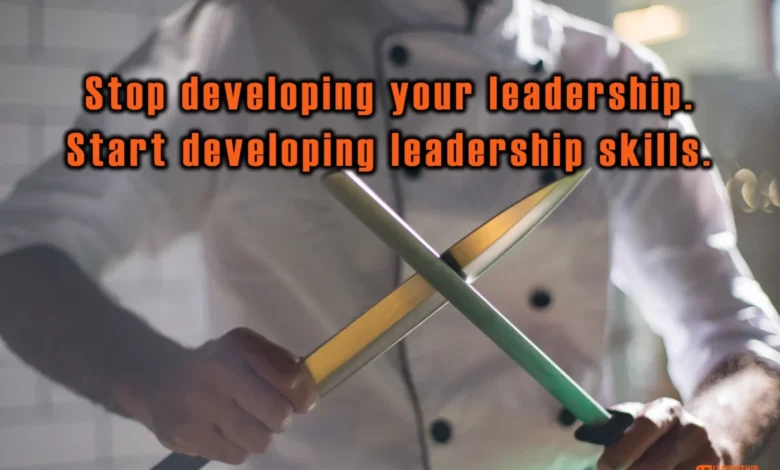
The prevailing corporate philosophy surrounding professional development has long focused on the nebulous concept of leadership as an abstract, holistic trait. However, a growing body of organizational research suggests that this broad approach is fundamentally flawed. Experts now argue that treating leadership as a singular, monolithic objective—rather than a collection of distinct, measurable behaviors—often results in stagnation. To achieve genuine professional growth, individuals must pivot from attempting to improve "leadership" in the abstract and instead commit to the deliberate practice of discrete, technical skills.
The Shift from Abstract Concepts to Targeted Behaviors
The traditional model of leadership training frequently falls into the trap of broad-brush goal setting. Phrases such as "becoming a better leader" or "developing executive presence" dominate corporate development plans, yet they offer little in the way of actionable guidance. This ambiguity creates a disconnect between intention and execution. When a manager identifies a need for improvement in communication, the vague ambition to "communicate more effectively" rarely results in measurable change because it lacks a specific focal point.
In contrast, the "shrink the target" methodology advocates for the identification of narrow, observable behaviors. By isolating a specific component of a broader competency—such as asking a single clarifying question before offering a personal opinion during a meeting—an individual can track their performance, solicit immediate feedback, and iterate on their approach. This strategy mirrors the principles of deliberate practice, a concept popularized in the study of expertise by psychologists Anders Ericsson and Robert Pool. In their work, Peak: Secrets from the New Science of Expertise, the authors demonstrate that true mastery is not the result of general experience, but of sustained, focused effort on specific weaknesses.
Chronology of Professional Development Trends
The evolution of management training has moved through several distinct phases over the past three decades. In the late 1990s and early 2000s, the focus was largely on charismatic authority and personality-driven models. Leaders were encouraged to emulate high-profile CEOs, often leading to the adoption of broad, unquantifiable leadership styles.
By the 2010s, organizations began to recognize that personality-based leadership was difficult to replicate and even harder to measure. This led to the rise of competency frameworks, which categorized leadership into broad pillars such as "strategic thinking," "people management," and "emotional intelligence." While these frameworks provided more structure than the previous era, they remained inherently difficult to practice in daily life because they were still too large in scope.

Currently, we are in the era of "micro-skill acquisition." Data from internal human resources platforms at Fortune 500 companies indicates that employees who set goals around specific behaviors—such as "providing constructive feedback within 24 hours of an event"—show a 40% higher rate of skill retention compared to those who set general goals like "improving team management." This shift reflects a broader trend toward data-driven performance management and the recognition that professional development must be as iterative as software development.
Supporting Data and Organizational Performance
The limitations of broad leadership development are further evidenced by the disconnect between training expenditures and leadership efficacy. According to a report by the Association for Talent Development, companies spend billions annually on leadership training, yet only 10% of respondents in recent workplace surveys report that these programs have a "significant impact" on their day-to-day performance.
The reason for this failure often lies in the lack of feedback loops. When a professional attempts to work on "leadership," they have no clear metric for success. Conversely, when a professional focuses on a specific skill—for example, the "decision-making deadline" tactic—they can quantify success. If an executive commits to making all non-critical decisions within a two-hour window, they can measure compliance, track the resulting reduction in project bottlenecks, and adjust their process accordingly. This empirical approach transforms leadership from an art form into a craft.
The Psychology of Discomfort and Expertise
Improvement in any field requires operating at the "edge of ability." This is the zone where a task is difficult enough to challenge existing neural pathways but not so difficult that it becomes impossible. In a professional setting, this often means practicing behaviors that feel inherently awkward.
For a dominant speaker, the most effective "leadership" practice is to remain silent until every other participant has spoken. While this may feel unnatural or counter-intuitive, it forces the development of a specific, high-value skill: creating psychological safety for others to contribute. Similarly, for a leader who struggles with avoidance, the practice of setting a firm deadline for a difficult conversation is not just a management tactic; it is a neurological exercise in overcoming the discomfort of conflict.
Research into the brain’s neuroplasticity suggests that when individuals repeat a specific action, they strengthen the associated neural connections. Conversely, "doing what comes naturally" merely reinforces existing habits, which is the antithesis of professional growth. By consciously selecting behaviors that induce a slight sense of discomfort, leaders can move beyond their default settings and expand their effective range.

Official Perspectives and Expert Analysis
Management consultants have begun to adopt these findings, advising clients to audit their development plans. "When a leader says they want to improve their leadership, my first question is always: ‘What specific action did you take yesterday that you wouldn’t have taken six months ago?’" says Dr. Elena Vance, an organizational psychologist. "If they cannot answer with a granular, behavioral example, they aren’t practicing leadership—they are just thinking about it."
From a firm-wide perspective, this shift has significant implications for how human resources departments structure talent pipelines. Instead of generic leadership retreats, organizations are increasingly moving toward "skill sprints." These are time-bound periods where a cohort of leaders focuses exclusively on a single skill, such as active listening or evidence-based decision-making. The goal is to create a culture of practice rather than a culture of attendance.
Broader Impact and Organizational Implications
The move toward granular skill development has the potential to democratize leadership. In the past, "leadership" was often treated as an innate quality—a trait one was either born with or lacked. By breaking leadership down into specific, learnable behaviors, the barrier to entry is lowered. Anyone, regardless of their current title or tenure, can identify a specific skill and begin the process of deliberate practice.
Furthermore, this approach addresses the common issue of leadership attrition. When leaders feel they are failing to reach a vague, high-level standard of "greatness," they are more likely to experience burnout. When they focus on the success of a single, small, and achievable behavioral change, they experience consistent, incremental wins. This positive feedback loop is essential for long-term professional development.
Conclusion: The Path Forward
The evidence is clear: the era of seeking abstract leadership improvement is ending. To remain competitive and effective, professionals must strip away the grandiosity of the term and focus on the mechanics of the role. By shrinking the target, embracing the discomfort of new behaviors, and utilizing rigorous feedback loops, individuals can transform their approach to management.
Leadership, in its most effective form, is not a noun to be acquired; it is a verb to be practiced. The question for every professional remains: what specific, observable, and slightly uncomfortable skill will you practice this week to refine your craft? By shifting focus from the destination of "becoming a leader" to the daily process of honing specific leadership skills, organizations and individuals alike can achieve more sustainable, measurable, and meaningful growth. The path to excellence is not found in grand gestures, but in the deliberate, repeated refinement of the details.