The Architect of Machine Imagination: Inside Danijar Hafner’s Mission to Bring General-Purpose AI into the Physical World

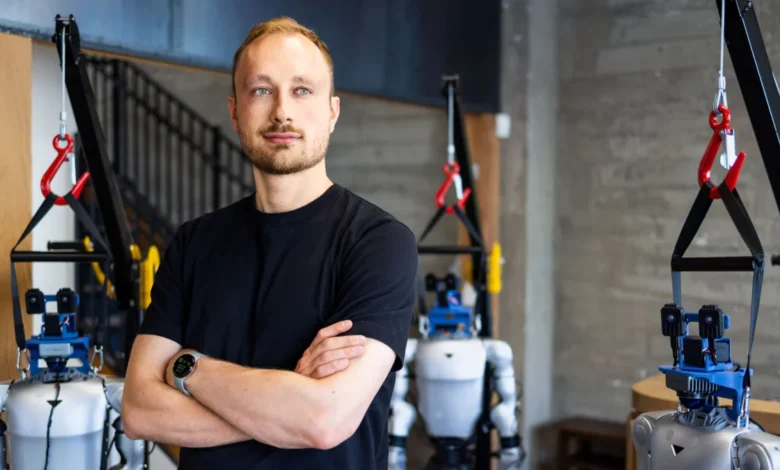
The transformation of artificial intelligence from digital assistants to physical agents is accelerating, and at the bleeding edge of this transition stands Danijar Hafner. Inside a sparsely furnished, largely empty office space in the South of Market (SoMa) district of San Francisco, a startup currently operating in stealth mode is quietly preparing for a massive unveiling. The name of the company is absent from the front door, and the warehouse-like floor plan boasts little more than a scattering of desks and a central rack of humanoid robots imported from China. Suspended like marionettes awaiting a master puppeteer, these robotic frames represent the physical embodiment of years of complex research.
Hafner, a 31-year-old prodigy and former Google DeepMind researcher, is fundamentally redefining how robots perceive, learn, and adapt to the unpredictable contours of the physical world. While his lips remain largely sealed regarding the exact commercial trajectory of his new venture, he characterizes the enterprise as a direct continuation of his lifelong obsession: teaching artificial intelligence to navigate environments it has never encountered during its training phase. In an era where humanoid robotics is moving from science fiction to venture-backed reality, Hafner’s approach sidesteps conventional paradigms by leveraging advanced world models to give machines the capacity to imagine, adapt, and survive outside the controlled confines of a laboratory.
The Technical Foundation: Model-Based Reinforcement Learning
To understand why Hafner’s work has captured the attention of the global AI research community, one must examine the limitations of traditional robotics training. Historically, teaching a robot to perform complex tasks in the physical world required exhaustive trial-and-error routines. Robots would be forced to repeat simple physical actions thousands of times, often resulting in hardware damage, astronomical energy consumption, and severe limitations when confronted with novel obstacles.
Hafner bypasses these inefficiencies by relying on model-based reinforcement learning. Instead of forcing a robot to learn exclusively through physical interaction, Hafner develops "world models"—sophisticated neural architectures designed to emulate the physical laws and environmental dynamics of reality. An AI agent is then placed within this internal simulation, where it learns how to act, react, and strategize.
By treating the model as a virtual mirror of the real world, the agent gains the ability to forecast future outcomes. Hafner frequently uses the metaphor of dreaming or imagining. Through this simulated foresight, the agent can anticipate the consequences of its actions before executing them in physical space. When embedded inside a humanoid robot, this capability transforms how the machine interacts with humanity. If a household robot is deployed into a residential home, for instance, it cannot rely on hard-coded routines for every possible floor plan or misplaced piece of furniture. It must possess the generalized intelligence to parse unfamiliar geometries and solve unexpected physical challenges on the fly.
From Rural Germany to the Heart of Silicon Valley
The intellectual trajectory that led Hafner to the forefront of embodied AI began far away from the venture-capital-soaked streets of San Francisco. He grew up in a quiet, rural town in northeastern Germany, the son of two classical musicians. Despite an artistic household, Hafner gravitated toward the structural logic of code. He taught himself programming with the help of a neighbor, laying the technical foundation for what would become a lifelong vocation.
During his high school years, Hafner’s interests gravitated toward the nascent online courses emerging around artificial intelligence. While his peers were exploring traditional subjects, Hafner became consumed by a fundamental philosophical and computational question: How does thinking actually work? Artificial intelligence offered a tangible methodology to simulate cognitive processes on a silicon substrate.
By 2015, Hafner was studying engineering as a second-year undergraduate at the Hasso Plattner Institute in Potsdam, Germany. Demonstrating exceptional aptitude, he secured a role as a student researcher at Google Brain, marking the beginning of a prolific decade-long tenure within the upper echelons of corporate AI research. Over the subsequent years, Hafner completed a dozen distinct internships and engineering positions across Google Brain and Google DeepMind, working seamlessly across facilities in the United Kingdom, Canada, and the United States.
During this period, Hafner collaborated directly with some of the most luminous minds in the history of computer science. His colleagues and mentors included Geoffrey Hinton, frequently hailed as one of the "godfathers of AI" for his foundational contributions to deep learning, and Ashish Vaswani, a coauthor of the monumental 2017 research paper Attention Is All You Need, which introduced the transformer architecture powering nearly all contemporary large language models.
Timothy Lillicrap, a prominent researcher at Google DeepMind and a former manager and coauthor of Hafner, speaks of his former colleague with unequivocal praise. "I get to interact with a lot of really smart people in research at Google, and he easily sits in the top half of 1%," Lillicrap observes. "In many cases he would build, single-handedly, things it would take entire teams of engineers to build."
The Chronology of Breakthroughs: From Virtual Games to Physical Reality
Hafner’s methodology was not born overnight; it was meticulously forged through a series of progressive academic breakthroughs, consistently validated by pitting his world-model agents against increasingly complex virtual domains.
His first major academic milestone was PlaNet, a pioneering model that demonstrated how AI agents could execute complex actions by planning ahead using learned environmental dynamics. Following PlaNet came the iteration of the Dreamer algorithm family, which systematically pushed the boundaries of reinforcement learning.
Dreamer 2 marked a historic threshold by becoming the first agent to achieve human-level performance playing Atari 2600 video games entirely through a learned world model, bypassing the need for direct pixel-based reactive policies. Shortly thereafter, Dreamer 3 achieved another landmark feat by solving the notoriously difficult "Minecraft Diamond challenge," successfully mining in-game gems autonomously without human intervention or prior instruction manuals. Pushing the paradigm even further, Dreamer 4 demonstrated the capacity to learn complex survival and resource-gathering mechanics—such as mining diamonds—solely from an offline dataset of recorded gameplay videos, eliminating the need for active interaction with the game environment entirely.
Having conquered virtual gaming simulations, Hafner began the arduous transition of migrating his algorithmic agents out of digital pixels and into physical hardware. His DayDreamer project served as a proof of concept, utilizing the Dreamer algorithm to allow physical robotic hardware to operate autonomously in novel environments. The robots were able to adapt dynamically to unprecedented physical stresses and real-world disturbances—such as being abruptly pushed over by human researchers—without requiring any task-specific retraining.
The Launch of a Stealth Startup and the Future of Embodied AI
The culmination of Hafner’s academic research and corporate tenure crystallized in the fall of 2025, when he officially departed Google DeepMind to establish his own independent startup in San Francisco. While the company remains in stealth mode, the intellectual capital and technological framework he brings from his DeepMind years position his venture as a formidable dark horse in the race toward general-purpose robotics.
The broader implications of Hafner’s work extend far beyond the walls of his SoMa office. For decades, the robotics industry has grappled with the "brittle intelligence" problem: robots perform brilliantly in structured factory environments where every variable is controlled, but fail catastrophically in unstructured human environments like homes, hospitals, and disaster zones. By decoupling robot skill acquisition from physical trial-and-error through advanced world models, Hafner’s architecture offers a scalable pathway to general-purpose utility.
As venture capital continues to flood into humanoid robotics and artificial general intelligence, the bottleneck is no longer hardware manufacturing; it is software cognition. Robots from various global manufacturers are increasingly capable of fluid mechanical movement, but they lack the cognitive map required to understand the world around them dynamically.
Danijar Hafner’s stealth startup aims to bridge that exact chasm. Though he remains tight-lipped regarding the commercial rollout of his humanoid fleet, his overarching ambition remains transparent. As Hafner notes when reflecting on his transition from Google DeepMind to founding his own enterprise: "I was interested in solving a problem that would change the world." If his history of computational breakthroughs is any indicator, the quiet startup in SoMa may soon make that dream a physical reality.