Scaling FinOps Excellence: How BMW Group Automates Cloud Cost Anomaly Detection Across 14,000 Accounts

Managing cloud expenditure at the scale of a global automotive leader like the BMW Group presents a challenge of immense proportions. With over 14,000 cloud accounts in its estate, the company faces the constant risk of "cloud sprawl" and unexpected billing spikes that, if left unchecked, could result in significant financial leakage. To combat this, BMW Group, in collaboration with Data Reply, has evolved its internal Cloud Efficiency Analytics (CLEA) platform from a static visualization tool into a proactive, serverless anomaly detection engine that identifies and alerts stakeholders to cost deviations with surgical precision.
The Evolution of Cloud Efficiency Analytics
For years, the standard approach to cloud financial management involved manual dashboard monitoring. While tools like Amazon QuickSight provided BMW employees with visibility into their cloud spend, this model was inherently reactive. An analyst had to actively open a dashboard to spot a trend; if the dashboard wasn’t reviewed, the anomaly persisted, potentially costing the organization thousands of dollars before discovery.
The transition to a proactive model was driven by the realization that in a distributed cloud environment, decentralized ownership is the only way to maintain agility. By empowering individual account owners with timely, actionable intelligence, BMW shifted the responsibility for cost governance to the teams actually consuming the resources. Today, CLEA processes approximately 3 billion rows of billing data every month, aggregating this massive volume into a consistent grain of daily cost per account per service. This analysis occurs with a T-1 lag, ensuring that yesterday’s spend is analyzed and reported on by the following day.
The Technical Architecture: Powering Scale with Serverless
The backbone of CLEA’s success is its serverless architecture, which minimizes operational overhead while maximizing performance. The daily pipeline is orchestrated by AWS Step Functions using a Distributed Map pattern. This allows the system to fan out workloads across as many as 500 concurrent AWS Lambda functions, enabling the analysis of 14,000 accounts in approximately 20 minutes.
The forecasting engine utilizes Prophet, an open-source library developed by Meta, to generate baseline predictions based on 365 days of historical data for each account-service pair. By leveraging additive seasonality, the model creates a robust, dynamic expectation of what a specific service in a specific account should cost on a given day. This approach is superior to static thresholding, which often triggers false positives as legitimate workloads scale or as development teams adopt new services.
By running on a purely serverless stack—including Amazon S3 for storage, AWS Glue for data consolidation, and Amazon Athena for querying—BMW has achieved an incredibly efficient cost profile for the tool itself. The entire compute cost for running this daily detection across 14,000 accounts is approximately $50 per month, translating to less than half a cent per account.
The Filtering Logic: Distinguishing Noise from Signals
One of the most significant challenges in automated anomaly detection is the "alert fatigue" caused by false positives. If a system alerts on every minor deviation, users eventually ignore the notifications. To address this, the BMW team implemented a multi-layered filtering logic designed to surface only the most relevant, actionable insights.
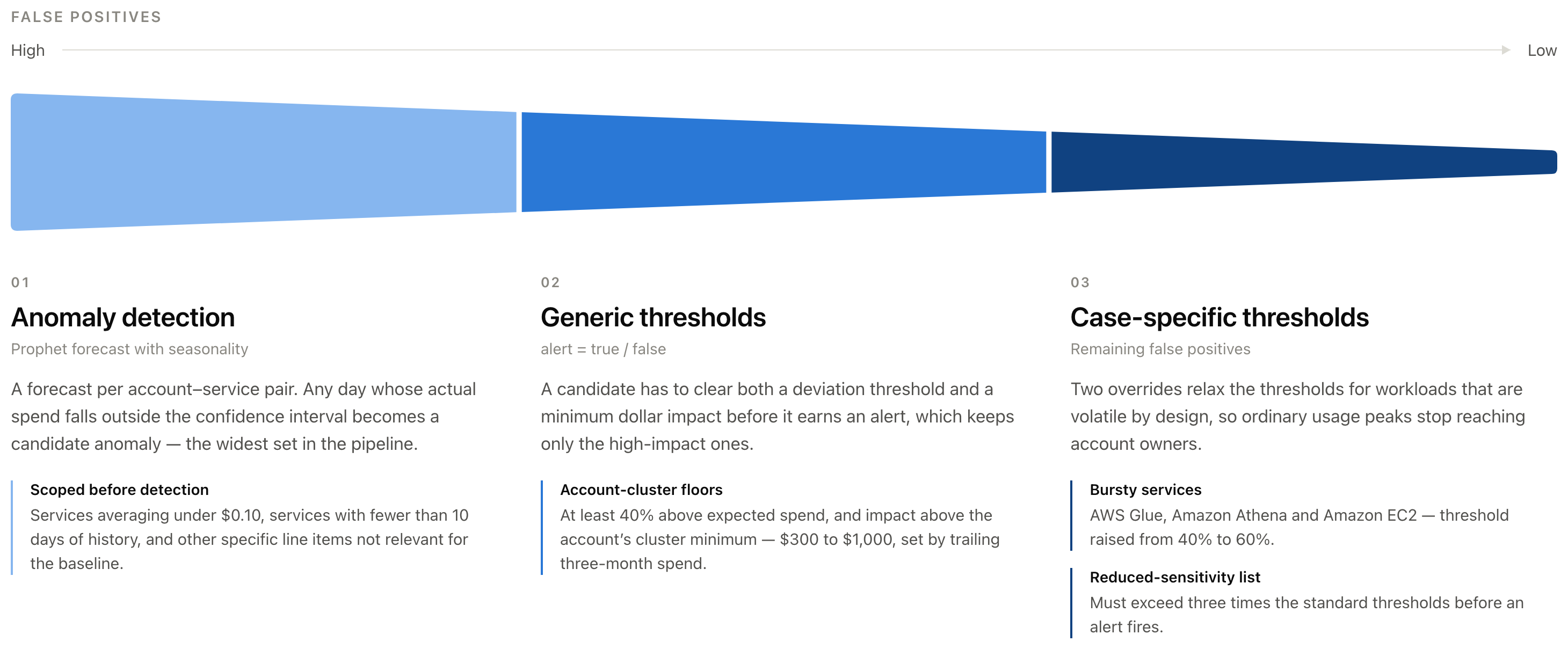
The filtering process begins by excluding "noise"—services with negligible spend or insufficient historical data. Once the baseline is established, the system calculates the "impact"—the difference between actual and expected spend. An anomaly is only flagged if the actual cost deviates by at least 40% from the forecast.
Beyond this percentage-based filter, CLEA applies two further tiers of refinement:
- Account-Cluster Filtering: Recognizing that a $1,000 spike is significant for a small team but routine for a large-scale data processing account, the system sorts accounts into four clusters based on their trailing three-month average spend. Each cluster has a minimum dollar impact threshold ranging from $300 to $1,000, ensuring that alerts are only generated for deviations that are financially meaningful to that specific account.
- Service-Specific Thresholds: Certain services, such as AWS Glue, Amazon Athena, and Amazon EC2, are inherently more volatile due to the nature of batch processing and on-demand compute. For these services, the threshold is raised to 60% to reduce false positives. Furthermore, teams managing known volatile workloads can request "reduced-sensitivity" status, which requires an anomaly to exceed three times the standard threshold before triggering an alert.
From Alert to Actionable Insight
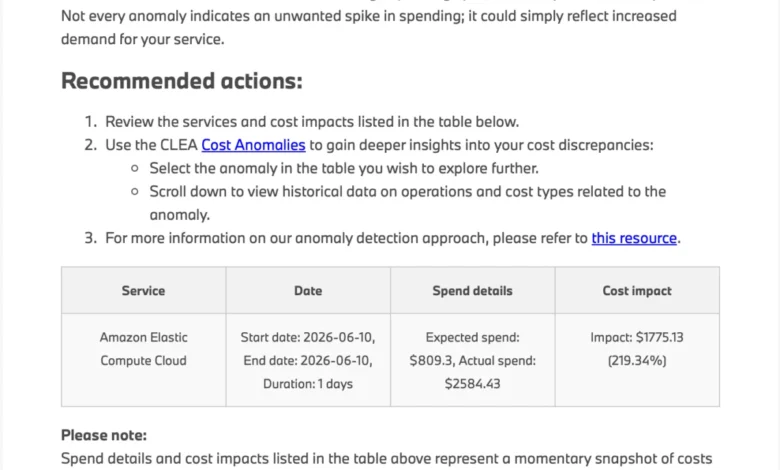
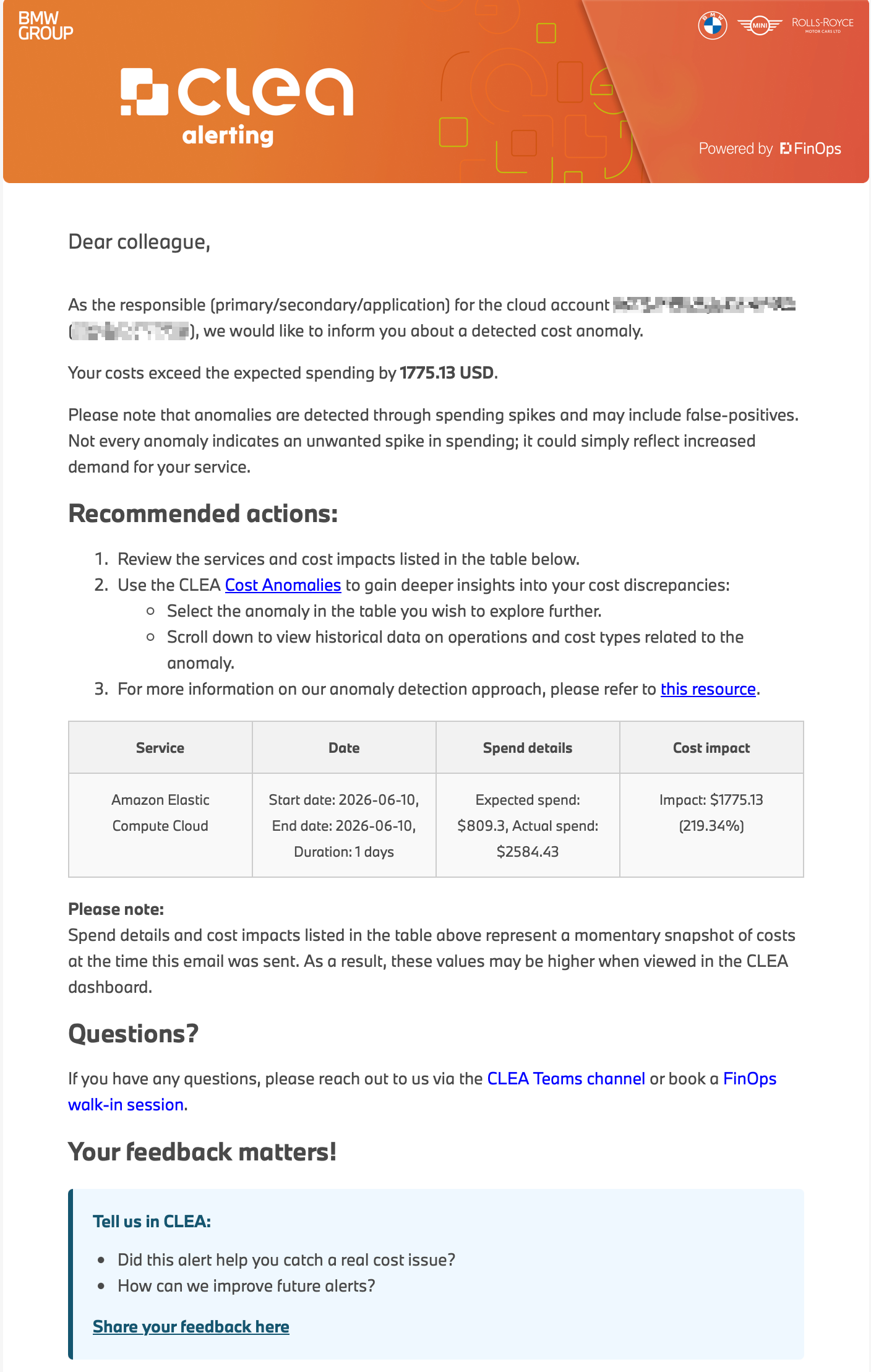
When an anomaly is detected, the alert engine triggers an email notification that serves as a direct, contextualized call to action. The email provides the recipient with clear data: the account name, the service affected, the expected versus actual cost, and the percentage impact. This transparency allows the account owner to instantly assess the severity of the event.
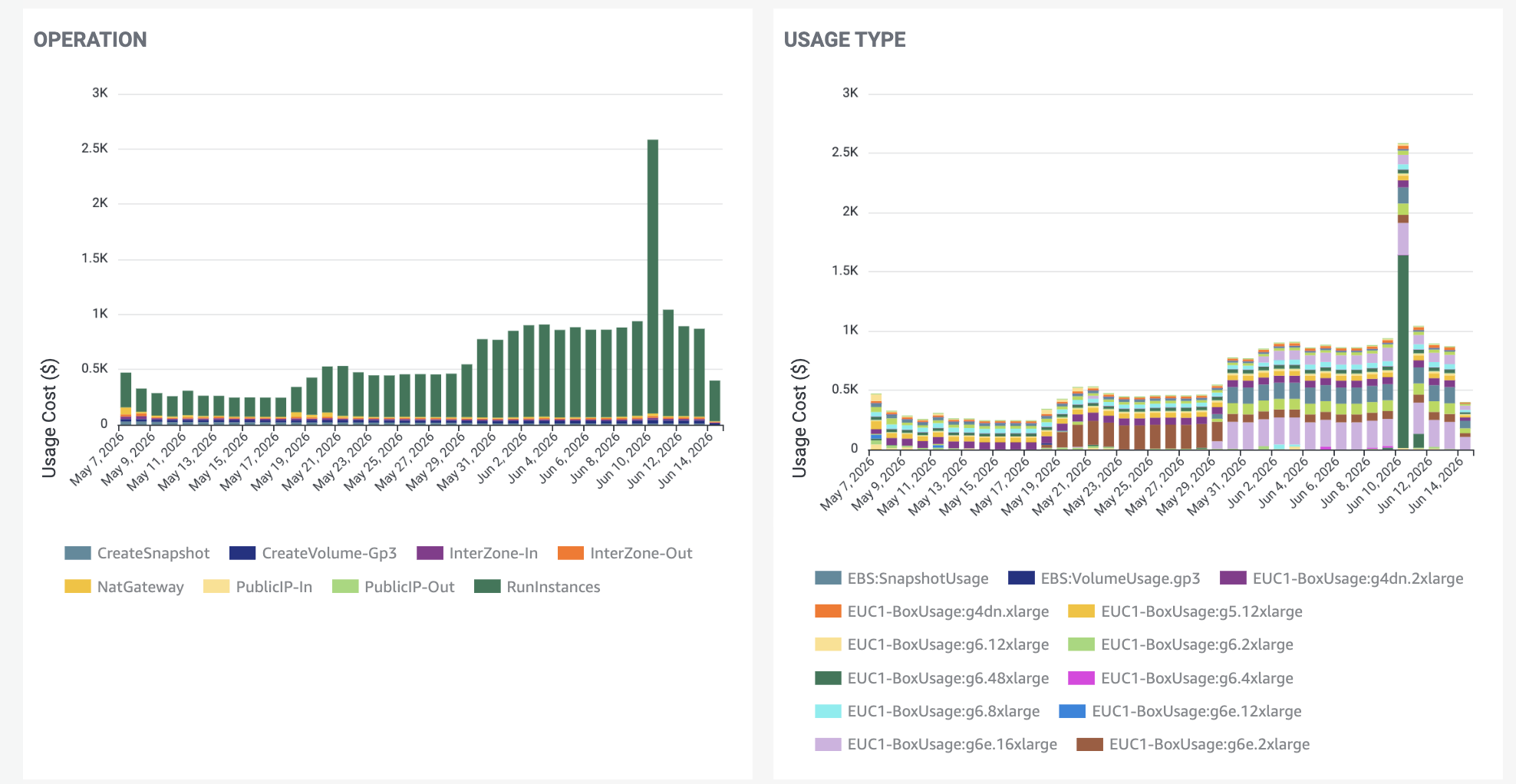
Crucially, the alert includes a link to a self-service dashboard in Amazon QuickSight. This allows the owner to conduct a root-cause analysis without escalating the issue to a centralized platform team. Using drill-down charts, users can view daily spend broken down by operation and usage type. For instance, an owner can instantly confirm that a spike in costs was caused by an unexpected increase in EUC1-BoxUsage:g6.48xlarge instances, enabling them to identify whether the spike was a legitimate business requirement or an inadvertent configuration error.
Broader Implications for FinOps
The BMW Group implementation highlights a shift in the broader IT industry toward "agentic" and automated FinOps. The ability to identify cost anomalies within 24 hours of their occurrence allows for immediate remediation, significantly reducing the "blast radius" of runaway cloud services.
Industry analysts note that as enterprises move toward multi-cloud and hybrid environments, the ability to normalize billing data—as BMW has done by ingesting CUR data alongside other provider exports—is becoming a critical competitive advantage. Organizations that can effectively automate the "detect and respond" loop are better positioned to innovate without the friction of rigid, manual budget controls.
Future Horizons: AI and ITSM Integration
Looking ahead, the CLEA project is poised for further evolution. The team is currently working on integrating these alerts into existing IT Service Management (ITSM) platforms. By turning an email notification into an actionable incident ticket, the system will integrate seamlessly into the existing workflows of DevOps and engineering teams.
Furthermore, the team is exploring the use of Generative AI to provide automated "root cause explanations." Instead of presenting the user with raw data, the system would offer a plain-language summary: "Your costs increased because of an unauthorized increase in high-performance GPU instances; suggest terminating these instances if they are not currently being used for active model training."
The final frontier for the project is the integration of AWS CloudTrail, which would allow the system to attribute cost spikes to specific users or roles. This shift from "what is happening" to "who is doing it" represents the next evolution in cloud accountability.
Conclusion
The success of the BMW Group’s Cloud Efficiency Analytics platform serves as a blueprint for organizations operating at scale. By combining robust statistical forecasting with a highly tuned, hierarchical filtering system, the company has transformed cloud cost management from a burdensome manual task into an automated, data-driven process.
The project’s philosophy—that the system provides the data, but the account owner provides the intent—is the key to its success. By acknowledging that automation cannot replace human judgment, BMW has created a sustainable, long-term solution that balances rigorous financial oversight with the agility required for modern software development. As cloud estates continue to grow in complexity, the lessons learned from the CLEA initiative will prove invaluable for any organization looking to bring order to the potential chaos of global cloud consumption.