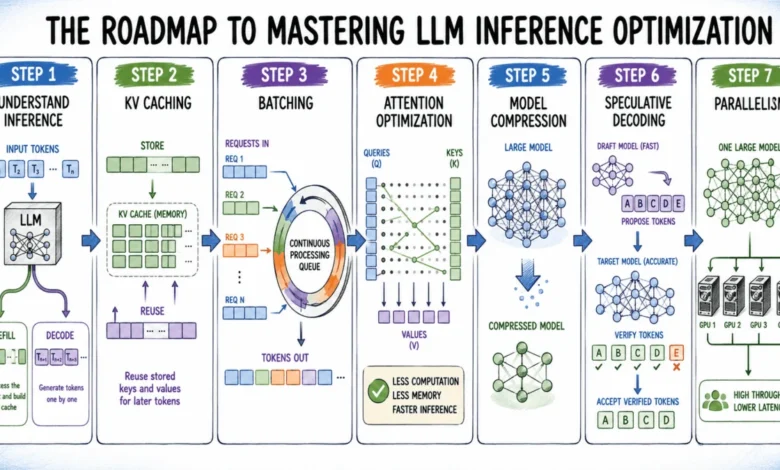
Large language models (LLMs) have transitioned from experimental curiosities to the backbone of enterprise artificial intelligence, yet the chasm between functional deployment and production-grade efficiency remains wide. While the initial challenge of achieving model accuracy has largely been addressed through refined training methodologies and alignment techniques, the focus of the engineering community has shifted toward the operational realities of latency, cost-efficiency, and scalability. In production environments, an LLM’s performance is rarely measured by its capacity to solve complex reasoning tasks in a vacuum, but rather by its ability to maintain consistent, low-latency performance under massive, concurrent user loads. As request queues swell and context windows expand, infrastructure costs often balloon at a rate that threatens the viability of many AI-driven business models.
The discipline of inference optimization represents a multifaceted engineering approach to bridge this gap. By fine-tuning the mechanics of how models execute, developers can maximize throughput and decrease latency without the prohibitively high costs associated with retraining or fine-tuning models from scratch. This process involves a rigorous examination of the two-phase execution cycle inherent to transformer architectures, the strategic management of GPU memory, and the application of architectural optimizations that allow hardware to operate closer to its theoretical peak performance.
The Duality of Inference: Prefill and Decoding
To optimize an LLM, one must first dissect the two-phase inference process that occurs every time a model generates a response. The first phase, known as the prefill phase, involves the ingestion of the entire input prompt. During this stage, the model processes all input tokens simultaneously to compute intermediate states—specifically the key and value tensors—which are essential for future generation. Because this phase allows for a high degree of parallelization, it is compute-bound, meaning performance is dictated primarily by the raw mathematical processing power of the GPU.
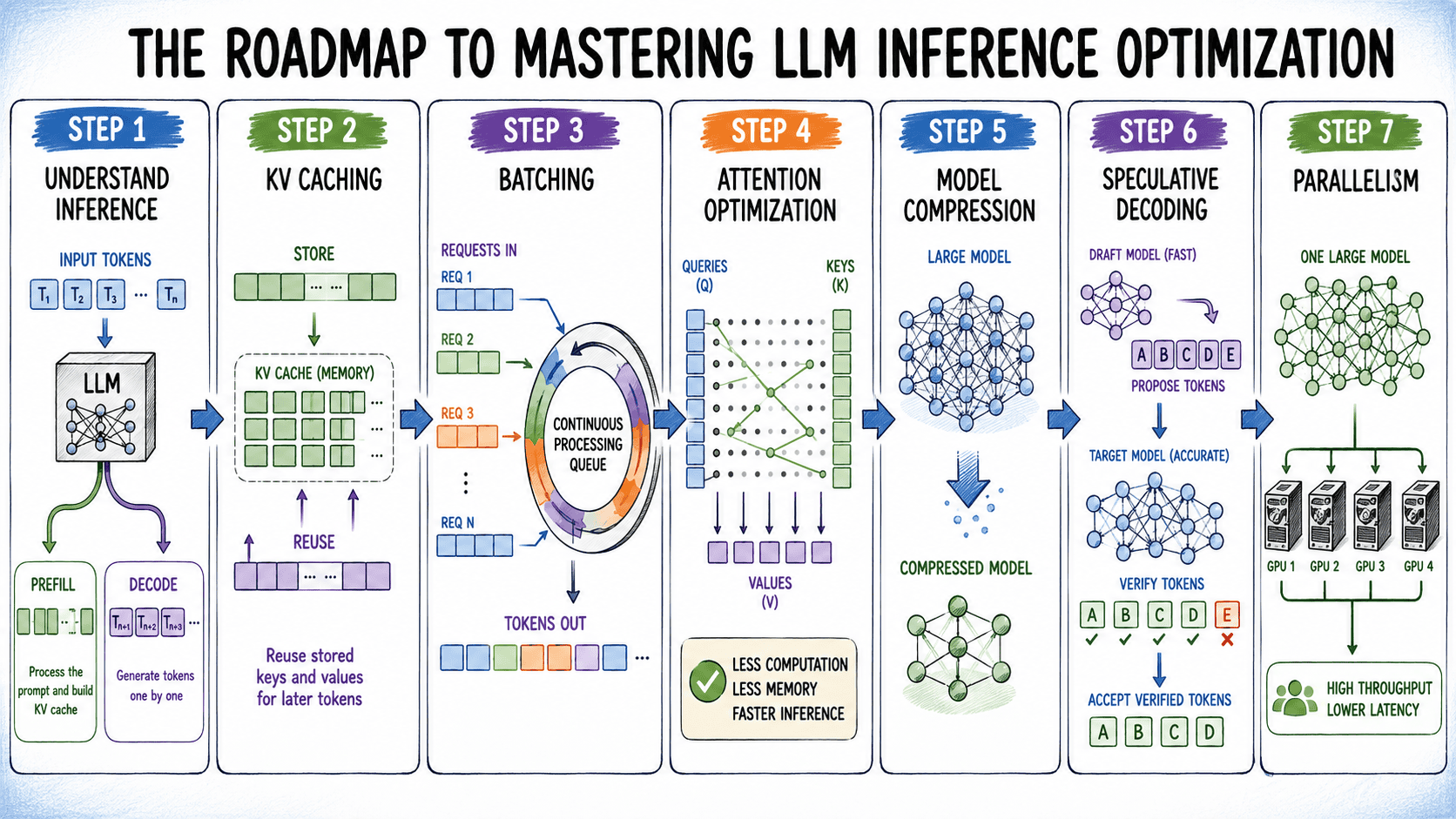
In stark contrast, the second phase, the decode phase, is autoregressive and inherently sequential. The model generates output tokens one by one, where each new token is contingent upon the entirety of the previous sequence. This constraint renders parallelization impossible within a single request, shifting the bottleneck from raw compute to memory bandwidth. The GPU spends the vast majority of its time moving data from memory to the processing cores, rather than performing calculations. This distinction is critical: optimizing for "time-to-first-token" (TTFT) requires improving the prefill phase, whereas maximizing "tokens-per-second" (TPS) necessitates alleviating the memory-bandwidth constraints of the decode phase. Failure to distinguish between these two phases often leads to suboptimal hardware selection and misplaced optimization efforts.
The Evolution of KV Caching and Memory Management
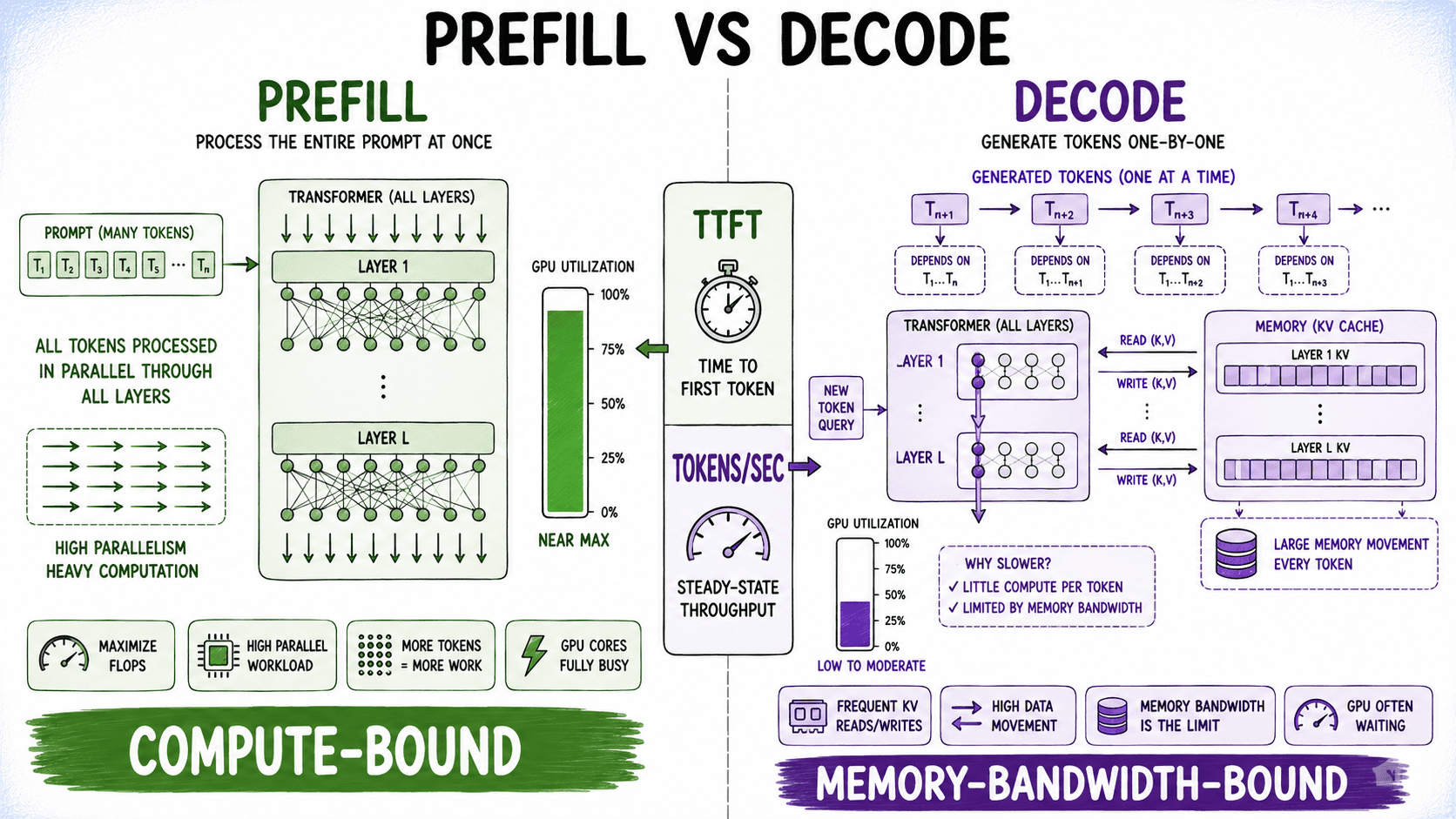
A significant breakthrough in managing the decode phase has been the implementation and refinement of Key-Value (KV) caching. By storing intermediate key and value tensors in memory rather than recomputing them for every new token, systems can drastically reduce computational overhead. However, this convenience introduces a severe memory burden. For modern models containing billions of parameters, the KV cache can consume several gigabytes of GPU memory for a single, long-context request.
The traditional, naive approach to memory allocation—reserving memory for the maximum possible sequence length at the start of a request—results in extreme fragmentation and limits concurrent user capacity. Modern solutions, such as PagedAttention, have revolutionized this space by applying virtual memory paging concepts to GPU memory. By dividing the KV cache into fixed-size blocks that are allocated on-demand, PagedAttention eliminates internal fragmentation and allows for significantly larger batch sizes. Furthermore, prefix caching has emerged as a vital technique for RAG (Retrieval-Augmented Generation) pipelines, where common system prompts or retrieved documents are reused across multiple requests, effectively eliminating redundant computation and freeing up precious GPU cycles.
The Transition to Continuous Batching
GPU utilization is the primary metric for cost-effectiveness in AI infrastructure. Static batching, the rudimentary practice of grouping a fixed number of requests and waiting for the longest one to finish, is increasingly viewed as an outdated bottleneck. Because LLM output lengths are highly variable, static batching leaves hardware underutilized, as shorter requests sit idle while waiting for longer ones to complete.
Continuous batching, or in-flight batching, has become the industry standard for production runtimes such as vLLM and NVIDIA’s TensorRT-LLM. This approach allows a system to replace a finished request with a new one mid-stream, ensuring that the GPU is constantly saturated with active computations. By decoupling request completion from the batch boundary, engineers have seen significant throughput improvements, often enabling a single server to handle multiple times the concurrent traffic compared to older, rigid scheduling models.
Architectural Refinements: Attention Mechanisms and Compression
Beyond scheduling and memory management, the fundamental architecture of the attention mechanism has been subject to intense optimization. Standard Multi-Head Attention (MHA) is increasingly being replaced by more efficient variants like Multi-Query Attention (MQA) and Grouped-Query Attention (GQA). By forcing query heads to share a unified set of key and value heads, these architectures significantly reduce the amount of data transferred from memory during the decode phase.
Simultaneously, FlashAttention has become a near-ubiquitous optimization. By fusing attention operations and leveraging on-chip SRAM, FlashAttention minimizes the need to write intermediate values to the slower global GPU memory. This requires no model retraining and provides a substantial speed boost across nearly all modern transformer deployments.
For deployments where hardware footprint is the primary constraint, model compression remains a vital tool. Quantization—the process of reducing the numerical precision of weights from 16-bit to 8-bit or 4-bit—has moved from a fringe research topic to a standard production practice. Techniques like GPTQ and AWQ ensure that this reduction in precision leads to negligible drops in model intelligence while allowing models that once required massive H100 clusters to run on smaller, more affordable hardware. When coupled with structured sparsity—which prunes non-essential weights—and knowledge distillation, these methods enable organizations to deploy high-performance models at a fraction of the original operational cost.
Speculative Decoding and Parallelism
For latency-sensitive applications like real-time chatbots, speculative decoding provides a path forward that sidesteps the sequential bottleneck of autoregressive generation. By utilizing a small, "draft" model to predict the next few tokens and a larger, "verifier" model to confirm them in parallel, systems can effectively generate multiple tokens per iteration. This approach maintains the accuracy of the large model while benefiting from the speed of the small one, provided the draft model’s predictions align with the verifier.
Finally, for the largest-scale deployments, parallelism is the final frontier. Tensor parallelism splits individual layers across multiple GPUs to lower latency, while pipeline parallelism distributes sequential layers across different devices. More recently, the industry has seen the emergence of prefill-decode disaggregation. By separating the hardware pools responsible for the compute-intensive prefill phase and the memory-intensive decode phase, infrastructure teams can tailor their hardware to the specific needs of each task, preventing the "head-of-line blocking" that often plagues monolithic inference servers.
Implications for the Future of AI Operations
The shift toward these advanced inference techniques marks a maturation point in the AI industry. As companies move beyond the "proof of concept" phase, the economics of AI are being rewritten by infrastructure engineers. The ability to serve an LLM at 10x the throughput or 50% of the cost is no longer just a technical achievement; it is a competitive advantage that dictates which products can remain profitable in a crowded market.
The current consensus among infrastructure experts is that there is no "silver bullet." Effective optimization requires a granular understanding of the specific workload—whether it is dominated by long-context documents, short-burst chat interactions, or massive batch processing. By profiling these metrics and applying the appropriate layer of optimization—from architectural changes like GQA to scheduling improvements like continuous batching—organizations can ensure that their AI deployments are not only functional but economically sustainable. As the gap between compute supply and demand continues to widen, the ability to squeeze performance out of existing silicon will remain one of the most highly sought-after skills in the field of machine learning engineering.